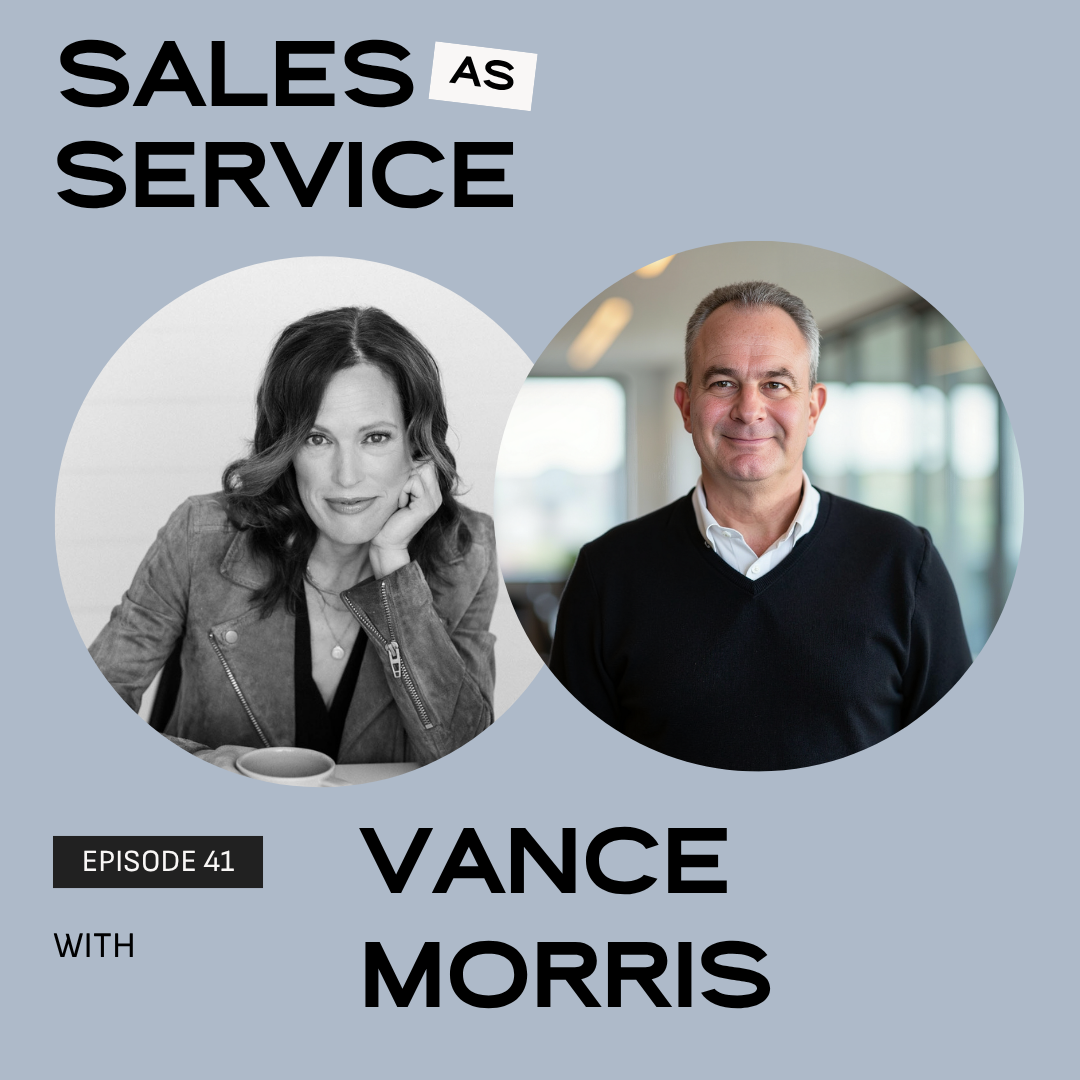
Your Client Experience is Your Sales Strategy with Vance Morris
EPISODE: 41

There’s a lot of people out there who do what you do.
From the outside, it can feel like you’re competing on the same offer, the same services, the same outcomes. But what actually sets your business apart isn’t what you sell—it’s the experience of working with you.
In this conversation, I sit down with Vance Morris, former Disney leader turned entrepreneur, to break down how customer experience directly impacts retention, referrals, and long-term growth. We talk about the small, often overlooked moments that shape how clients perceive your business—and why those moments matter more than any new strategy or tactic.
If you’ve been focused on finding the next big thing, this episode is a reminder that your biggest opportunity might already be inside your business.
In this episode, we cover:
Why customer experience is your real competitive advantage
The gap between the journey you design and what clients actually experience
Simple ways to elevate your client experience without more time or budget
Where businesses unintentionally break trust (and how to fix it)
How small moments drive referrals, retention, and repeat business
LISTEN TO THE EPISODE HERE 👇🏻
-
Speaker: [00:00:00] People say, oh, you know people, people will remember me. They'll call me when they need me. No, they won't. You know, it's not the customer's job to remember you. It's your job as the business owner to remind the customer you exist. So many business owners forget that.
Speaker 2: Welcome to Sales Is Service. The podcast designed to help you change your mind about sales.
Literally, I'm gonna help you change the way you think about selling. I'm Tam Smith, your host. Sales bestie and pitch partner next door. You're tired of bros with biceps telling you how to crush a million dollars in your sleep or battling imposter syndrome on your own. You've come to the right place. All you need to do is listen, then take action.
No gym membership required. Let's get started.
Before we get started, this show is shaped by real questions from agency owners and service based founders who want sales to feel relationship first and values led minus the cringe. If you're wrestling with warm [00:01:00] outreach, follow up. Asking for the opportunity or how to lead your own sales process without sounding like a salesy weirdo, send your question in, find me on LinkedIn, or email me at Hey tam at studio three 40 nine.com.
If it's something you are dealing with, chances are you're not the only one. Alright. Let's get into today's episode. Hey there, and welcome back to Sales as Service. I'm your host, Tam Smith, sales growth strategist and founder of Studio 3 49. Now, there are probably a lot of people out there that do some version of what you do.
They offer something similar, they solve a similar problem, and from the outside it can feel like you're all competing on the same things, but you're actually not. Your real competitive advantage isn't your offer. It's the relationship you build with your clients and the experience you create for them.
That's what people remember. That's what they talk about, and that's what determines whether they stay, refer, or simply move on. And most of the time, this part of the business isn't intentional, it's just happening. So today we're digging into what actually makes an experience stand out, and how small simple moments can completely change how your business is perceived.
And joined today by [00:02:00] Vance Morris, former Disney leader, turn Entrepreneur, spent a decade inside Disney learning what it actually takes to create experiences that build lifelong loyalty. After leaving Disney, he applied those same principles to his own business and now works with service-based companies to help them stop losing customers and build systems that drive retention, referrals, and long-term growth.
Because this isn't about doing more, it's about being more intentional with what already exists. Here's my conversation with Vance Morris fans. Thank you so much for being here. Welcome to Sales is Service.
Speaker: I appreciate it. Hopefully we'll drop a couple of golden nuggets today for everybody.
Speaker 2: I am very confident there's gonna be more than a couple.
First off, tell us who do you help and how do you serve?
Speaker: Sure. So I help professional service businesses with their customer experience and customer retention. I primarily focus on customer retention, but if you're not delivering a great experience, you really don't have a prayer to keep your customers.
So really focusing on those two areas.
Speaker 2: You have obviously have a, a background with former Disney [00:03:00] and you talk a lot about the Disney standard for the customer experience. What do most small businesses must understand about that level of service?
Speaker: They think it's expensive to implement it, which it's not.
You can, you can. Upgrade your customer experiences without spending a penny. It's just in how you approach each position on the customer journey, which while not sexy, every business needs to map out their customer journey from first point of contact to, well, hopefully there isn't an end 'cause you're.
Journey should just continue and continue. Unless you're an undertaker or something, then I guess it kind of stops. So that's definitely one is the expense. Certainly a complaint I hear, but it's not a valid one. The other thing is, oh, it's gonna be hard. No, it's really not. It's just brainstorming some ideas on what we can do to elevate your customer experience so that you do have what I call [00:04:00] raving fans for life.
Speaker 2: I, I used to tell it to when I was in re still in a retail sales environment. You know, there's a lot of people you know that are gonna do what you do, you know, in any business, you know, you're not, not the only one in the market. And I would tell teams, like our point of differentiation is the, the relationship we have with the clients that we're serving and the experience we create for them.
Where do you see, you know, most founders and business owners kind of unintentionally break that trust in the client experience. Oftentimes, like without even realizing it,
Speaker: they do something. Silly or stupid. One is they don't answer their phone live or don't even answer the phone. And, you know, I'm, I'm a partner in a call center and we did a study of 4,500 businesses, um, and we got their phone numbers from Google, uh, ads.
So they're paying to have their phone number out there, only 19%. Answered the phone.
Speaker 2: Oh my gosh,
Speaker: 19%. So people are paying great money to Google [00:05:00] and not even bothering to pick up the phone. And if, I mean, we're all in highly commoditized businesses, so if you don't have any way of comparing one company to the next, if the first one doesn't answer the phone, well guess what the customer's doing.
They're just going down to the second one, and hopefully they'll answer the phone. So answering the phone live. Is a huge competitive advantage, especially these days with the advent of AI answering your phone and all these bots and things. I, I will never give that up in any of my businesses.
Speaker 2: Again, I go back to my retail experience, you know, it's the basic things that, you know, cut.
We've all fallen victim to that, you know, shiny object, you know, looking for, you know, some magic solution when it's just the basic things of answer your phone. Or I would tell teams, like, I would walk into retail spaces and like how I would be just, you know, not even acknowledge, you know, for be in the space for, you know, 10, 15 minutes and not even acknowledge.
And I would tell teams just say hi and we win.
Speaker: Something. [00:06:00] Yeah,
Speaker 2: something. Now you and I, we kind of a, a very similar philosophy on this where I, I often say, you know, marketing builds the room and, you know, sales starts the conversation and it kind of, to your point, you've said marketing gets people in the door and experience determines if they stay and refer.
Where do you see that kind of disconnect happening? I mean, it could probably goes to what we were just. Talk, chatting about just some of the basic things that we either don't do or forget to do.
Speaker: Well, you know, your marketing, you know, or advertising, you know, are designed as you said to, to get 'em in the door.
So what does answering the door look like? You know, that's where we have the potential to. Create an emotional connection with somebody and lead them through our journey and have them make a purchase and then make repeat purchases. And the only way to do that is to create an experience out of that, that first touch point.
So you mentioned, so just, just say, hi, it, it sounds boring and mundane, but that's, the bar is so low these days. Saying hello [00:07:00] is like, oh my God, who's talking to me? This is great. And you, you just have to be intentional about. How you want people to go through the customer journey, and then at the end of it.
Like if say you're, you know, you're selling widgets or perfume or whatever, and they, you know, have just given you money, well, that's the time to make sure that you can retain them. And because people will, you know, oh, we get the money and then that's it. You know, it's like, you know, I'll walk into a retail place and, you know, everybody's, they'll, they'll greet you and they open, they hold the door open for you, and they walk you over to the shirts that you want, and they help you with the purchase.
They ring you up at the register, they whack your credit card. That's it. Nobody holds the door for me when I'm leaving. Nobody says anything. On my way out. I just gave you money. I am more valuable than anybody else in this store that has not given you money yet. Why would you ignore me? It makes no sense.
Speaker 2: Kind of back to your point, [00:08:00] there's this perception that it has to be time consuming or expensive. So, you know, for small teams, you know, solo professionals, teams of, you know, one, one to three, what are like two, three simple ways they can immediately elevate. Their client experience.
Speaker: Sure. Thing one, you map out the customer journey.
You have to do this 'cause otherwise you're not gonna know what to look at. And you look at it from the point of view of the customer, so not you. So let's say first point of contact is, uh, telephone calls. So you know, the client calls into the office. Alright, what does that look like? And then what's the next touch point?
Client comes into the office or prospect I should say. Well. That's great. That's your two points. But between phone call and first meeting, the client is doing something. They're waiting. So what are we doing to entertain them or talk to them while they're waiting for the next meeting to [00:09:00] ensure that they actually show up?
So Disney has this all figured out. They actually call it line entertainment. They entertain you while you're in line because you wait for a lot of stuff at Disney. You wait for transportation. You wait for the entertainment to get on the ride, get food. Disney knows this. And so while they can't compress time, they can make it not feel so bad.
And so if your prospect is waiting, well, what happens when they wait? Well, they could be having buyer's remorse. Second thoughts, maybe an a competitor swooped in with a better offer or something like that. So. You've got to map this out so that you can find those points where you can do something now. So what can you do during the wait period?
Well, one, you can send 'em a handwritten thank you note for, you know, calling in and saying, Hey, uh, we're looking forward to, you know, seeing you at the first meeting. If you have a copy of your book, you know, get that sent out to them, certainly at at minimum some kind of email [00:10:00] sequence. And I would throw videos in there, maybe a private podcast, all these things to ensure that they show up at the second meeting.
So that's definitely one thing. And then how do we turn the meeting into an experience? And you can do this inexpensively. So most clients will probably come in and. If you're smart, you'll offer 'em, Hey, can I get you a drink while we're doing this, you know, cup of coffee or glass of water or whatever. So when you do that, it has to be congruent with the fees you are charging.
So I worked with a, a really high-end financial advisor and when I went in, uh, as a consultant and the receptionist, you know, offered me something to drink, I said, yeah, you know, love a glass of water or a bottle of water. She came out with a little four ounce styrofoam cup that she probably just got out of the tap.
Now she's charging fees starting at $15,000 a year. A four ounce styrofoam cup is [00:11:00] not congruent with that fee. So the first thing we did, and this really the only expense was the printing. We said, let's give you a menu. So like one of those steakhouse menus that, you know, the real heavy cardboard ones.
Let's, uh, let's just add some different beverages. So on one side of the menu is six bottles of still water. The other side of the menu is six bottles of, uh, sparkling water. Which one would you like? So we're literally spending. $3 to give 'em a bottle of water. But the experience is now elevated. Oh, we got a financial advisor gave me a menu for water.
That's huge. So you gotta look at ways and that, and that wasn't expensive. I mean, like I said, printing the menus was probably the most expensive. They only needed three or four of 'em. Uh, probably 20 bucks each. So I mean, all in, they're, you know, a hundred dollars. To create this experience that's going to, again, create an emotional connection and help further the sale.
Speaker 2: It's an [00:12:00] experience that's in alignment with, you know, the next step you're expecting your prospect to take, like they have an expectation, you know, you have an expectation of them as far as you know, the, I guess the fees you're. Asking for, and they have an expectation of you that, okay, the experience should be in alignment with that.
And if it's out, you know, it becomes it. You might not, they might not even realize why they're hesitating or why they're second guessing, but it's just sort of subconsciously, it's just, it's completely out of alignment with the ask you're making.
Speaker: And the other thing I would add is, you know, attention to detail, because every detail in your business is either enhancing or detracting from the experience.
There is no middle ground. For a detail. So if you've got dusty house plants, well that's detracting from the experience. You know, especially God if you're a medical professional. You know, I've been to, I went to the dentist, uh, a new dentist and they had dusty house plants. I canceled my appointment. I said, I don't know what your instruments are gonna look like.
You know that you're gonna be poking in my mouth. You can't even keep the, the [00:13:00] plants in the waiting room clean. So again, focusing on the details that are important to you as a business owner.
Speaker 2: Need a better system for getting clients consistently. Grab my VIP Power Hour, a free daily rhythm designed to help you stay visible, nurture your network, and spark new conversations in just 60 minutes a day.
It's not about cold pitching or chasing algorithms. It's about showing up with intention. Do it for 30 days and you'll start seeing more confidence, more conversations,
Speaker: and yes, more revenue. Download it free at Studio three 40 nine.com/freebies. Now back to the episode.
Speaker 2: Kind of thinking about, you know, you were talking about your, you know, a in-person experience, you know, if you're going into like a, a retail experience and making a purchase, you know, there's all of this upfront, the initial experience before you've actually made the money exchange, and then you are hustled out the door where it's, you know, I feel like even in our own small businesses where I always say like, though.
Most important client is the one you have right in front of you and the way that you're taking care of the existing client that you have, like kind of the, the process [00:14:00] doesn't end after they have, you know, said yes. You know, it really, it just starts and how you're continuing. How can you continue, like how do you recommend businesses?
Like once they've said yes, you know, the actual sort of like the, the, how can you build that into the actual process of working together?
Speaker: Sure. Well, you know, once they've said yes and given you money, you know, that's Woo. Thank you. It's always a good thing, but is okay. You know, again, looking at, you know, the congruency.
So again, let's just take our financial advisor with the $15,000 fee. You know, a lot of advisors will just email the proposal over. Or the financial plan, I'm like 15 grand. You can't sport $8 for a two day FedEx.
Speaker 2: Mm-hmm.
Speaker: Again, so you know, what are the things you can do to, to further that, you know, after the sale, especially if you're in a business where there is a years long relationship, like a financial advisor, or maybe you sell shampoo [00:15:00] and they need to consistently.
Buy shampoo from you? What are you doing to ensure that they come back after you sold 'em the first bottle? You know, do you have a customer retention system in place? You know, one that not only. Has offers in it, but also kind of entertains 'em. Because if the only time you ever hear from a business is when they want money and they're trying to sell you something, that's not a relationship.
That's just transactions. And so, I mean, we're not in, I mean, no offense to mattress companies, but the only time I ever hear from the mattress company is, you know, 4th of July, labor Day and Memorial Day when they got a sale. You know,
Speaker 2: it's just true. Very
Speaker: true. I mean, I bought a $5,000 mattress. You couldn't send me a little note or a little, you know, monthly newsletter or a postcard, you know, kind of saying, you know, Hey, here's three tips for a better night's sleep.
Speaker 2: Mm-hmm. Mm-hmm.
Speaker: And not trying to sell me something. You want to, you need to mix your [00:16:00] messages so that they are value driven. And then you can add in the promotions or the, the ads or the offers, but it's gotta be a mix. It can't be a, always hit 'em, you know, hit 'em for money.
Speaker 2: What is like an example? One of the best?
Like customer experiences that you've had yourself and what made it so memorable?
Speaker: You know what, I will tell you, I've bought a pair of seat covers for my car. So my car, horrible seat covers. I bought 'em and you know, I wasn't expecting really anything in the box except that they sent me all this extra stuff.
They sent me the tool. To punch the, the seat cover into the back of the thing. So I mean, instead of using my hands or a screwdriver, they actually gave you the tool. And then at the other end of the tool was this little clip that you could slide the clips under your seat so you don't cut yourself. And then while you're doing that, because you've got elastic, they give you safety glasses in the [00:17:00] box so that you wear those.
And they gave me a Kevlar glove. So when I am reaching under the seat, I'm not cutting myself on all this stuff. And they had a nice little thank you note in there. It came in a nice decorative baggie. Of course, they were smart and they put a catalog in there. And then something I didn't expect was they gave you.
Seat things to make it not slide around. So if you're putting, uh, seat covers on top of leather, well, you don't want it sliding all around. So they included bees. None of this was in the ad when I bought the seat covers, so it was stuff that they just added to the box, you know, to make the experience that much better.
So the installation went smooth. You know, here's the QR code for the video on how to install it, and they made it just for my car. So I don't, I'm not looking. I've got a Volvo. I'm not looking at seat covers. Going into a Ford. It's actually my year of a Volvo that the video is for. So that's just a [00:18:00] really small thing and just literally happened yesterday.
That was an amazing experience.
Speaker 2: Yeah. So it's like surprise and delight moments.
Speaker: Yeah.
Speaker 2: Yeah. Yeah. And on the flip side, without naming any names, like what is the, like one of the most memorable experiences, because it was. Not pleasant. What was, what stood out that could have been done better? Oh,
Speaker: you know, well, I mean,
Speaker 2: sadly we probably had more of those in,
Speaker: I got kind of, actually, I wrote a whole book on that.
Uhhuh Tales from the Customer Service Crypt Volume one, working on volume two. It's this, this will illustrate why employees. Need to have common sense and, and I really think this, this person had checked their brain out. So we've got a little restaurant here in town that we love, and we were sitting outside and we were gonna be about eight people.
So they pushed two tables together for us. And at one end of the table was this enormous potted plant. I mean, just enormous. It didn't bother us. I mean, we were fine sitting around it. The server came [00:19:00] over. Took one look at the plant, took a look at the table and couldn't figure out what to do because the plant was where she normally stood.
So she literally is fighting with the plant to get through to take our drink order. And I'm like, I, I just wanted to tell her, come around the side, but I wanted to see what she would do next. So, takes the drink order, takes our appetizer, order the server or the busboy comes and fills our water glasses.
He doesn't even bother with the plant. He just kind of goes around. The food runner brought our appetizers. He didn't bother with the plant. He just put the appetizers on the table where they were supposed to be. Server comes back with our drink order and she's fighting with the plant again. Because that's where she serves from and she's moving the plant and trying to serve.
She did this the entire night.
Speaker 2: Oh my gosh.
Speaker: She was so ingrained in that spot, that particular spot. She didn't know what to do when something in the [00:20:00] business changed. And I'm just like, and, and we have this in all of our businesses, something like this is happening where something small has changed and the employee is like.
Completely blotto about what to
Speaker 2: do. Yeah. Can't adapt. Yeah. Well, to that point, when you, when you're working with clients, like kind of the initial, let's just say your first 30, 60, 90 days, like what is your kind of the first step and what are your approach as far as you're evaluating what the opportunity is and how you can help them?
Speaker: Yeah, well, I mean, I will mystery shop them, certainly phone call, email, web form submission, et cetera. I'm surprised that you know that at the number of companies that don't return voicemail. Maybe they thought I was a salesperson or something, but I just said, Hey, this is Vance Morris calling for, for Gabby.
Could you have her give me a buzz back. Here's my phone number. I left three voicemails. Never once did anybody call me back. So I have no idea if the voicemail was listened to, if it didn't ever got to Gabby or Gabby didn't want to call me back or [00:21:00] whatever. So, I mean, that's something that, you know, mystery shop your business, especially if you have employees.
And if you don't have employees, mystery, shop your website. You know, look for those links that are broken. Do all the buttons on your website. Do what they say they're supposed to do because that is a. Again, a detraction. That's the detail that is going to prevent a sale or prevent service. Certainly then we do, we take.
Quite a bit of time mapping out the customer journey. Yeah. This is, this is a, a non-negotiable. You gotta do it not, not sexy, like I said, but it's vital. And then we look at points on the customer journey where either we can make big leaps in and bounds of improving the service, improving the experience.
Where can we then increase our pricing based on this new level of service? Because. When you deliver an experience, you have tremendous price elasticity because you can't be compared to anybody else. And, and so those are the, the, [00:22:00] the things that we hit. And then we look at the customer retention system, you know, that is huge one, you know, people say, oh, you know, people, people will remember me.
They'll call me when they need me. No they won't. You know, it's not the customer's job to remember you. It's your job as the business owner to remind the customer you exist. So many business owners forget that.
Speaker 2: When you say customer retention system, what? What are the basics that should be in included in that or thought about?
Speaker: I mean, at a minimum, a weekly email, and that's just sad and pathetic in and of itself. You need to be multimedia, multitouch, multitouch. Times per month. The system I use is very simple. They get a monthly newsletter in print, in the mail. Now listening to the news recently, hopefully the postal service will be still around in, you know, six months, but we'll see.
And there's nothing salesy in the newsletter. It's all designed to entertain and continue the emotional connection. Then they get a [00:23:00] monthly postcard. Postcard has an offer on it that is our promotion of the month or our sales item, and then we send a weekly email that has a story from the newsletter with the promotion of the month as the sales item.
So it's kind of a combo deal. So every one of my past clients gets hit. Six times a month in different media, you gotta stay top of. You don't know when they're gonna run into, I mean, I, one of my businesses is a, uh, carpet cleaning business. If I only reached out to 'em twice a year, they're not gonna remember me to refer to a friend.
But if I'm in front of 'em six times a. They're gonna remember, oh yeah, you gotta call Vance over at the carpet cleaning company. He'll take good care of you.
Speaker 2: The lost art of just his pers the personal touches is the baking those into you. The experience. I had an experience this week that just reminded me, I, I'm a big fan of, you know, the handwritten note.
Just, I have not been as consistent in doing that as [00:24:00] of late in recent months. And I had an experience where I had just a connection call with, you know, a new peer referral part, potential referral partner. And it was so thoughtful. She was very intentional to ask me for my mailing address. And I got just a thank you note for the conversation the next week.
And I, it was a just to, again, we know to just to receive a handwritten note that she'd been that thoughtful, like. She's baked in my brain now and it's so memorable that it was just a reminder of how those little things like that we, the, the things that we know work that we're looking for, you know, something usually faster and easier that, you know, if we just did the things that we know work.
Yep.
Speaker: Hundred percent. And you know what I mean? My businesses have gotten too busy for me to do the handwritten note. You know, I'm, you know, I, I'd be, I'd be sitting there writing eight hours, writing 150 notes every week. So we subcontracted the handwritten note out to a bunch of grandmas. Mm-hmm. We [00:25:00] rent grandmas to write our handwritten notes.
We, we were at a senior center and there was this little group of ladies at a table. They were yapping. And you know, I said, you know, how often are you here? Oh, we're here every day. We have coffee. Get away from our husbands, yada, yada. I said, well, do you ever get bored? And I go, yeah. I said, well, you know, would you like to make a little something on the side?
Uh, and they're like, uh, sure. What are we gonna do? I said, uh, I need handwritten notes for written for my business. Uh, thank you notes. They said, you don't even have to pay us. Just buy us the coffee.
Speaker 2: That's fantastic.
Speaker: So
Speaker 2: yeah,
Speaker: twice a week. These ladies are writing handwritten thank you notes for us. I mean, it's nice cursive grandma handwriting and it's still the thing.
Speaker 2: Well, let's jump into our fast five. Your, I can't live without it. Software or app?
Speaker: My CRMI would definitely, CRM is at the top of the list.
Speaker 2: Do you have a favorite
Speaker: Uh, go high level.
Speaker 2: Yeah, go high level. Best advice you've ever received about sales and business development.
Speaker: Sales is a ongoing process. It's not a one and done.
The other corollary to [00:26:00] that is that, uh, the buyer will buy when the buyer is ready, not when you're ready to sell. So you, you know, the first no is just the first maybe for me, you know, until you tell me to like, you know, go kill myself or die, or whatever. I'm gonna keep hounding you. Well, hound is not the right word.
Speaker 2: Yeah, yeah. Can continue following up. Exactly. Follow up your morning routine. Must have
Speaker: morning routine. Must have is I have switched to decaf coffee and have, uh, this is year 12. No caffeine and so I'm very reli. I'm up at four 30 and I'm at the gym by five. Get my workout in, uh, at my desk By six 30 I get more done between, between four 30 and 8:00 AM 'cause nobody bothers me.
And so highly productive time.
Speaker 2: Your walk-on song, the one song that always pumps you up,
Speaker: it is, uh, thunderstruck by AC CDC. Just 'cause I love the intro.
Speaker 2: And if you only had one hour a [00:27:00] day for business growth, how would you spend it
Speaker: calling current clients.
Speaker 2: Thank you so much for being here, Vance. Where can folks find you and connect more with you?
Speaker: Well, the only social media I do is LinkedIn, so you can find me there. I'm the only Vance Morris Disney guy. On it, so I shouldn't be too hard to find. And, uh, you can find me, uh, actually, I've got a gift for everybody, if that's okay. Absolutely. Uh, which is, uh, 52 ways to Wow your customer without breaking the bank.
So it's one wow for every week of the year for you if you're not feeling overly creative. And you can find that at wow. 52 ways.com.
Speaker 2: Love it. Thanks again so much.
Speaker: I appreciate it. Thank you.
Speaker 2: Thanks again to my guest fans, Morris. And if there's one thing to take away from this conversation, it's this, we're all out here looking for the next big thing, the new strategy, the better funnel, the thing that's gonna give us an edge.
And more often than not, it's not that. It's the things we already know how to do and we're just not doing them answering the phone. Saying thank you. Following up when you said you would delivering a better experience than what someone expected, even if it's as simple as a bottle [00:28:00] of water instead of a styrofoam cup.
Those are the things people remember, the things that build trust and the things that actually differentiate your business. So here's your sales to service challenge for this week. Look at one part of your client experience and instead of asking what do I need to add, ask yourself, where am I overlooking the obvious?
Where could I be more thoughtful, more responsive, more intentional? Then choose one simple upgrade. Pick up the phone instead of sending the email. Send the handwritten note, tighten one moment that currently feels rushed, overlooked, or transactional. Keep it small and keep it doable because this isn't about doing more.
It's about doing the basics better and doing them consistently. That's what builds relationships. That's what creates loyal clients, and that's what drives sustainable growth. If this episode gave you something to think about, share it with another service-based founder, and if you haven't already, be sure to follow the show so you don't miss the next conversation, and I'll see you right back here next week on sales is service.
Speaker: You've just listened to the Sales As Service Podcast, the
Speaker 2: podcast to help you shift your [00:29:00] mindset around selling. If you liked what you heard, be sure to hit subscribe and share it with a friend, because we're all about more sales. Awesome and less sales awkward. See you next episode.
MORE OF A READER? 👇🏻
There's a common pattern I see with service-based business owners.
We're always looking for the next thing. The next strategy. The better funnel. The new approach that's going to help us stand out in a crowded market.
And on the surface, it makes sense. When you look around, it feels like there are a lot of people doing what you do — offering similar services, solving similar problems.
So the natural question becomes: How do I differentiate?
But here's what I've found — and what this conversation with Vance Morris reinforces:
Your differentiation isn't your offer. It's the experience of working with you.
Vance spent a decade inside Disney learning how to create experiences that people don't just enjoy — they remember. And more importantly, they talk about.
When you translate those lessons into a small, service-based business, it's not about doing something elaborate or expensive. It's about paying attention to the moments most businesses overlook.
Answering the phone. Following up when you said you would. Acknowledging your client after they've paid you — not just before.
These aren't groundbreaking ideas. But they're often inconsistently executed. And that inconsistency is where trust starts to break down.
One of the most useful distinctions in this conversation is the difference between the client journey you design and the experience your client actually has.
As business owners, we tend to focus on structure — our onboarding process, our deliverables, our systems. But your client isn't experiencing your systems. They're experiencing what it feels like to interact with you.
Are they waiting without communication? Do they feel acknowledged? Does the experience match the level of service you're charging for?
Those details matter more than we think. Because clients don't just evaluate outcomes — they evaluate how they felt along the way. And that feeling is what drives retention, what leads to referrals, and what makes someone say "you need to work with this person" instead of quietly moving on when the project ends.
Another important takeaway: client experience isn't separate from sales. It is sales.
It shortens the trust-building process. Reduces friction. Makes future conversations easier because you're no longer starting from zero — you're building on an existing relationship.
And improving your client experience doesn't require a complete overhaul of your business. It starts with awareness. Looking at one part of your process and asking: What does this actually feel like for my client?
Not what it looks like on paper. Not what you intended. What they actually experience.
Because more often than not, growth doesn't come from adding something new. It comes from doing the basics better — and doing them consistently.
✦ YOUR SALES AS SERVICE CHALLENGE
Look at one part of your client experience—just one.
Instead of asking, “What do I need to add?”
Ask yourself: Where am I overlooking the obvious?
Where could you be more thoughtful?
More responsive?
More intentional?
Then choose one simple upgrade:
Pick up the phone instead of sending the email
Send a handwritten note
Improve one moment that feels rushed or transactional
Keep it small. Keep it doable.
RESOURCES & LINKS
Learn more about Vance Morris
Connect with Vance on LinkedIn and YouTube
Simplify sales with the VIP Power Hour - download the FREE guide
Learn how to consistently book 3–5 sales-qualified meetings each week - Book an Alignment Call
SUBSCRIBE & REVIEW
If you loved this episode, please take a moment to subscribe and leave a review on Apple Podcasts! Your support helps us reach more creative agencies and service pros who need these insights. Thanks for tuning in to Sales as Service—see you next week!

TAM SMITH
I’m Tam Smith-Sales Growth Strategist and Founder of Studio Three 49. I help service-based founders find, connect with, and convert right-fit clients through scalable, sustainable outbound sales solutions.
No pushy pitches. No bro-marketing. Just simple, structured systems that turn connections into clients.