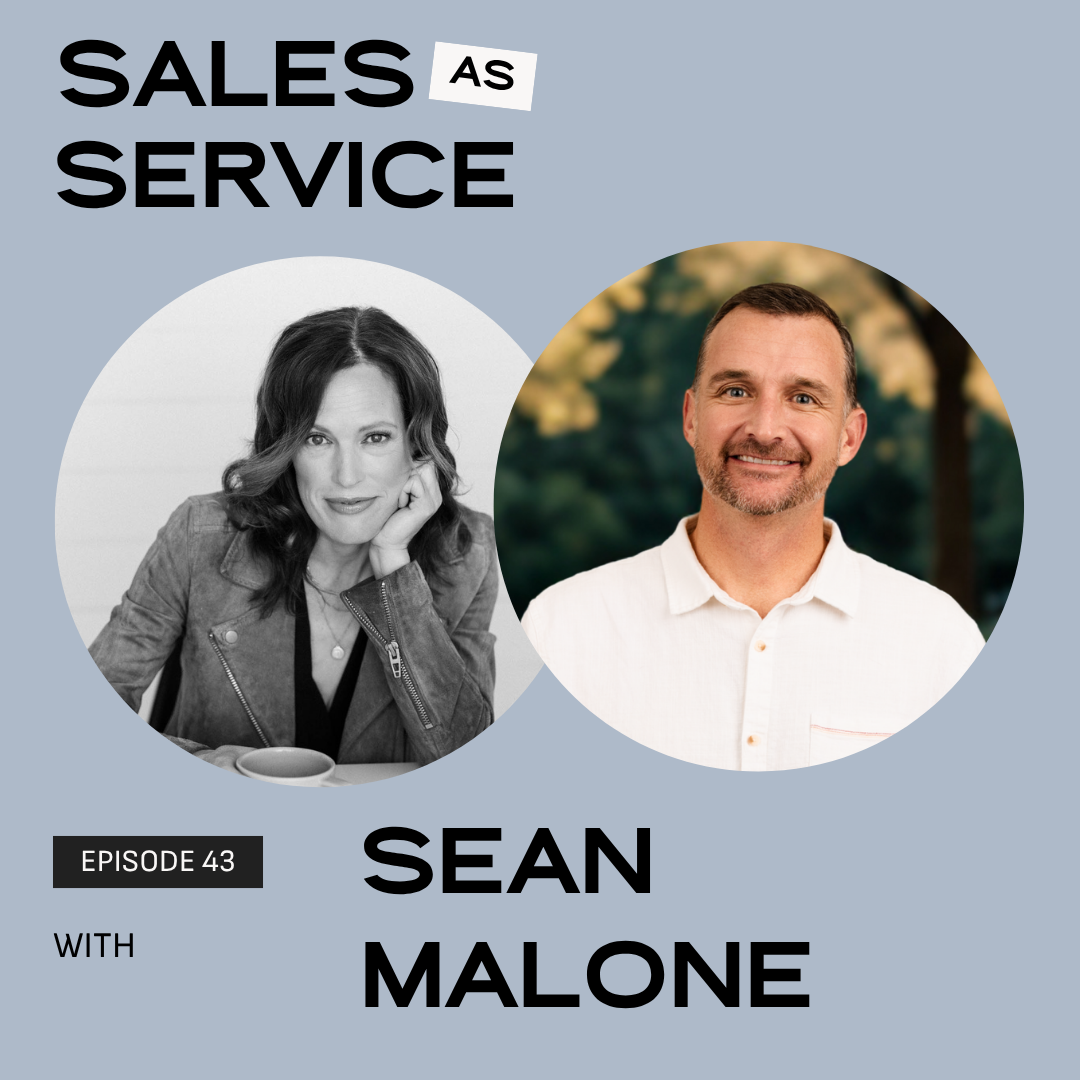
DM Me: Turning Conversations into Clients with Sean Malone
EPISODE: 43

Somewhere along the way, sales became more complicated than it needs to be.
Funnels, tech stacks, automation—all before we ever have a real conversation. But when you strip it back, every new client opportunity comes down to four simple steps: finding the right people, connecting with them, nurturing the relationship, and making an offer when there’s a genuine fit.
In this episode, I’m joined by Sean Malone—Co-Founder of FlowChat, author of DM Me, and someone who has been part of more than 1.5 million direct message conversations. Together, we break down why most founders don’t have a lead problem—they have a consistency problem—and how direct messaging creates the fastest, most human path to starting real conversations that lead to new business.
In this episode, we cover:
The 4-step framework behind every client opportunity
Why inconsistency—not lack of leads—is the real problem
How direct messaging removes friction and accelerates conversations
What most people get wrong about outreach (and how to fix it)
Why human connection matters more than ever in an AI-driven landscape
LISTEN TO THE EPISODE HERE 👇🏻
-
Speaker: [00:00:00] Y dms, it's the fastest path to direct cashflow beyond anything else. It will get you there quicker. So if that's your goal, you need cashflow, think about this strategy.
Speaker 2: Welcome to Sales Is Service. The podcast designed to help you change your mind about sales. Literally, I'm gonna help you change the way you think about selling.
I'm Tam Smith. Your host sales bestie and pitch partner next door. You're tired of bros with biceps telling you how to crush a million dollars in your sleep or battling imposter syndrome on your own. You've come to the right place. All you need to do is listen, then take action. No gym membership required.
Let's get started.
Hey, Tam here. Most growth sage founders are great at delivery referrals, prove it, but referrals aren't predictable and you've avoided sales because you think you have to be something you're not. Sales isn't pressure or cringey tactics. It's connection. Starting conversations, recognizing when you can actually help [00:01:00] someone.
The hard part. Doing it consistently. That's why I built the VIP Legion app. Powered by Flow Chat. It helps you build a repeatable practice that supports three to five sales qualified meetings per week, ready to create opportunities on purpose. Book a free alignment call at Studio three 40 nine.com. Sales is a practice.
Let's make it consistent. So I think we've overcomplicated sales Somewhere along the way. It turned into complicated funnels, landing pages, lead magnets, email sequences, tech stacks and automations. Before we. I ever actually talk to a real person. But when you strip it all the way back in my own business and in the work I do with my clients, it really comes down to four things.
Find the right people. Connect with them, nurture the relationship, and make an offer when there's a genuine fit. That's it. Welcome back to Sales as Service. I'm your host, Tam Smith, sales growth strategist and founder of Studio 3 49. I build predictable business development systems for growth stage founders three to five years in so they can consistently book three to five sales qualified conversations [00:02:00] each week.
And the gap I see for most founders isn't that they don't know what to do. It's that they're trying to do all the things, and business development is typically the first thing to go when client delivery gets busy. There's no consistent daily or weekly practice actually moving people through the four steps.
So things stall, opportunities stay passive. Conversations don't get started. Revenue becomes unpredictable, which is why I keep coming back to one of the simplest and honestly most overlooked tools we have right now, direct messages because dms remove. All the friction. No setup required, no landing page, no funnel, no ad budget.
You find someone, you say something worth responding to and the conversation begins. And most importantly, it's human. Every message has context. You can see who you're talking to, what they care about, what they're building. You're not guessing, you're responding. And right now that matters more than ever.
AI generated content is everywhere. People are paying attention, but they're also more skeptical. They're asking who's actually behind this? And real conversation [00:03:00] cuts through that in a way. A post or an ad just can't, and the numbers back it up. Direct messages are converting at around 26% compared to email sitting closer to 2%.
That's not a small difference, but here's what I think is the most important part and what we're getting into today. It's not about sending more messages, it's about sending better ones and having a system behind how you start and move those conversations forward. And today I am talking with someone who's been thinking about this at a level.
Most people haven't. Sean Malone, co-founder of Flow Chat and author of DM Me, create life Changing Conversations that sell. Sean's someone who's been part of over 1.5 million direct message conversations over the last 30 years. And he put it this way, dms are the. Fastest path to direct cash flow beyond anything else.
It will get you there quicker. There's no setup. You can just find the person that you can serve. That's exactly what we're getting into today. Not just why dms work, but how you can use them in a way that feels aligned, human and sustainable. So you're not just starting conversations, you're building relationships that [00:04:00] turn into real opportunities.
Let's get into it.
Speaker 3: Sean, thank you so much for being here. I, I'm a fan girl. Uh, I, but kick us off. Tell us in your words, who do you help and how do you serve?
Speaker: Yeah, Tia, first of all, I just wanna say, man, like the, the movement you've created, the stuff you're putting together is totally awesome and I want you to keep doing it.
And we're just here to support pushing you up and keep going. So like, congratulations and it's really a big honor, honor for me to be here. Thank you. What do I do? I help founders to find, connect, and close deals using. Direct messages. Okay. So in, in like as, as from backing out, it would be, I help founders to communicate better through the channel of like high ticket sales and the lost art of Prospecting.
Speaker 2: So I just finished your book and it has become my playbook, my personal playbook and reference book. When you wrote this, you know, I feel like so many founders, you know, agency owners, you know, were. Very comfortable posting and waiting. So when you, when you wrote this, what were you most obsessed with solving for [00:05:00] founders and agency owners?
Speaker: Such a great question. Right. So that book is a, is a compilation of my last, like 25 years of doing this. And it's really been by trial and error. And so it's been kind of a long time coming that I was gonna write that. But the foundation and the principles in that book are rooted in straight up, like doing the thing.
I would say I've been in about one and a half million direct message conversations myself, just more than anyone I've ever met and going through that much work over 25 plus years, almost 30 years now, there's, there's patterns that just pop out. Right, and there's structure and there's format that just all every time happens.
In fact, there's four predictable DM campaigns that are the most profitable that are ever been used. And I saw it in industries like government. I, I've helped people to use direct messages to, to find these a hundred thousand, $200,000 government road projects all the way down to like helping a girl this earlier this year, her name's Jessie Ann.
I helped her [00:06:00] build a, a dog walking empire. And you're like, Sean, what does that even mean? Well, like. She came to me and she's like, Sean, I love dogs. I wanna build a dog walking business. I was like, great. So we helped her. Set this all up. Within her first hour, she had five calls booked. By the end of the first week, she had three new clients to walk their dogs.
And then after that, the month later she calls me, she's like, Sean, I now have 25 other people that walk dogs for me, and I just use your stuff to fill up their calendars. And so like going through so much of this, what was I thinking when I wrote that book is like, people need to know this. Because most people do it absolutely wrong.
No offense. It's just 'cause they were, they, they didn't know. Right? And so this is a skill that everyone already has. Like, look, we've been texting on our phones since we're little kids, right? Whenever the smartphone actually came out and you, you remember the days where you had to like hit 3, 3, 3 to get a letter C.
Now it's just, you could type on the keyboard. But yeah, that's where I came from. And so like the first. Very first version of this was kind of sell by text before the [00:07:00] internet really became popular. And then over the course of my career starting, and again, my, my, my career is very width wide. I started selling government projects to like Raytheon for $60 million over like five year agreements.
Like that's the deals that I started learning how to close when I first started. Then through my journey I've gone B2B, B2C, B2B back to B two G and like all over. And so I just like through trial and error, through seeing the, the whole like matrix as if you will. I just realized it was like, look like there's some very simple foundational elements.
In fact, every direct message conversation follows four, what we call hinge points, like four blocks. And as long as you understand the framework and then you put the campaign in the framework, you can win every time.
Speaker 2: Why dms? Like there's a lot of, you know, tools we could be using and a a lot of, you know, methods you, you could focus on.
Why the dms, why is that where
Speaker: we should be fighting? Well, think about it this way, right? So like most people, when they come in the online. Space. [00:08:00] They get overwhelmed with all these things. Shiny object syndrome, like, oh, pay dads, oh, I gotta do a challenge, a live event. You know this. And so then people are like, I'm gonna go do that and I'm gonna follow this person that I love.
And then they get into it and they realize, oh my goodness, it's gonna take me a month to set it up. Is it gonna take me like, I gotta trial and error and fix this? I don't know when I can launch this. Who's gonna even come to it? And then most of those systems don't have a way to get people to go to these events.
And so like a lot of these methods and strategies that are shiny object for people don't have any traffic systems behind them other than, Hey, go run paid ads. Now you're paying even more money. And like you don't know the return, right? So, so for me it was like, and, and again, it kind of goes back to like my story, right?
So, so. Our first big run in the internet space was in 2016. I had left my previous job selling roofing material, and my wife and I were just married, so we're like, Hey, how do we spend more time together? What if we could do this online? So we went online. I had never done online stuff, and I had been trained in sales, but I didn't know marketing.
Now I'm a student of [00:09:00] marketing. I don't know marketing as well as like I study the greats and I've studied them for a long time. So I'm pretty versed, but I'm not a great marketer. I am a great sales professional. That's my calling. So when I saw this marketing concept, I thought, man, like. I don't know marketing, but if I can learn enough and I can get people to come my way, I can convert them.
'cause I know sales. And so we started learning paid advertising. That was the first thing I learned back in 2016. And here's what happened. It sucked for a long time, right? Like paid ads. When you do it, when you're first starting, it's kinda like learning a new language through like, and you have to go into this platform and figure out buttons and all this stuff.
And it took us like. I think like four and a half, five, six months before we got one piece of paid ad content to actually work. And through that journey I spent like 40, 50 grand. So it was like, ah, it hurts. But then it started to work. And so this is 2016, so we started in like March, 2016, April, may, June.
Yeah. So like by July to the end of the year when we got it to work, we actually made about 300 grand. Me and my wife. And I was like, well, this is amazing. And I thought, [00:10:00] next year's gonna be a breeze. We're gonna crush it. We'll double that. February 17th comes around and Mr. Zuckerberg says, screw you, Sean, your flag, boom.
All of it, right? And so we lost everything. I'm sitting there like, oh God, what am I gonna do? Tam Like, this is crazy. And my wife comes over and she's like, Sean, all these paid ads we've run in the past six months have thousands of comments, tens of thousands of likes. What if you just DMD them? 'cause you know how to talk to people.
I was like, oh my God. Like that's a solution. 'cause we have no ad accounts. Like what are we gonna do? So I just started doing it. Boom, boom, boom. What do you know? I booked more calls, we closed more deals and we didn't have any spend on ads. And I was like, yo, this is way better. Right. And so about that time, um, the marketing system we were using kind of fell down.
And so all these people we had as clients were like, Sean, you need a new software. And I was like, well, we didn't even build this one. They're like, we don't care. Go build it. Anyway, so we ended up building our first software product, it's called Digital Genius Lab. Inside Digital Genius Lab. It taught people paid [00:11:00] ads.
'cause that part was important for us, but it also had this new element of here's how you DM and you message. So that was like the very first part of like where we went down this path. That software company did $13 million in 10 months, crushed. And then it burned me out. 'cause I had no parameters. I had the, the no coach had ever told me like, yo set parameters and, and have space for yourself.
And so that was a, like, that's a real journey. Like I think there's a lot of founders who are just getting started, or even women founders, right? Like women founders are always kind of a little bit more reserved even though they're like hyper intelligent. And like, I think that takes, gets taken, missed for granted a lot.
Like, so, so it's one of those things where it's like, okay, well, like. I'm burned out. Now what do I do? Russell Brunson, I'm in his inner circle with the ClickFunnels community and he says to me, Sean, you need to sell that software company 'cause it's stealing your soul. Okay? So we ended up trying to sell a software company.
It took me and my business partner about a year to sell it. Great. We got an exit that was cool and that was like, Russell, what should we do? And he said, Sean, what are you good at? And I said, we're good at sales. And he goes, guess what? All these online [00:12:00] guys, they need a little bit of help with sales.
Speaker 3: Great.
Speaker: Okay, cool. So I believed him, but I didn't believe him. Right, because it's always like, ah, is this real? And so I just did the Dream 100 strategy where I, I listed 50 people. So this is, so if anyone's starting a new career right now, new business, whatever item that you're working on, here's the fastest way to get to cash.
So that's the answer Why dms? It's the fastest path to direct cash flow. Beyond anything else, it will get you there quicker. So if that's your goal, you need cashflow. Think about this strategy.
Speaker 2: I have two questions. One, I think a lot of people listening think sales and marketing are the same thing. I've had, I've had a lot of people say that to me.
Like, what's the difference? You know? And so how, how do you differentiate the two
Speaker: marketing's? The, okay, so they're kissing cousins. That's how I call 'em. Right? So, and, and, and they're interrelated. Like it's very important, right? But sales. Is a conversion, Hey, here's my credit card. Take my money. That's a sale.
[00:13:00] Marketing is, here's my bullhorn, look at me. I'm pretty, come my way. Right? So marketing is the vehicle to get attention. Sales is the vehicle to convert to client. That's the difference
Speaker 2: around direct messaging. Like what is the magic? Like what, why is it that that's the fastest path to cash?
Speaker: Because there's no setup.
You can just go find the person that you can serve. And again, this is kind of what I did, right? So I think this leads perfectly into this story, is like I thought to myself, man, I only wanna work with kickass cool people. So I made a dream list of like if I got half of these 50 people like to say yes to me, I'd be like so excited.
In fact, if I got two of them to say yes, I'd be pumped. And so I 50 people and I just opened a spreadsheet and I tracked this. So I was like, okay, here's their link. And I put it on a spreadsheet and I was like, okay, I'm gonna send this first message to see if I can book a call. First message was so simple.
Hey Pam, I'm starting this new thing in in sales. [00:14:00] Not sure if you struggle with it. Would you be open to a market research call? That was my first message to people, right? 42 of the 50 said yes. So when you find the transformation or the problem that you can solve for these people and you say a simple message like that, they're gonna say yes most of the time.
So that's what happened to me. And so we got in these calls. At the end of 42 sales conversation. It wasn't even sales conversation, it was marketing research. But here's what happened. I was just asking, Hey, why do you struggle with sales? How do you struggle with sales? What are you doing for sales now?
Like I wasn't any salesy type questions whatsoever. I was just trying to learn. Five people said, Sean, we're not getting off the phone until we put a deal together. Okay, cool. Like now I have a high ticket sales agency. Like that's how it happened, right? Everyone always asked me that stuff. And so then we were serving about six to seven clients at a time.
'cause that's all me and Chris could handle. And it was a high ticket. So it was 30 grand for every six month, uh, engagement that we were doing after. It was weird 'cause we saw patterns. So like the first month we'd hire their sales team. So what we did is hire onboard and train the sales team for them. So [00:15:00] first month, put the whole system in.
Hired the people. Second month. Third month. Taught 'em how to sell fourth and fifth months. They had the biggest months they've ever had. And then month six, seven, and eight. Sean, thank you so much for the sales team. Now I, I like, I love it 'cause I don't have to sell anymore, but I can't sleep at night because I don't know how to find more leads and put 'em in front of the sales team and we're like, oh.
Like we didn't know that was a problem. We have this system from before the internet through text message that we used to use. Just put it in your business, see if it works. Every one of them hit home runs, so now these clients are like, this is awesome. We love you. We're never gonna let go of you. And we're like, hold on a second, like.
That's a bigger problem and we could probably help more people if we did it like in a group setting. So we launched a mastermind and we showed these people in a mastermind three months to put the system in your business. And then nine months of advanced sales conversation coaching to go through and close deal.
We had 83% success rate out of all these people coming through this. It was like two years we ran this thing and then one day one of our [00:16:00] clients is like Sean. You're teaching this off a piece of paper in a spreadsheet. Like you gotta, you gotta build a software and we're like, dang, I had PTSD from the first one, but like, okay, like we'll go try it again.
So we dmd a bunch of CTOs and we found Bruno. Hey Bruno, what do you do? Oh, Sean. I built this software back in 2017. It's amazing. How many clients do you have? Four. Ooh, yikes. What do you guys do? We have thousands of clients, but we don't have a cool software like that. Like what if we took a hundred and put 'em in, see what happens?
And so that was really the very first, this is back in like 20, 20 19 is when we started working with Bruno directly and put a hundred clients in there. And like most softwares, everything broke. We're like, shoot. Right. But then Bruno fixed it so quickly, I was blown. I was like, are you a robot? Like that's what I thought, right?
Like, is that real? And so we took another a hundred clients and put 'em in there, more stuff broke. He fixed it faster, and then hired a teammate. And at this time I'm like, my gosh, Chris, like we should probably merge and like acquire this. And so we ended up [00:17:00] merging and acquiring all the software and then we redressed it and we launched it as a gift to our mastermind members.
That's what it was for. And the gift, all it did was show these people how to get infinite amounts of leads. Put 'em into a manageable system and then walk them through a selling process to actually get a result. After a while in our mastermind, one of our members was like, dude, I don't want the Mastermind, I just want the tech.
So in 2020, Chris and I made a decision like, Hey, we're we're, we're gonna shut down the Mastermind. We shut down our agency and we went full steam for the last five years in into flow chat.com. And the goal of Flow Chat is simple to help you find the right leads. Give you the exact right messaging to talk to people and then track everything so you could scale it.
That's all it does.
Speaker 2: If your pipeline feels inconsistent, it's usually the sign of an outreach gap. I created a free tool called the New Client Calculator to help you see exactly what it takes to land your next client. How many messages, how many conversations, how many follow-ups? [00:18:00] No guessing, just clarity.
If you've ever wondered, am I doing enough or just not doing the right things, this will show you. Head to Studio three 40 nine.com to download the new client calculator and find out just how close your next client really is. Alright. Let's get back to the episode. You and I were having some conversation ahead of recording, and we're, we both love prospecting, but recognize that we're, you know, in the minority around that for, you know, founders that really struggle with that.
You know, there's a resistance around that. What's your message to them? How do you kind of coach them through that? Because I, I feel like is it, is that that's where the opportunity is, you know, like you said, you're able to create your dream list and invite who you want to the table, you know, versus waiting to get found.
Speaker: I always ask people like, what's your path of least resistance? 'cause everyone has a different appetite for everything. And so they're like, well, I want cashflow now. Right? So if you want cashflow now, now we have a few options that we can look at. Actually weeds out a couple other ones, right? Because there's only several methods, right?
You can [00:19:00] email somebody. You can call 'em on the phone. That's cool. People hate calling. People like picking up and cold calling. When I first started my sales career, I did 2,400 cold calls and I never even booked an appointment. That's how bad I was when I first started. Okay? So if anyone's listening to me like Sean now, like I'll never be like you.
That's not true. It's a learned skill. Okay. Prospecting is a learned skill. Sales is a learned skill and if people are hesitant about selling or doing anything, it's just 'cause they don't know what they need to know in order to execute. That's all.
Speaker 2: Thank you so much for pointing that out. 'cause I do, I think there's this perception out there that, you know, we, you just come out of the gate being good at this.
Speaker: No.
Speaker 2: Yeah.
Speaker: Not even close. I've had way more failure than any success that I've ever had. Right. So. I think that's also, it helps people put a shield on. So it's like, you know, when like somebody once asked me, Tam, I said, what is, what's the one thing I need to do to become the world's best sales professional?
Because I've actually coached over 8,000 people in sales. Okay. So it's a lot like it's not a few. And I thought about it for like three months and I never had an answer until I had an answer. I only came up with this answer [00:20:00] not too long ago, and I had to like modify it. But it's like there's actually not one thing.
There's three things that are very, very vital to be one of the world's best sales professionals, number one. You must be convicted a hundred percent conviction about what you sell. So if you're not, take out a piece of paper and write down why you're not convicted a hundred percent. What would you buy your own thing?
Number one, would you sell it to your best friend? Number two, that's how you know whether or not you're convicted, okay? So if you have the conviction where you'd go share your thing with your best friend, if it's a fit, right? Like you don't wanna sell the wrong people, of course. That's number one. Number two is consistency.
Look. I can teach you how to sell in a weekend, but if you don't have reps at the plate, you don't have swings at the plate like you, you'll never get good, right? And so consistency is the number two thing you need. And then the number three thing is no, you're gonna get punched in the face. That's where I was going.
People are gonna punch you in the face, you're gonna give you black eyes, you rip your teeth out or tear your clothes in half, and that's okay. Right.
Speaker 2: It doesn't mean you're, you're doing anything [00:21:00] wrong. It's just part of the game. Like Yeah.
Speaker: Persistency. It's persistency, right? Yeah. So it is like, as Les Brown says, you know, one of the greatest public speakers ever, he's like, if you get knocked down and you can see up, you better get up.
And so it's like, look, if you're convicted, you do the consistent work to do it in, you're persistent whether or not someone says yes or no, because you're cons convicted about it, you will be one of the best salespeople in the world. Like, that's it. Like there's nothing else. And so like, as I started learning these things, I was like, oh man, like this, this is the move.
Right? And so and so like. The question again was, why are dms more powerful? Because everybody already knows how to do this. You already know how to text your friends, but people just kind of do it a little bit wrong. Most people think, oh, I'll just send this one message and close the deal that we call it pitch slapping.
Mm-hmm. I hate being pitch slapped.
Speaker 2: Mm-hmm. Mm-hmm. Me and you both.
Speaker: How do you switch that, right? Mm-hmm. Think about your client's experience, the journey that they're gonna travel, the interaction that you make with that prospect is so valuable, right? So like the move is not to ever sell from the first or even [00:22:00] the second message, because if we try that, people are like, Ooh, you have sales commission, breath.
Like, I get out of here. Right? Like nobody wants that. So all we do is we just put a little bit of friction in front of the questions we're gonna ask to actually close deals. Like that's it.
Speaker 2: And there is like you and I are talking about that there's so much opportunity and I think it's like this double-edged sword 'cause there's a lot of resistance because it has been done so poorly and we don't want.
We don't want to be, you know, the one delivering the pitch slap. So we, you know, there's a lot of resistance to not do it, but there's so much opportunity when it's done well. And you touched on the four hinge points of every conversation. Can you walk us through that? Like what is a, what is a good outreach message look like?
Speaker: Yeah, so statistically the best, so lemme start with some statistics that are important for people. 60% of sales conversation engagement, 60% of engagement happens at the fourth touchpoint. 80% of sales deals are [00:23:00] closed at the 13th, touchpoint or beyond. Most people have 2, 3, 4 touchpoints and they give up. So even if you just said, Hey Sean, I'm gonna put 13 touchpoints of a messaging sequence.
Try to write one. What's the 13 messages you'd send somebody to buy something from you? And if that's your structure, you're like, okay, I just gotta create 13 messages and let's go test and see if it works. That's it, right? And so what are the four hinge points? What are the buckets that every DM convo goes through?
They're very simple. Number one, engagement. You must get your prospect that you just outreached to, or you made a piece of content and they flowed inbound towards you. You must say something to them to where they say something back. Get engagement from them. Okay, that's the first. Now, how do we track this?
Create a first message, send it to a hundred people. And look for 10 to 40 of those people to respond back. If you're in that range of 10 to 40 out of a hundred, you have a solid enough first message to move through the rest of the [00:24:00] hinge points, getting engagements, number one. Number two, this is where most people stumble and fall down.
We call it transition. Once somebody's engaged with you, how do we move them from, Hey, how's it going, Tam, to, oh my god, Tam, I need to buy your stuff. Right. That's what we're trying to accomplish. So the transition becomes incredibly valuable, and what we want to do is we want to ask questions through the messaging sequence to get them to disqualify themselves or qualify themselves.
So transition can be one, two, normally about three questions max. Some people could do it in less, but again, I'd say at least one. Definitely one at least probably two, sometimes three. And then we'll get 'em to the place where like, hey, they've raised their hand and they're interested. Notice like these first two steps, I haven't sold anything yet.
I'm just creating engagement and connection and building rapport. Now we get to stage three in the hinge points, which is invite and call to action or invite in the link. So now we know, Hey, hey Tam, like I'm [00:25:00] pretty interested in what you're saying here. Like I do have this kind of problem. And then they're kind of like, what do we do?
Then you send out a signal to say, well, look, I helped someone else solve this. Why don't you just let me share what I did with them? Let's book a call. How about it? Yes. And then you're like, oh, that sounds great. Here's my link. Boom. They book a call, and then that leads into the four step, which is the clear future.
Hey, right before our call, watch this two minute video about me. Might prompt some more questions. I'm excited to talk to you. See you on Tuesday. And so it's like, and so you ask, what's the best first message, statistically a compliment. So whatever industry that you're in, gimme an industry. We'll make it up on the spot.
Speaker 2: Creative services. Let's just say marketing. Marketing,
Speaker: branding. Okay, so marketing, right? So, so my first message to somebody who's a woman founder that does creative services might be something like this. I see that you're kicking a lot of ass in marketing services. Tam, I'm crazy busy today. I'll be back tomorrow and I have a little more time.
In the meantime, keep up the great work. Compliment.
Speaker 2: Genuine compliment.
Speaker: Genuine compliment. That's pretty on target. That's gonna get [00:26:00] you more engagement than anything else. 'cause people will either heart your message, thumbs up. Hey thanks, that's cool. And then we come back and we ask our first transition question 'cause they've actually engaged with us and we say.
I'm back. I had a few more minutes to look at your profile again, Tam, and then throw a zinger question that's gonna help identify whether or not they're a fit or not. And so for us, we sell direct messaging services. So the question we use is, curiously, have you ever used dms to close a deal before? If they say yes, great.
Was it by mistake or by accident, or did you actually do it intentionally? Oh, Sean. Well, it was by mistake. Hey, how would you like to do that all the time? I, I'd love that. Oh my gosh. Let me show you how we helped Bob do this last week. Let's book a call. I booked a call. If they say, no, I've never done that before.
Oh my gosh. Like you might be leaving a lot of money on the table. Do you want to talk about how we could implement this? Oh, that's interesting, Sean. What do you mean? Well, let me show you how we did with Bob last week and we could talk about it. Book to call. No selling. Very soft, just easy. [00:27:00]
Speaker 2: Yeah. Oh, it's just, it's again, it's.
Making connections, starting conversation, and then it's like an invitation like, hey, you know, to, to solve a problem or, you know, help someone achieve a goal. It's just a very just natural relationship building.
Speaker: Yeah. A lot of people think, oh, I gotta say this sales tactic and I gotta close this deal. Well, think of it this way.
It's not selling in the dms, it's sending signals. And if we think about, I wanna send a signal to see if this person is interested or not. They say yes or no, or maybe so people can say no, and that's okay. 'cause there's gonna be a lot of other people that say yes.
Speaker 2: Realistically speaking. Like from a, from a time standpoint, 'cause I know a lot of, you know, founders, small teams.
What does a DM routine look like for someone? Like how much time should they expect to invest on a, you know, daily, weekly basis?
Speaker: Yeah, it depends on the capacity. So what I always say is, is a great question. I, I would say the speed of your business is dictated by the capacity of your systems. Okay. Very important to understand that because if you can only serve 10 [00:28:00] clients at a time or five clients at a time, if you're like a done for you agency or something like that, we don't need to spend as much time doing the prospecting work.
Also depends on the price point that you're offering, but most of the time what I tell people is. Even me today, after almost 30 years of doing this, I spend two hours a day prospecting. Most new founders or up and coming founders should be spending at least one or two hours a day, if not more, finding opportunities to grow their business.
And I think people neglect this because here's why. Okay? This is why this is extraordinarily high value for any business, no matter what, but it's very low skill. Can be systemized and when something's high value, low skill, you get bored and you just don't do it. It doesn't mentally challenge you to go message people.
And so people get bored and they're like, oh, I'll do that later. And then by the time it's five 30 and they're like, oh, I gotta go make dinner now. And like they just don't do it. Right. And so I think that like making it a routine is the [00:29:00] very first part of your day just to knock out, Hey, I know I can only manage 10 clients at a time.
That means, hey, I need to have, if I'm closing 10 people, what's my close rate? Well, if your close rate is. Let's call it 20%, right? So that means, what would that be? So 20%, that means you'd need like what, 50 is five? Yeah. So you'd need 50 conversations on the, you know, like on a Zoom or something to close 10 clients.
Well then if we need 50, how many conversations do we need in order to book 50 calls? And then how many prospects do we need to reach? To connect with the 50 people to book the 10. You know, like that's the kind of idea that we're thinking through. And so you can reverse engineer based on the outcome that you're trying to get on, how much prospecting is necessary for most businesses.
Speaker 2: How do you personally, like I felt, you know, consistency, that, that word creeps in all the time. You know, that that's the most powerful thing is the, is the practice and the discipline, the consistency. How do you yourself, like keep [00:30:00] that. Honor that practice and be that dis live and
Speaker: die by live and die by time blocking on your calendar.
Speaker 2: Yeah.
Speaker: That live and die by it. Right? Yeah. I hear that. Everyone's like, calendar, Sean. Like that's gonna be so restrictive. That's what I used to think too.
Speaker 2: Mm-hmm.
Speaker: Until I paid Alex Charfen a boatload of money to say, look. Calendars will set you free. Right. And it took me a year with him to learn that out and so, but then I realized, I'm like, oh my God.
Like if I actually time block the most important thing for my business, which is new opportunity, right? For every business, it's usually always new opportunity. If you block that and you do that, then your business will continue to flow and grow. That's the idea. So it's like time block, the first hour of your day.
Hey, I start at nine, okay? 8 55. You better be walking in, turning your computer on, and then from nine to let's do one hour, nine to 10, what is the outcome I need to do? Maybe you need to find every, okay, so the first 10 minutes, one, one minute per person. Find 10 exact good prospects in the first 15 minutes.
[00:31:00] Then send them a connection request. Then send them maybe the initial message, right? And then go to the ones that you did yesterday, see if anyone responded, and keep having those conversations, and that's what you do for the rest of the hour. Right, and you drive those existing conversations through the hinge points to the outcome that you want.
Speaker 2: I so appreciate that. We're, you know, talking about that it is a discipline and a practice. 'cause so many of you know, the clients that I have worked with and conversations I have, you know, it's founders that have you built a solid business, has been largely referral, new dependent, which is great, you know, you've got a proven concept, but it's not predictable or scalable.
But, you know, they're, they have not. Having, uh, understood the need for a discipline and a practice for business development that it, that it doesn't happen on its own. And being able to be, you know, be in the driver's seat of your business and be proactive to find those ideal clients and start those conversations that it is just, it's just a practice and a discipline.
Speaker: It doesn't take long to recognize that once you start doing the activity, [00:32:00] because if you're sitting there as a founder up and coming and you're like, man, I wonder where my next deal's gonna come from. If you stay awake at night thinking like, shoot, I gotta find another client. I don't know what I'm gonna do.
This is because you're not being disciplined doing the work. But if you just get in there for that first hour of the day and you actually message 10 exact people, the perfect people you want to serve every single morning new, you'll never have to worry about where your next deal's coming from. Ever.
Speaker 2: Full stop. We've talked about, you know, AI and automation, you know, with personal dms like. With the success that you've had, like what parts of the process can you systematize and automate and what part you still really needs to be very like people first, hands on.
Speaker: Yeah, so AI is continuing to rapidly develop and whether we realize it or not, or know it or not, it's gonna take over a lot of people's jobs in the future, right?
And so what we want to do is we wanna lean on it as a tool to do as much as we can with makes what makes sense. I'm sure everyone [00:33:00] listening has received a direct message from ai. It sucks. AI does not know how to talk in the dms, not at all, right? It's got those big, long M dashes and it asks you questions that are stupid and sometimes it doesn't even ask questions, and then it writes you a book when it should send you ascendants.
So what do we do? Right? So unless you're a master prompt writer and you understand direct messaging and you can like prompt it to speak, well, then we think about what are the things we can basically automate? And it's always the heavy lift activity, right? Finding the right group of people we wanna message.
So maybe like as an example, we can have AI look at like a Facebook group and any new member that's a good fit for like our flow, right? Then hey, maybe sending like a friend request and an initial message. That's something that could be automated because if you write like a good compliment. Then you have the ability to put a variable in there, in the, in the words like your first name.
Then you can automate that and it can just send [00:34:00] messages on your behalf. Okay, so here's the big difference between flow chat.com and all the other tech that's somewhat like it. We're a sales brained organization, meaning we focus more so on after the initial engagement to a closed deal. That's the part we are specialists at where all these other tech.
Any platform, whether it be, you know, LinkedIn or X or Facebook, whatever, which one you play on, doesn't matter. They have other tech that was built by a marketing brain. Now Marketing Brain, again, kissing cousins, remember? So Marketing Brain is this idea of, Hey Tam, here's a million leads. I just got you a million leads.
I sent connections to all of them. What you do from here on, I don't care. That's what those texts start teaching. Okay.
Speaker 3: Right. That's like one step.
Speaker: Yeah.
Speaker 3: Yeah.
Speaker: And then it leaves you in the dust, like even a MiniChat. Right? MiniChat has amazing software. It's only designed for. Inbound off your content most of the time, and it can only respond one or two times or three times maybe, and then you're left.
Like how do you continue that conversation? Well, people say, oh, I'll [00:35:00] put it in my CRM. CRMs are not designed for direct messages. This is why Flow Chat exists, because the part after the engagement. So now look, all the other tech that's out there, all the marketing tech that's out there, we've looked at all of it.
And in fact all the good like formulas that they're using, we built into Flow chat. So all the tech, we could do all the same of all of them. The part we have they don't is after the initial engagement with somebody, step by step by step by step, Hey Tam, here's my credit card. Take my money. Okay? That part is way more valuable to a founder than, oh, I got a million leads.
I don't know how I'm gonna keep up or catch up with all of them. I don't even know how to talk to them. Right? That's the part. So the big difference is management of conversation. Once you've already got engagement, no other tech. Covers that the way we do
Speaker 2: that, and that's key.
Speaker: I mean, you'll never close a deal if you don't have that.
Speaker 2: No, no. So let's just say hypothetically, like you lost your list, you kept all your skills, you had one offer to sell. What would your [00:36:00] first 30 days of DM prospecting look like?
Speaker: Oh, it'd be so juicy and it would close a lot of deals. So the first thing I would do is I would think about who. Does my offer serve the best?
And what transformation does it give? Then I would locate places on the the any social media that you love. I started with Facebook. I've done tens of millions on Facebook, tens of millions on LinkedIn, tens of millions on Instagram, millions on x, millions on TikTok, and so on, so forth. Okay, so I would choose the platform I like the best.
In my case, it'd probably be Facebook. I would think about on Facebook. Where do those people actually hang out? Are they in high ticket mastermind groups? Am I in a high ticket mastermind group that I could go sell to those members? That's the one idea, right? Is there an influencer that has a following list or maybe there's an influencer that follows people that I wanna sell to, depending on how high up the chain you wanna go, and I'd find where these people are located.
And then I just build a list on a spreadsheet. If I had $0, I'd have their link to Facebook, their name, [00:37:00] and then I'd have kind of like my sequence, right? I'd say, okay, I'm gonna connect with these people 10 a day. I'm gonna start 10, boom, boom, boom, boom. And then tomorrow I'm gonna do 10 more. Next day I'm gonna do 10 more.
And if you just. Build this process into your daily flow. What happens is your pipeline spools up like a turbo and it just starts kicking out these amazing conversations that if you know how to manage the conversation down to the end point, then you close deals practically every time. So here's, here's the stats, right?
So it's like on average it takes with like if you structure this correctly, and now this is based on data of serving thousands. Thousands of people. The average deal takes about 21 days, okay? For somebody to connect you, nurture through chat, you book a zoom call, you close the deal. That process, if you're like very consistent with it, 21 days is the average.
So we know we got like a three week window. So in that three weeks, I better be super consistent, right? And I'm not gonna get discouraged 'cause I know it's 21 days. Most [00:38:00] people stop too soon. That's the big thing.
Speaker 2: The fortune's in the follow up. I mean, and it's, and the consistency and you, it just, I'm so appreciative of you being able to mention those stats and the data, because I think you, you try once or twice, you don't see the result and then you're onto the next thing and you know, knowing that it's
Speaker: because you don't know that it takes 21 this, right?
Right. It's just because you don't know, like, you're like, oh, this doesn't work. Or you've only sent messages to three people. Like, okay, if you ran a paid ad and three people saw it, are they gonna buy? Probability is this big, right? Not really, but if you send an ad to 10,000 people, yeah. You might get a couple buyers.
Same thing with messaging. Right? I see. Messaging isn't as like impromptu or, or, or impersonal as as like ads are. Ads are super impersonal, but a direct message, if you say something true and real and you get in someone's world. They instantly know I can trust you. Right.
Speaker 2: I feel like on some level, even with, for all of our digital tools and, you know, AI and, and tech toys, that relationship is on only going to be even more important, [00:39:00] which I, I see like direct messaging even becoming even more valuable.
Sales tool just for that. So because it allows that personalization and that one-to-one human connection,
Speaker: and here's what's gonna happen, okay? Here's, this is why I'm so glad that I'm grateful that you're helping women founders do what you help them with. Because at some point, including our tech and everyone else, like AI's gonna get better.
Okay. AI will eventually get to a place where it can probably chat for you. In fact, internally, we have some bots that are doing this where we've booked calls and closed deals from this already. Okay. I would say we're kind of on the leading edge of this simply because we wrote the book on the rules of DM copywriting, and we have some really good prompt writers.
Most people don't have that stuff. But at some point, all these other tech are gonna get okay at it. And they may end up building this like management stuff that we've already had for years. And it may get to a place where like all the chat stuff is super personal and then it gets you to a book call and it can be run by maybe one [00:40:00] person managing all the different platforms.
But then what happens is you're gonna get into a Zoom call. What happens on Z call? Oh my gosh, Sean, what the heck do I say to this person?
Speaker 3: Right?
Speaker: Yeah.
Speaker 3: Yeah. That's a, that's a whole nother conversation.
Speaker: Whole nother conversation. Yeah. But I think, like, as I, I, you know, like I speak on a lot of podcasts as, as a leader in the AI kind of movement, and I would say like that's the big shift that's happening is like AI's eventually gonna catch up.
Right now, I don't think it's gonna catch up to b basically like impersonating you and having a Zoom meeting as a sales professional for you. Maybe in 10 years from now, or maybe sooner, but like the forecast is like, I would say by 27, 20 27, autonomous AI chat will be real and it will be, you won't be able to distinguish between a human and an AI at that point.
Yeah.
Speaker 2: That's scary. Citing and scary all at the same time.
Speaker: Well, think about it this way. The people that are like using your software and, and, and using our software, whatever, they're gonna have this opportunity. To just turn on this faucet, and if you're not using a [00:41:00] software like you have, they're not gonna be able to turn on the faucet, and that is gonna be a problem.
Speaker 2: Yeah, very definitely. I'm glad that you have made it accessible and available to start like testing and leveraging these things now to stay ahead of it. Yeah, I mean, I think I was very, I mean I've, I've told on myself that, you know, when it was first suggested, you know, with the emergence of chat, GPT and everything had come in online, and when it was first suggested to me that I should be incorporating it into my, you know, workflows, you know, as a.
I was frankly offended, you know, as a, as a mess. Like I felt like, you know, content and messaging was my, you know, superpower and it just felt like, oh, that is cheating. That is, how dare you? But when I, you know, paused and investigated where that was coming from, it was just fear. And I've, you know, realized that, you know, it is a, you know, a thought partner and a supporter in my bus and an enabler, and it only makes me better.
I'm, you know, my output and productivity is only, and it's as good as the, the inputs and it's as good as the user. So I'm, I'm embracing it and, uh, and I, [00:42:00] you know, as nervous as I am, I'm excited for where it's going.
Speaker: Could it be, I mean, it's, it's gonna be really exciting. I mean, like, I mean, as the, the landscape continues to shift and I think like change is the only constant.
And if you don't embrace change, you're gonna be left behind. And so it's like be o okay with change.
Speaker 2: Let's jump into our fast five. Your I can't live without IT. Software app. I think I know what you might say
Speaker: without question.
Speaker 3: Without questions. Definitely.
Speaker 2: Best advice you've ever received about sales and business development?
Speaker: Best advice. I think it's the same thing like I mentioned is like be convict. Be consistent and stay persistent no matter what
Speaker 2: your morning routine must have.
Speaker: So I follow Hal Elrod's Miracle Morning, the SRS acronym. So I have a moment of silence. I repeat a couple of affirmations. They change every month.
V is a visualization, so I visualize where I'm wanting my business, my life, my relationships. To go E is exercise. I usually walk about 10,000 steps a day. I do between 50 and 60 pull-ups every other day and 200 pushups on the off days. [00:43:00] So that's kind of the exercise for my day. I always read something for the last 16 years.
Now this is 16th year in December, I read Think and Grow Rich. I've read that book for 15 years straight now. So like I always get something new out of it every time, which is crazy. And then the last one is scribing or journaling, right? Like writing. So I'll usually journal the way I journal's a little bit different than most people, like most people like open a journal and they write down their thoughts or whatever.
I actually go into my email inbox in Gmail and I open a new email and I write it to myself. Hey, future Sean. And then I ask future Sean a bunch of questions or I'm saying, Sean, from the past read this, right? Like, or whatever the case, and then I schedule it for some time in the future. So then I'll get that email and it force me to reread it, right?
So that's kind of the way that I journal. It's been really helpful to like grow myself in a lot of different personal areas. So that's kind of my morning routine and must have. And then of course, coffee. Everybody loves coffee. So, yeah, that's it. Right? So
Speaker 2: your walk-on song, the one song that always pumps you up.
Speaker: Yeah. Forrest Frank, he's a Christian rapper [00:44:00] and, uh, it's called Good Day.
Speaker 2: And if you only had one hour each day for business growth, how would you spend it?
Speaker: DM me.
Speaker 2: Yeah. Yeah. Yeah.
Speaker: Without a question.
Speaker 2: Thank you so much for this conversation. I, I hope it's inspired a lot of people to actually take that first step and be the first one to initiate and say hi and start the conversation.
Where can folks find you online?
Speaker: Yeah, so anywhere on social. I mean like, if you want to experience how flow chat works, just come find me on. Book or Instagram or X or TikTok or LinkedIn or Pinterest or wherever, and just send me a message, like my team will probably pick that up. The nice thing about what we do with our software is you're able to run it manually, right?
So you can take over and do it all manual if you want. You can semi-automate it where you can automate kind of the heavy lifting parts of it. Or again, we're testing this like fully autonomous system. It's really complicated right now how we set it up. But as soon as we get it, like completely proven, we're gonna rebuild and reuse our interface.
So it's super easy for our members to just click in, answer four questions and hit go. And so that's [00:45:00] gonna be coming. So again, I would say like, just hit me up on a social, that's really, really the fastest way to do it.
Speaker 2: Thank you so much. You have just, again, like I said, fan girl, and I've gotten so much from your content and just, um, being able to absorb from your experience and I know our audience will too.
Speaker: Yeah. Well, Tam, thank you again. Like I said, I, uh, the movement that you're building at at Studio 3 49, like look. If you've, if anything today that you've listened to as a, as a founder, listening to this has like, piqued your interest or, or caught your ear or even got you to lean in a little bit, like book a call with Tan because what she's doing will truly transform your business, your life, and everything else around it.
Speaker 2: Thank you for that. Thanks again, Deshaun Malone for joining me today, and hopefully this conversation has demystified the sales process for you at least a little bit. There's no secret formula, no silver bullet. It's a discipline and a practice moving real people through a simple, repeatable process. Find the right people, connect.
Nurture, make an offer when it makes sense. So that's the work and the difference between founders stuck in feast or famine, and the [00:46:00] ones building real momentum. They have a rhythm for doing this consistently, not occasionally, not when things slow down every single week. So instead of giving you something new to figure out, here's a structure you can step into right now and your sales is service challenge for this week, the VIP Power hour for the next five days.
Block one hour on your calendar each day and follow this structure. 20 minutes to nurture your network, respond to direct messages. Check in with a past client or connection. Make an introduction. Stay in relationship with your network. 20 minutes to build visibility. Post something. Engage with people in your space.
Show up in the conversations that matter, and 20 minutes for strategic outreach. Identify two or three people you genuinely want to connect with and send a thoughtful, specific message. That's it. No overthinking. No perfect scripts, no complicated systems, just one focused hour that moves people through those four steps we talked about today.
What you do today typically shows up 90 days from now, so don't wait. Start today. Do this consistently, and you won't have [00:47:00] to wonder where your next client is coming from. You'll be creating the conversations that lead to those opportunities every single day, and that's the shift from waiting to initiating.
From hoping to building, and if you take this challenge, send me a message. I wanna hear what conversations you started and what opened up for you. And if you're ready to turn this into a system that supports your business long-term, that's exactly the work I do inside Studio 3 49. We start with an alignment call together.
We'll look at where you are right now. What's working, what isn't, and whether it's an actual fit. If it is, I'll walk you through exactly what working together looks like, and if it's not, you'll still leave the clarity on your next move. Lingus, in the show notes, if today clicked for you and you know you don't wanna figure this out alone, that's your next step, and until next time.
Go be the one that starts the conversation
Speaker 3: you've just listened to. The Sales Is Service Podcast,
Speaker 2: the podcast to help you shift your mindset around selling. If you liked what you heard, be sure to hit subscribe and share it with a friend, because we're all about more sales. Awesome and less sales [00:48:00] awkward. See you next episode.
MORE OF A READER? 👇🏻
Sales has become more complicated than it needs to be.
Scroll LinkedIn for a few minutes and you'll see it—new funnels, new frameworks, new tools promising to fix your pipeline. It creates this underlying belief that before you can generate consistent business, you need the right system in place.
But when you look at how business actually gets done, it's much simpler.
Every new client opportunity comes down to four things: finding the right people, starting a conversation, building the relationship, and making an offer when there's a genuine fit.
That's it.
In my conversation with Sean Malone—Co-Founder of FlowChat and author of DM Me—we talked about how often founders skip the simplest path in favor of something more complex.
Sean has been part of more than 1.5 million direct message conversations over the course of his career. His perspective is straightforward:
Direct messaging is the fastest path to starting conversations that lead to revenue.
Not because it's a trick or a tactic—but because it removes friction.
There's no setup required. You don't need a landing page, a funnel, or an ad budget. You identify someone you want to connect with, say something worth responding to, and the conversation begins.
More importantly, it's personal.
Every message has context. You can see who you're talking to, what they do, what they care about, and how you might actually be able to support them. That changes the quality of the interaction entirely.
And right now, that matters.
We're in a moment where AI-generated content is everywhere. It's easier than ever to produce, but it's also created more skepticism. People are paying attention—and questioning what's real.
A direct, thoughtful message cuts through that.
It signals effort. It signals intention. It creates a level of connection that a post or an ad simply can't replicate.
But this isn't about sending more messages.
It's about building a consistent practice around starting and moving conversations forward.
Because this is where most founders get stuck—not in strategy, but in execution.
They know what to do. They're just not doing it consistently enough to see results.
That's why structure matters.
When you dedicate time each day to nurturing your network, showing up visibly, and initiating new conversations, you remove the guesswork. You're no longer waiting for opportunities—you're creating them.
This is the shift from passive to proactive.
From hoping something converts… to knowing you're generating conversations that lead to business.
And the impact compounds.
Conversations turn into relationships. Relationships turn into opportunities. Opportunities turn into clients.
Not overnight—but predictably.
Sales doesn't need to feel complicated or forced. It needs to feel practiced.
✦ YOUR SALES AS SERVICE CHALLENGE
For the next 5 days, block one hour on your calendar and follow this structure:
20 minutes: Nurture your network
Respond to messages. Check in with a past client or connection. Make an introduction.
20 minutes: Build visibility
Post something. Engage with people in your space. Show up in conversations that matter.
20 minutes: Strategic outreach
Identify 2–3 people you want to connect with and send a thoughtful, specific message.
No scripts. No overthinking. Just consistent, intentional action.
This is how you move from waiting for opportunities to creating them.
RESOURCES & LINKS
Learn more about FlowChat
Connect with Sean on Facebook, Instagram, LinkedIn, X and YouTube
Your next client - calculate what it takes
Simply sales with the VIP Power Hour - download the FREE guide
Learn how to consistently book 3–5 sales-qualified meetings each week - Book an Alignment Call
SUBSCRIBE & REVIEW
If you loved this episode, please take a moment to subscribe and leave a review on Apple Podcasts! Your support helps us reach more creative agencies and service pros who need these insights. Thanks for tuning in to Sales as Service—see you next week!

TAM SMITH
I’m Tam Smith-Sales Growth Strategist and Founder of Studio Three 49. I help service-based founders find, connect with, and convert right-fit clients through scalable, sustainable outbound sales solutions.
No pushy pitches. No bro-marketing. Just simple, structured systems that turn connections into clients.