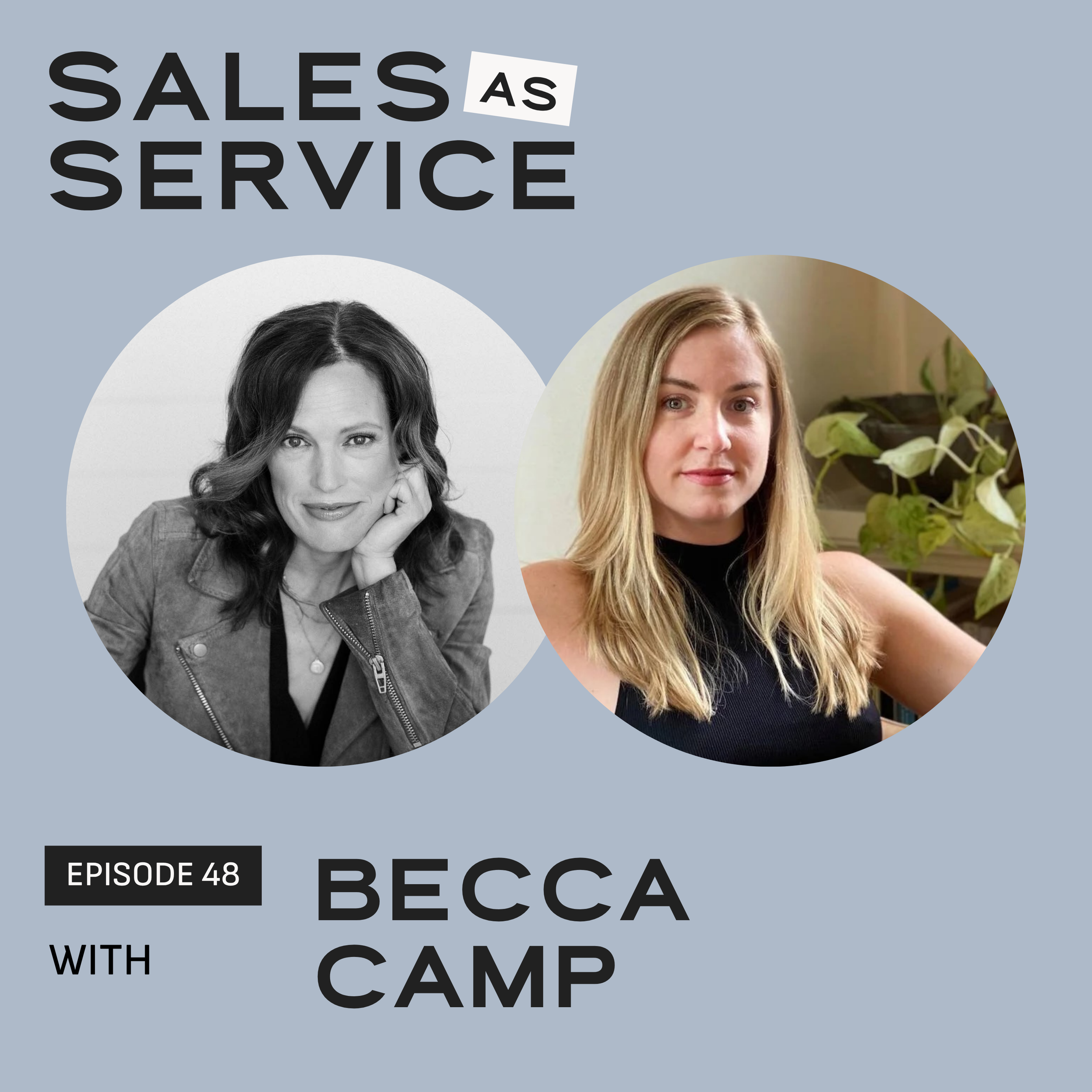
Nail Your Offer: Get Clear, Get Specific, Get results with Becca Camp
EPISODE: 48

What does it mean when your offer stops converting? Most founders go straight to the copy — rewriting, repositioning, polishing. Becca Camp says that's usually the wrong place to look. In this live episode recording, we get into the deeper reason offers don't land, and it has everything to do with what's happening in your body when you're in the room.
Becca is the founder of Fearless Femmes and a former Silicon Valley product leader who now helps women transition from corporate into consulting businesses built around their authentic strengths. Her approach blends practical business strategy with somatic practice and nervous system training — and the conversation we had was one of those that went well beyond marketing advice.
This is a live session, so you'll hear real questions from the room, real moments of recognition, and at least one concept — the glitter — that had me taking notes mid-interview.
In this episode:
Why 80% of whether your offer converts has nothing to do with the words you're using
The three-part framework Becca uses to help clients package their expertise — including the question most people never think to ask
What your body is broadcasting in a sales conversation before you say a single word
Why perfectionism is a physiological symptom, not a personality flaw
How to build the nervous system capacity to show up consistently — and why that's the real competitive edge
LISTEN TO THE EPISODE HERE 👇🏻
-
Speaker: [00:00:00] No amount of domination, safety, convincing, whatever, is really gonna convince a high quality client that they need your services if they don't. So , so the way that I like to look at it is, like, if your marketing is working, a sales call should be as simple as, "Hey, I know how you can help me and like why.
How can I pay you?"
Speaker 2: Welcome to Sales as Service, the podcast designed to help you change your mind about sales, literally. I'm gonna help you change the way you think about selling. I'm Tam Smith, your host, sales bestie, and pitch partner next door. If you're tired of bros with biceps telling you how to crush a million dollars in your sleep or battling imposter syndrome on your own, you've come to the right place.
All you need to do is listen, then take action. No gym membership required. Let's get started.
Hey, Tam here. Most consultants and service-based founders are [00:01:00] great at delivery. Referrals prove it, but referrals aren't predictable. And you've avoided sales because you think you have to be something you're not. But sales isn't pressure or cringey tactics. It's connection, starting conversations, recognizing when you can actually help someone.
The hard part? Doing it consistently. That's why I built the VIP Lead Gen Pipeline system. It gives you a repeatable way to book three to five sales-qualified meetings each week through relationship-first outreach, not cold pitching. Ready to create opportunities on purpose? Book a free alignment call at studio349.com.
Sales is a practice. Let's make it consistent. Hey there, Tam here, and welcome back to Sales as Service. Today's episode is just a little bit different. This is from our latest Sales as Service live event. It's part podcast interview, part working session with a room full of founders, consultants, and service providers getting really honest about what it actually takes to shape an offer people understand, connect with, and will say yes to.
It's one of those conversations that challenged me too, because if I've learned [00:02:00] anything building my own business, it's that clarity is uncomfortable. Getting specific can feel risky, and owning the real value of your expertise requires a level of self-trust most of us were never taught. Today's guest is Becca Camp, CEO and founder of Fearless Femmes and a former Silicon Valley product leader turned business coach.
She helps women transition from corporate into consulting businesses built around their authentic strengths. Not hustle, not hype, and not trying to sound like everyone else Together, we get into why offers stop converting, how your nervous system is doing more in a sales conversation than you probably realize, and what changes when founders stop trying to sound impressive and start communicating what actually makes them different.
Becca introduced a concept called glitter, that thing that you could talk about forever and completely lose track of time. And I'll be honest, I was doing my own journaling after this one. This goes well beyond messaging strategy. It's about self-trust, visibility, and learning to clearly articulate the value you already bring to the [00:03:00] table.
So whether your offer feels unclear, underpriced, almost there, or you're just trying to show up more confidently in your sales conversations, this episode is for you. Here's my conversation with Becca Camp.
Speaker: Becca, thank you so much for being here. Welcome
Speaker 2: to Sales to Service.
Speaker: Yay. It's a pleasure, Tam. Thank you.
Speaker 2: I always like to start these conversations by asking, tell us in your words who do you help and how do you serve?
Speaker: Yes, love to. So I help women replace their corporate tech income with a coaching or consulting business that puts their nervous system first, finally. So most of them are breaking the golden handcuffs because they're absolutely done with corporate values, which I like to kind of summarize as extraction, profit at all costs, domination and subjugation.
Probably sounds familiar. But honestly, Tam, it's like a, it's like a full body reconfiguration, like a reconditioning process to incorporate new values, like aligned authentic values into a business and then into the business that they're [00:04:00] bringing to life. And that's, that's where my expertise comes in.
Speaker 2: Let's talk first about early stage service-based founders. Will you walk us through the process you take your clients through in initially packaging their expertise into a clear, compelling offer? 'Cause I know that, like, when you're moving out of your corporate expertise, transitioning into, you know, a, a consulting service-based practice, it's hard.
You've got all this wealth of knowledge, like how do you distill that down and turn it into an actual offer?
Speaker: Yeah, definitely. And so that bit is of course the first step, but the way that I like to break it down for, for folks who are at this sort of precipice, articulating the offer is really 20% what you say and 80% how you say it.
So, so, so of course like that 20% is essential, so, so we'll kind of break that down here, but I'll be, I'll be straight with you, like my clients regularly land $50,000 clients of their own with what we call a shitty first draft. It's absolutely amazing at how far or like how far good enough can get you.
So, you know, just, just bearing that in mind 'cause we will get into the 80% down the road here in just [00:05:00] a second, but this is the essential starting point, right? Everyone kind of is eyeing their exit ramp for from corporate and they're like, "Oh, but like what am I gonna sell though?" And so we walk it through in a pretty efficient way, comprised of three steps.
So first we always ask, and this might, this catches some people off guard, "What are you afraid that people will find out about you?" Not the starting place people expect. But, but invariably this, the answer to this question ends up being reflective of people's superpower. So for a lot of my clients, it's about how deeply they feel their emotions.
Like, "Oh my God, if people knew, they'd think I was crazy." Or how they're not as detail-oriented as they're, think they're supposed to be, right? Stuff like that, that kind of has an anchor and a little bit of flavor of shame to it, that when we unlock it, inevitably ends up being an incredibly important part of their narrative and story and what we call their unique angle.
So you get the idea. So that's part one. Part two, a little bit more standard, right? So we, we do wanna pull out the skills [00:06:00] that one might have on a resume. So in your corporate life, were you a whiz at strategic planning and like guiding the organization through that process? Were you a, a, like a Jedi who could magically get executives to come to a consensus?
Maybe you, you specialize in taking a product from zero to one and, and building from scratch, that kind of thing. We like to surface two of those just to give a little dimensionality to, to your skillset. And then the third part, the final part is also like my, this is like a, like a Becca Camper original.
I love this question. We always ask, what gives you the glitter? And so, so I wanna like, I want you guys to, when you imagine this, like I, I always imagine like a sparkle kinda like bursting up through your collar. Like you could just, you could talk about a topic, a certain thing, this topic that gives you the glitter forever and just totally lose track of time.
You can approximate this effect by having one margarita. Totally off the... But if you're wondering, wait, what does this feel like? And you've had a margarita and you're hanging out with your friends, it's that kind of [00:07:00] like, like ki- genuinely like a psychoactive state where you're so in flow talking about something that you have so much embodied passion for that, you know, we would call it the glitter.
It just feels like, brr, like glitter sort of, you know, exploding everywhere. So those are the three parts. And, and that really, that last bit is the secret ingredient that, that gets people all the way to what we call their unique angle.
Speaker 2: And I wanna ask, 'cause that glitter part, I feel like that is the part, it so, kinda goes back to that thing that you don't want, you know, anybody to know about, and it's the thing that's so easy to dismiss, like that thing that has ease and flow and joy.
At least in my own experience, it, I didn't honor that and value that. Like I, you know, I was so attached to, you know, the resume skillset of what I thought I, quote-unquote, "should be doing" that I didn't allow myself to value the glitter. Do you, do you see that a lot? Is it something you have to coach people through?
Speaker: Absolutely. Absolutely. And I think this [00:08:00] is also a, a thing that people who are socialized as women are conditioned to do. We're not supposed to stand out. We're not supposed to be so enthralled about a topic that, like, we lose self-consciousness. No, we're supposed to be completely pos- self-possessed and, and buttoned up.
And what that does, of course, by design, is make us blend in with the crowd And, and that is actually where safety is for, for w- for most women, right? Again, we're, we're-- we don't wanna be the tall poppy as, as they say. And so this is an adaptive, it is an adaptive behavior that, that was evol- we evolved in service of our survival.
So it's something that we do wanna honor and really like look at is this isn't something that you're doing wrong by avoiding showing yourself and revealing yourself vulnerably in this way. It is a survival response, but it's also one that is worth deprogramming so that you can truly bring your full authentic self to all parts of your business, whether it's in a sales [00:09:00] call or in your marketing or in your actual client work itself.
Um, this is really where you get to stand out and creating, creating safety for yourself there is, is the whole game. That's a big part of the 80% that I mentioned before.
Speaker 2: And it's funny, I started this question, you know, speaking to, uh, specifically to early stage founders, but I don't-- I think you ask those three questions re- at any point in your, in your journey.
Like, I was just like right now having my own like, okay, I'm gonna have to do some journaling after this conversation.
Speaker: Honestly, same. I try to do it, I try to journal every day because as you know, Tam, we've been in business for a long time. Like there's pivots that happen. There's-- Oh my God. I just, I woke up literally probably maybe it was six months ago, and I was like, wait a second.
Like, I actually wanna get back to my roots. And this is my unique angle, right? My thing that I thought I wouldn't-- I could get a glitter about, but I never thought would be relevant for business, which is all about evolutionary anatomy and human physiology and biochemistry, like all things that I have either a degree or, or deep [00:10:00] academic training in.
And I thought it was this little like appendage of like a, like a weird interest, special interest that, but it turns out it has been absolutely essential to, to my own business success as well as the, you know, what I do most of my educating about. And it's, it's, it's so fascinating. I could literally talk about it all day, and it comes in handy every single day.
Those pivots where the thing that used to work isn't working anymore. Oh my God, how many times does that happen in our business? Well, every two years or so we're having to like do a little bit of a revamp. And if my body were, were freaking out and getting this like, oh, we're not safe anymore. We have to like figure it all out.
Like what, how, you know, do, did we ever actually have success or was that just all a fluke? Those are all symptoms of a body that, that's in a state of dysregulation. If I didn't understand the mechanics of what would, what was happening in that moment, oh my God, I would be, I would just be on like a hamster wheel of efforting and, and, and worry and, and, and like, and self-doubt, right?
But instead, I'm just simply understanding the mechanics of it gives me all the [00:11:00] tools I need to kind of come back to, ah, yes, another moment of radical creativity.
Speaker 2: Well, that set me up for my next question. You know, talking a-about founders that are further along and have hit one of those you know, inflection points in the business where they're feeling stuck and things aren't, you know, I said specifically, you know, for this conversation, the offer isn't converting anymore, and you know, that maybe don't have, you know, the background and, and training that you do, like what-- how do you approach those conversations to help them get un-stuck and get underneath what's really going on?
Speaker: Totally. And so whether you're just starting out or you're years into business, guys, spoiler alert, this is gonna happen. She's like, "Your shit will stop converting, and it'll be very confusing." Uh, and so, so please, like, listen up because this is so essential and, and truly, like, uh, this, this is life-changing training and, and, and information for me.
I love it so much. So really there's, there's kind of two components. Okay, my offer isn't converting. What could be happening here? So two components to this. The first [00:12:00] is back to, okay, so we figured out what you're saying, and then there's this 80% quality of, like, how you're saying it. And, and so given that the, the shitty first draft converts just fine for most people, going back to refine the offer over and over and over again, "Oh, it's not perfect.
I need to polish it more. I need to rev-- What words am I using?" Blah, blah, blah. Like, that usually is a futile endeavor. It's just, it's not the point of highest leverage most of the time. And so what do we do instead, right? If we're not going back and wordsmithing, what do we do? We look at what the body is doing in the moments that you are sharing the offer.
And we look at these things in terms of physiological symptoms, okay? So, so everything that's happening, everything that you can observe consciously about your delivery and how you're saying something is what we can call a symptom. So are you collapsing inward? Even, you know, whether it's your actual posture, kind of like hurling forward and which again, we, we can intuit is, is a self-protection mechanism, right?
Or even if it's [00:13:00] just like a sinking feeling in your chest or solar plexus, in your gut, right? That kind of collapse is really, really important information. Are you rambling and scatterbrained? Like are you just kind of feeling like your mind is like sw- like swimming all over the place? Do you have racing thoughts kind of going in the background like, "I don't belong here.
I don't have enough credibility." All of those stories which happen to take, you know, the form of thoughts sometimes, they're just, they're just symptoms. They're symptoms of a body that's not broadcasting safety So given that everyone makes decisions, your client who you're, you know, the prospect that you're talking to is gonna make decision, a decision from their emotional center, it's important that they feel safe, open, curious, like confident by extension of your confidence.
And, and here's the crazy thing is, is there's this incredibly sophisticated technology that over the millennia that we have, you know, we've been evolving as social animals. My [00:14:00] nervous system at this point in our human evolution is constantly broadcasting on an unconscious level whether I think I'm safe or not.
Your nervous system, the nervous system of everyone here like on this call is picking up, oh, is, is Becca feeling safe? And if I'm not, if I'm having this dysregulation, if I've got these racing thoughts in the background, if I on some physical physiological level don't believe that I belong there, that I'm safe, that everything, we're all good, your body will pick that up and start mirroring it.
And so it's this crazy like mind control level spot where, where like, it's like, you know, it's actually body control, but you know, it's one and the same, where, where we have this enormous point of leverage of helping other people feel the way that we need them to feel to make the decision that we need them to make.
So that, that's part one, right? And again, like if you're like, wow, that sounds like manipulation, yeah, guys, like use, use this power for good not evil. It is, it is really, really powerful, [00:15:00] and 99% of people have no idea that it's happening on this like unconscious like constant level between, between any two human bodies.
Which then of course gets us to the, the second part of, of the second reason why your offer might not be converting anymore. You know, no amount of domination, safety, convincing, whatever is really gonna convince a high-quality client that they need your services if they don't. So, so the way that I like to look at it is like if your marketing is working A sales call should be as simple as, "Hey, I, I know how you can help me and like why, how can I pay you?"
Right? Like, it gets to be that easy. And so of course, at that point we can, we can, you know, if the body is sort of passing the first round of checks, like, yes, I'm, I'm feeling grounded, safe, open, confident, so other people are feeling the same way, we can clock that. Then we can get into this question of, okay, is my marketing sufficiently explicit [00:16:00] about how I help people so people can self-diagnose as it being a good fit for them?
Um, and does it, and you know, am I being, am I being clear enough in my marketing leading up to that sales call so that the sales call is, is fairly straightforward?
Speaker 2: I mean, this is like, again, anyone regardless of what stage of business can think about and apply because it is, you've got to, I mean, first and foremost believe in yourself and believe in what you are, whatever the product or service is you're selling before you can expect anyone else to.
Speaker: Like that's like a, it's like a, it's hard to quantify, right? It's like how do you know if you believe something? You can think it all day long.
Speaker 2: Mm-hmm.
Speaker: If you're not feeling it, and I literally mean feel, physically feeling, then, then it, then it's just not gonna land. So that's what we're really tuning here and, and there's a whole set of somatic practices that are so worth learning.
Again, this is, this is just core to what, what I train.
Speaker 2: And I'm just, I'm thinking about my own ent- my own experience. Like I was, you know, career sales, career sales leadership, you know, in a corporate environment where I'm representing someone else and someone else's product and service. That was like... [00:17:00] I mean, I, I won't say easy, but you know, making the transition to representing yourself and your service, it's a, it's been a whole different experience.
Way more vulnerable. And where, you know, I, I think of myself as being a, you know, confident person, but it unearthed every ounce of fear, insecurity, lack of trust that I've really had to, you know, work through. And it, I don't think it's ever anything I'm, you know, it's never a one and done. You know, it is a, a constant process, you know, that we can always get better.
Speaker: Absolutely. And, and it's just, again, like this is a practice that I take so seriously and, and, and feel so empowered around and, and my clients do as well, right? Because every single day that we're out in the world or on the internet or whatever, we're receiving a signal of, this is just imperial capitalism, like this is a symptom of imperial capitalism, that you're not enough.
Like capitalism requires that we believe that we are not enough to function.
Speaker 2: Mm-hmm.
Speaker: And so every single day I like to imagine that we're just [00:18:00] being handed a brick, like a brick, and if we don't set it down, like actively, proactively set that brick down every single day with like a dedicated practice, we're just carrying it.
And if we keep carrying it every day, we get a new brick, and it just goes in the backpack, and it just starts to weigh us down more and more. So it is, it is something that, that is, I, I literally mean set aside 10 minutes a day to do this practice, and that is, that is the kind of dedication required to unburden ourselves from the status quo.
Speaker 2: Yeah. Wow. Can you share, do-- is there a specific, any kind of case study or example where you can walk us through, you know, someone you've worked with to make that transition from, you know, fear resistance to, you know, self-trust, like regardless of what the offer... 'Cause I think what I'm hearing is it's less about the off- you know, it really is kind of less about the offer and more about how you're representing it and speaking to it.
Yeah.
Speaker: Absolutely. So they're, they're usually the, the women that I work with tend to come in from their, their very successful corporate off- [00:19:00] often executive level, you know, careers in, in corporate tech, primarily a lot of Silicon Valley folks. And so they're used to having this bolster of the name brand or whatever behind them.
And all of those things do offer a certain level of safety, right? There's a structure behind you that has gotten a lot of external validation, that has gotten your body into a state where you're like, "Oh, we're good. Like, as long as I have this structure behind me, like I'm safe." And so once that structure goes away, it's a whole reckoning of, of like learning how to internally validate.
And so, gosh, I mean, there's, there's so many examples and I'm thinking of, of one client in particular who came in and had the tightest, like sweetest like, like resume, right? She had every name brand company. She had-- Oh, she had, she had all of the shiny, like big products on her, like in her, what, what we call the stitch, which is her story plus pitch.
It's kinda like how we in a sentence like condense the, the content that we came up with earlier. So it's just a quick little elevator pitch. And it just, and it [00:20:00] sounded, it, it on paper just sounded so incredibly tight. It was something along the lines of, you know, had grown X product from zero to the first 10 million users, you know, with line of sight on 100 million ARR for the organization and like a departmental like strategic like, uh, it was becoming like strategically central to the entire organization, right?
I mean, just like epic badass, like boss babe stuff, right? And yet anytime that she showed up in a call where, you know, her dream was to work 20 hours a week out of that kind of corporate environment that was so oppressive and had so many politics and so much just bullshit, like, just like bad actors and, and people who were so caught up in the rat race.
It was just, you know, just not a values aligned situation for her and it was really corrosive to her spirit. And so here, here she was now like outside of the scaffolding of this thing that she had convinced herself was safety. In fact, you know, the corporate culture had convinced her it was safety, you know, that she leaves, you know, she dare, she dare not, right?[00:21:00]
That's how, that's how they keep us. And so here she was doing this incredibly courageous thing where we ran through the process, the method that, that we use in Fearless Femmes for, for finding these early clients. So it's a systematic way of leveraging your network. We, we talk to starting with an inner circle all the way and, you know, get introductions that help us increasingly with each introduction to get more targeted and more likely to hit a person that is a great, great fit for us as a client.
And so she would sit down in front of even her what we call the besties, like the bestie ring, this inner circle, and her mouth would go dry, her palms would start sweating. She would just like, like her mind would just go totally blank. And this is a particularly severe case. Like obviously those, those symptoms were like very, very intense.
But everyone that I work with has some optimization available to them in terms of their body symptoms that is causing them to unconsciously... because their, their, their body is going through this thing where they had this firm structure [00:22:00] that they've convinced themselves was certain and safe, and now they're in something they're having to create for themselves.
Your body is going to respond to that change. It, like it's a, it is an evolutionary imperative that it responds. Like, it's your body working as designed to, for it to, to feel unsafe there, right? And so, so for all these clients, regardless of the, the severity of their, of their symptoms in these moments, we're able to notice and name them first.
So that's really, that's really the biggest part because there's, you know, in, in this body of science, there's, uh, this thing called pendulation, where sometimes our symptoms are ev- like evidence of the nervous system getting super jacked up and like, ee, like fight or flight, right? Like, gotta get out of here, run, run, run.
Like get rid of your digestion, you know, g- like get your blood pumping so that we can escape, right? Other times we go into freeze and fawn. That's the other side of the pendulum. So you know, we're having reduced heart rate. Our breathing tends to stop. We, we get very still, right? And so depending on where you lie, like where, [00:23:00] what your body's initial response is, depend-- You know, that influences the practices that we use to bring you back to baseline.
There is no one size fits all solution to how your body is gonna get back to baseline. Everyone that I work with gets to notice and bring awareness with mindfulness onto what's happening in their body in those moments, naming those symptoms, and then depending on where they are, they experiment with, with the, the techniques that work best for their body.
The one thing though that can be done universally, regardless of whether you're trying to get your, effectively like your heart rate down or your heart rate up, right? So, so you might be in, in one of those two categories. Everyone gets to have a practice that's going to help anchor them in safety. Kind of like a, you know, like you go running every day to, to increase your cardiovascular fitness.
This is kind of the-- this is your daily jog, right? Where we sit and we simply observe the sensations that are happening in our body. I really like the five, four, three, two, one technique where we'll have [00:24:00] folks kind of come down. Actually, we can do it right now if you want. That one that sits really, really nice.
Speaker 2: Yeah.
Speaker: So, so if you're, if you wanted to do this, I'll, I'll do a slightly sped up version just in case people just wanna listen. But we drop in, feel our feet on the floor, and just sort of bring our attention and awareness to the contact points of where our body is being touched and being supported by the chair, by the floor.
And, and this is where I do wanna just, just to take a quick moment to if this ever feels uncomfortable, if you ever feel like you are feeling worse during this exercise, just stop, open your eyes, come back into breathing. There is no, no virtue in like pushing your body into doing something that it's not ready to do or feels unsafe doing.
So, you know, if it does feel unsafe, that's a separate topic and, and we deal with that a little bit separately. Um, but we always wanna be working within your body's window of tolerance rather than pushing it and overriding it. That's the old way, right? And so what we do, assuming that it's feeling safe and feeling good, we get the feet on the floor.[00:25:00]
And I like to, to start just by looking around and naming just in your mind five things that you can see. This is sort of a five senses meditation, and you can note that. Just note those five things. Don't overthink it. And then I like to do four things that you can touch. So you can kind of reach out and touch something.
Maybe just notice the touch that's already on your clothes, on your body. And then we do three things. Note three things that you can hear. So you listen for something really far away. Then we do two things that you can smell. So maybe you like smell the laundry detergent. Maybe you've got perfume, you note that.
And then one thing you can taste. Usually most of us have like a, "Oh, that's my lunch." And that alone, guys, that like 60-second exercise of coming into your body breaks the chronic dissociation that we have been conditioned for our survival to adopt as our day-to-day MO so that we can survive being in these [00:26:00] environments that our bodies don't wanna be in, intuitively are, are revolting against.
Again, anything that's aligned to our values, our body's sending a lot of really uncomfortable signals like, "Get out, get out, get out." And so our, our way of, our way of coping with that is to totally dissociate, to like hit mute on all our body's signals. So just by dropping in and spending a little time with your body, it's so simple, so simple, it can completely transform your relationship with your body signals.
Speaker 2: If your pipeline feels inconsistent, it's usually the sign of an outreach gap. I created a free tool called the New Client Calculator to help you see exactly what it takes to land your next client. How many messages? How many conversations? How many follow-ups? No guessing, just clarity. If you've ever wondered, am I doing enough or just not doing the right things?
This
Speaker 3: will show you. Head to studio349.com to download the New Client Calculator and find out just how close your next client really is. All right, let's get back to the episode.
Speaker 2: You have really set for me how important it is to just have if, if even if it's [00:27:00] just five minutes of just stillness and being present to actually like hear what's going on in your...
Because we're just, we're taking in so much noise to actually, you know, hear what's happening and kind of operate from the inside out versus outside in, uh, really changes the way you respond to, you know, situations that are challenging and testing. Once you've got that, you know, established internal You've mentioned the shitty first draft.
How do you-- what is your method for making that compelling? You know, even if it's, even if it's not perfect. I think there's, there is, you know, I had thinking about resistance, you know, and specifically as women, I'm a recovering perfectionist.
Speaker: Mm-hmm. You know,
Speaker 2: it's very easy to, you know, delay because you want it to be perfect.
But, you know, shipping is better. Shipped is better than perfect. So how do you, how do you get that out the door?
Speaker: Absolutely. So this is where a perfectionism also an incredibly common trait that my clients are coming in with, uh, also a symptom, physiological [00:28:00] symptom. Again, when you think about taking something that isn't perfect and putting it out into the world, your whole, your body experiences this gripping, right?
Mm-hmm. And so that is an evolutionary adaptive, I think adaptive coping mechanism in your body working as designed. And so we wanna work with the grain of the body rather than just bulldozing overriding it, right? So this is why my, my method for, for getting these early clients, right? So getting into a rhythm, and, I mean, I have, I have clients who only use this method and have a $2.2 million pipeline, we just celebrated the other week, in the first nine months of working together.
I mean, this is, this is all you need. You don't need social media. I mean, you know, all those things are great if you want to. Even email marketing is, I love email marketing, but it is optional. You can use this, just this method to have a multimillion-dollar business. And so, so what we do is we work with the nervous system.
So, so the... Again, the, the idea being we wanna stay within our window of tolerance, not like blowing out our anxiety so much that we feel like we're just like picking up the pieces and trying to [00:29:00] hold it together in these calls. Like, it doesn't serve anyone, actually. And so the first set of people, I usually start with five.
I mean, we name five people who you could to, to, to share your, your offer with, right? The, the shitty first draft that we've, that we've drafted. And ideally, we, we, we pick five people who maybe it's on an edge, right? It's like, "Ooh," that's like, I'm like trying to like psych myself up for doing it, but you can do it.
You can get there, right? It's not this disastrous, you know, terrifying endeavor to do it because they're close enough that you could totally F it up and be like, "Oh my God, babe, can I just start over?" And they'd be like, "Totally." You know? So that's the level of closeness that we're going for that will, again, through this co-regulation of our, of human bodies, you will be mirroring safety back to each other.
And once we get some reps in, just with these first five people about sharing the, the, like sharing the, the, the offer that you've created, the shitty first draft, and getting not a disastrous [00:30:00] response. Oh, look, I survived that. What? Crazy. Then our body starts to pick up and get in this habit of like, okay, like that was an edge, and here we are.
We're good, we're good. And suddenly our tolerance expands for more uncertainty and, and the possibility of rejection even, right? Becomes a little bit more something that we can do. And so this is the thing that everybody skips, by the way because it is so uncomfortable and also an edge in, in the process of, of actually taking this tactic of networking and making it a strategy that has an ROI for your business.
And it's a very simple tweak. At the end of every conversation you say, "Awesome, this is amazing. Based on what we talked about, who should I meet with next?" And then you shut up until they name a name. And there's a couple, you know, a couple ways in, in my program where we troubleshoot. Like there's, there's some ways to even like help people come up with a name a little bit more easily.
But the most, the biggest challenge is actually just insisting that they give you a name right there on the spot. Like it's okay, no, you [00:31:00] can take your time to think. And and that, what that will do is then they give you a second round, right? Sort of the, the second ring, if that was the inner circle. We've got now a second circle, just one step removed of people who are going to be an order of magnitude more targeted.
We rinse and repeat that process. In that third ring, the outer ring, that is where the client tends to be. Statistically with my clients it's around 90, 95% of the time. If you do five, introducing five, introducing five 95% of the time the client will be there, $50,000 15 meetings away.
Speaker 2: Love it. And that's so practical and actionable.
Mm-hmm. We can all do that like today. Yeah. Start that process today.
Speaker: Always be linking. That's what we call it the third link rule, like the third link in the chain is, is sort of where it's at. And yet you would be amazed at how many incredibly high achieving women will be like, "Oh yeah, I'll make that first call as soon as I perfect and polish my offer."
And so you one more go. So again, this is why like, oh, all I want is to like give all this information away for free. [00:32:00] And again, the, the real, the reason where my expertise comes in is 'cause it's not about the information. It really is about the guidance and the co-regulation that, that I can create and, you know, my clients create for themselves and community that, that enables them to, to outsource the courage to, to keep going.
Speaker 2: Yeah. Yeah. I, you and I both are well aware of the fact like I, I don't I'll, you probably heard me say, and I'll say repeatedly say this, I don't believe that there's anything in, in me working in sales and business development that there's anything as a sales expert. You know, there's just folks that have, you know, have done enough exposure therapy that it's a little less uncomfortable, and I have lots and lots of practice.
And I, you know, am the same way with you. Like, I, like, I'm not holding any secrets. There's no, like, magic formula or, you know, a silver bullet to what I'm doing. I'm just willing to be the one that's gonna be the first one to grab your hand and bring you onto the dance floor with me
Speaker 3: and,
Speaker 2: and help you take that leap of action.
And, you know, know that you don't, you know, you're not alone out there and don't have to look, you know, stupid hanging out there by [00:33:00] yourself and be, you know, the cheerleader in your corner while you do it.
Speaker: And yep, and it's such a gift. Like, it's such a gift that I think, you know, women have been trained because we, we, we, we could call this emotional labor or the soft skills, right?
Kind of thing that we're talking about. And in fact, it is an incredibly sophisticated, weaponizable piece of physiological technology that, that we're actually doing all the time. We just, we just don't know it, right? Every time that we take someone's hand, whether it's metaphorically or literally, we're offering this gift of co-regulation, and that, that is the antidote to this hyper-individualistic winner-take-all kind of, you know, culture and value system that we're operating in right now, especially in the corporate world.
Speaker 2: And I would say just in the age of AI and for all of our digital tools, like we-- it's so easy. I feel like as women, we're, we're, as a, obviously, you know, kind of as a broad sweep, you know, that is those soft... We're, we're very good at the soft skills, and we undervalue them, and they are, they're, I mean, often undervalued in the [00:34:00] workplace, traditional workplace.
And I think, you know, this is our season.
Speaker: It's a big one. Totally. Like, it is a differentiator. I mean, I think that, you know, we were convinced that, that they were under, like, not, like, less valuable than quote-unquote hard skills, but we've been using them-
Speaker 2: Mm-hmm ...
Speaker: and leveraging them the whole time. We just don't, we're educated about the mechanics of them.
So again, this is, this is my glitter, right? I can talk about it all day. Like, the mechanics, like, once you get it, and I really do believe, like, I'll, I'll, I'll be straight up with you, Tam. Like, if we can-- I, I sort of half-jokingly use the word weaponizing, but, but I really do think that if we can, can leverage this internal physiological evolutionary technology to put and to install our values and, and, and use our physiology as a, a mode of influence, it is the most powerful influential factor that there is, right?
Mm-hmm. People just don't know that they're using it to influence it, as influence. But for those of us who do understand it and do know, we can dismantle any power system because all people wanna [00:35:00] do is feel safe. That's all they actually want, and that is the biggest opportunity we have in our culture right now because no one does.
Everyone, everyone hates this party. All you have to do is throw a better party. That's my joke.
Speaker 2: Love it, and use our forces for good.
Speaker: Exactly. Exactly. And I, I will die on this hill that my values are better than the values of corporate culture. I, I will go ahead and say that.
Speaker 2: I will not disagree. And with that, let's jump into our fast five.
Speaker: Yes.
Speaker 2: Your I can't live without it software or app?
Speaker: Ooh, WhatsApp definitely. So it just, it just makes me feel so connected to this beating heart of a, of a community that I love so much.
Speaker 2: Best advice you've ever received about sales and business development?
Speaker: Yeah. So let's see. This, this mindset of I'm just here to help, and if I'm not the person to help you, I will point you or introduce you to someone who will.
It is the ultimate power move. I feel like there was a before and after in learning that, and that that generosity is just absolutely magnetic.
Speaker 2: Morning routine must-have?
Speaker: 90 minutes of nothing. [00:36:00] Unstructured time. I just sit in bed or whatever.
Speaker 2: Your walk-on song, the one song that always pumps you up.
Speaker: Yeah.
So I, this is a little bit of like a weird hippie answer, but it's, but it's actually very honest. I like listening to the sound of my life and just being fully dropped in and walking through the city and actually hearing the traffic or the birds or, or people talking next to me and just being fully attuned to like what's actually happening around me.
Speaker 2: And if you only had one hour each day for business growth, how would you spend it?
Speaker: It was kind of what we said, what we said at the very beginning. Yeah. So making friends with cool people and talking about how we can support each other. That's it. That's actually the strategy, guys.
Speaker 2: Agreed. And where can people find and connect with you online?
Speaker: Yes, definitely. So beccakampf.com has pretty much all the information about my programs, and you can sign up for my newsletter there. I'm regularly, you know, again, I try to give everything I possibly can away. So whether it's the kind of spiritual musings or tools for, for business that, that I've been practicing, real data about what's working for my [00:37:00] clients, all that is available on my newsletter.
You can sign up right there on my website, beccakampf.com. Awesome.
Speaker 2: Thank you so much. I know I've gotten so much from this conversation. I know our listeners are going to as well. Thank you,
Speaker: Sam. Oh, it's truly a pleasure. Thanks, guys.
Speaker 2: With the time we have left, I wanna open it up to questions, feedback, any burning questions from the conversation to our audience here today.
Speaker 3: I would have to say this was like an eye-opener and like alignment. My business is based off of referrals, and we start out with talking to our five intermediate circles of, of people we know. So I love that whole like aspect of things. You just put it in like a clearer version. And we do ask those questions at the end of our presentations like...
And this is without any of your coaching. I've never met you. I've never taken your coaching. But I do ask that question, and then what I get, and I'll wait 'cause I'm, I have no problem waiting. And I've only been in my business for about a year now, and I could remember [00:38:00] like talking to people at the beginning, and I'm shaking.
So I'm like listening to like your symptoms and stuff like that. So I'm like replaying the past year and how I got from that to here. So I definitely feel like maybe there's just some tweaking I need to do. But my question is, is like when you get to those, at the end of your presentation, and you're asking like, "Okay, so now that we've gone through and now we know a little bit more about each other, and I, you know what I do, who do I need to talk to next?
You know, who's somebody that you know could use this information?" And then I stay quiet, and then it's just like content, and I'm waiting I was like, to me, and then I'll kind of guide it and be like, "Name, like, two people. You know, give me one person." "Well, I don't really know anybody." Like, that's what I get, and I do hear that, like, a lot from my people, like the people in my industry, that they'll, they'll ask the right questions.
They're, they're guiding things along and they're guiding people. They're holding their hand through processes, and then at the end of the day, like, [00:39:00] we still don't get to that second tier. So what could be going on in that situation?
Speaker: Absolutely. So like I, I literally, I should just, I like have a slide about like the troubleshooting for that moment 'cause every UR is not on everyone, everyone struggles with this, so, or has this moment rather.
So, so there's a couple of troubleshooting points that we, that we go through. One is we just do a quick look about like, okay, were we clear about who we're helping? Like, was it again, this is the, the one little check mark about, about word smithing that we'll just take a quick look at. Like, were you like, "Oh, I can help any old person."
And what that does is it creates this free recall problem in the listener's mind where they're like, "Oh, anyone. I can't think of..." Like she can help everyone. What? I can't think of anyone now. Like it just like glaze over. And so the more specific we can be about who we help, then you know, the, the easier it's gonna be for someone to latch onto a name.
The other thing is that when you shine the light of your attention on somebody, sometimes their nervous system [00:40:00] can react, even if you're co-regulating them into a state of relaxation and ease. It, uh, it's triggering for people at a very low level, right? And so sometimes their mind will go blank as their own, like dysregulation symptom.
And the way that we can avoid that, just a pro tip, at the beginning of the conversation, we can prime them by just telling them what's coming. Be like, "Okay, at the end of this conversation, I'm gonna ask you for a name of someone that you think I should meet. So like, get those wheels turning, but like don't worry about it right now."
And what that does is it brings people back to a state of familiarity, which relaxes their body. And if our body's... Like we can't get into a place of curious creativity if our body's dysregulated. So we really wanna be creating, creating those conditions for, for the person who's, who's listening. And that I find that those two things, like be specific and prime them from the beginning usually again, and sometimes look, sometimes people just really can't think of a person, so that's why we do five.
So like maybe like three or four of them actually advance to the next level. But usually with those two tips, we, we knock out a lot of the false negatives.
Speaker 3: That was really [00:41:00] helpful, like a very clear, concise, and had me like, okay, how do I end, like to be more specific? And so I love that 'cause now I'm like, depending on the person where we're going, like who do you know that has a 401k that they left a job and it's sitting there?
So being more direct. I love that. So like in two seconds I got it.
Speaker: So good. Yeah, it's funny. The, the, once you, once, I mean, you see this, I've been doing this for 10 years, once you see the patterns. 'Cause like, guys, I literally just packaged up networking. That was like, that's what I just described. Isn't it amazing?
Like I, I, I remember I was talking to a client where I was just like, I was... And Quinley, she's an absolute star. I was like, "Quinley, like, like you really want me to write down the steps to this? Like, like it's just, you're doing, like people do it all the time." She's like, "Becca, write down the steps." And that was, I was like, "Okay."
And sure enough, people really wanted the steps. Again, it helps soothe their nervous system to feel like there, there's a, there's a protocol. Um, so anyway, it is networking. We're all actually doing it, but doing it, like taking it to that sy- next [00:42:00] level of systematizing it, I find can really supercharge, supercharge as a strategy.
Speaker 2: You're like creating a disciplined way to do it.
Speaker: Right. Exactly.
Speaker 2: Yeah.
Speaker 4: My question actually kinda relates to systematizing. So I am not one for just small talk. I have to have the idea o- of the framework of how I, I approach, say like a coffee chat or something like that. Is there a way to, like, is there a framework instead of just small chat so that it becomes productive instead of just like Hey, what do you do?
Well, I do this. What do you do? Like, you know?
Speaker: Uh, definitely. I mean, I think actually most of these conversations are best done, unless you're really just in a open flowy state, and that's kinda, you know, your strategic anchor. Most of the time I think we should have an, an idea of like what we're trying to accomplish with the conversation.
So I, I like to kind of like lump them into three categories. So the base case is we're trying to find clients, right? I think that's the, the [00:43:00] most common, at least for, for my, for my people. But actually, one- once we're a little further on in business and, and we're kind of in the flow and trying to just like expand, I don't know, expand in all sorts of directions, not just in terms of clients.
We can frame them as like, okay, there's a client-getting conversation where we're like, we're here to, for me to get one step closer to someone that is-- that I can help. And so that is the point of this conversation, is to h- you know, hear about what, what they've got going on. And I do like to make it an e- an energy exchange where like I can offer them support too.
So it's not the small talky version. "So what do you do?" It's more like, "I wanna help you. Like, help me help you, and like I would love for you to help me as well. Here's what, here's what I'm doing, and I-- right now I'm on a mission to find clients. And, and that's, like that is, that is why we're here, right, is to help each other like get to that next step."
So that is the framework, but it's not always the, it's not the only thing you can be talking about. I'll always encourage my, my clients who are a little further along, talk to people who are [00:44:00] doing the kind of thing that you do. 'Cause often, you know, it actually is in service of clients too. I remember my first consulting offers came, I got sold in through a former colleague who was doing consulting, and just because we're in similar line of work, like I was able to be like, "Yeah, like who sh- who should I meet that does similar work?
'Cause I just wanna like build community with those people." So that's another frame. Uh, the other is, I wanna meet someone who's an expert in this thing so that I can like get more information and like get more like cooler resources and like deepen my own wisdom around this thing. So those are sort of the three buckets that I use for this.
All of them are very like not, not just, you know, there for a nice lovely chat. We're like, we're here to get an introduction, and that is very much the point. And so giving all of the information and transmitting that information, and ideally it's bi-directional 'cause I just like, you know, good juju.
Speaker 4: Thank you.
Speaker 2: And I would say what's helped me too, because I, I mean, I may have said to you when we've chatted, like I, I'm a high-functioning introvert and, you know, I e- early... [00:45:00] Now I have enough reps that I have less anxiety, but those conversations used to... Well, any, any time I'm in front of-- I still get anxiety, but I have to remind, I-- it's when I get in my head making it too much about me, and I- if I remember that out, you know, that it's not about, you know, my performance, you know, it's again, it's, you know, in service of who's on the other end.
All that to say, people love to talk about themselves. So like a little bit of it's more l-listening. Like I have to rem-- I just have to listen and ask good questions. And so it's been helpful to me just to take... I mean, I've even like created a little GPT for myself that I can drop someone's LinkedIn profile.
You know, if, if I haven't had, you know, proper time to prepare, I can drop someone's LinkedIn profile to basically like, give me five to seven good questions, you know, that can guide this conversation, you know, to help me identify, A, kind of have a summary of what their work is, and then some good [00:46:00] questions that can lead me either to, you know, referral partner opportunity to support them in their business.
And then I sh- I feel like it, it calms me because I show up prepa- like I feel prepared and I actually have some guiding questions so that there's not, you know, cricket. It's, you know, there's, there's no dead air.
Speaker: Or if you just talk a blue streak like me, there's no risk of dead air. So But, but either way, actually that is a, a form of hyperarousal.
There's some times where I can talk, again, like you're saying, like there's a body technique that I use to drop back into my body so that my hyperarousal symptom of being hyperverbal can chill out a little. 'Cause sometimes I'm just genuinely excited. Other times I'm, I'm nervous and like, then suddenly, I start babbling.
And, and what I do is I drop my diaphragm, like my, the breathing muscle, like right under my ribs, and suddenly I go from waiting for my turn to talk to actually listening. So like all of these things have little body cues that, that practicing over the years and experimenting to see what works for you.
The body [00:47:00] is the point of highest leverage for any of this. Even if you're like, "Oh, I'm scared. I'm like nervous about it being small talk." That's act- That thought is a symptom of a body that's a little bit, little like nervous about how it's gonna go. And when you're truly calm, curious, like kind of in that body of, of total safety, it'll
Speaker 2: just go where it wants to go.
You know? We're just here to have a nice time. Thank you so much, Becca. This was a good one. And so many founders assume the problem is the strategy, the offer, the wording, the platform. But sometimes the real issue is that we still don't fully trust ourselves in the room. And when that happens, we tend to overexplain or overcomplicate.
We keep polishing instead of practicing. And the thing that actually builds momentum is so much simpler than that. Clear language, clear positioning, clear belief in the value of the work that you do. So this week's sales to service challenge is simple. Write your offer in one sentence. Not the polished website version, not the full paragraph, one sentence.
"I [00:48:00] help X achieve X by X." And then use it in three real conversations this week. That might be a networking conversation, a DM, a sales call, a coffee chat, wherever you already naturally connect with people. And pay attention to where you hesitate, where you start to ramble, where you soften the value or pull back.
Those moments are just data, not proof you're doing it wrong, just a signal pointing to where your next layer of clarity lives. As always, thanks so much for listening to Sales to Service. If this one resonated, be sure to share it with another founder, consultant, or service provider navigating the same season.
All right. That's it for me this week. I'll see you right back here next week on Sales to Service. You've just listened to the Sales as Service podcast, the podcast to help you shift your mindset around selling. If you liked what you heard, be sure to hit subscribe and share it with a friend, because we're all about more sales awesome and less sales awkward.
See you next [00:49:00] episode
MORE OF A READER? 👇🏻
If your offer has stopped converting, the instinct is to go back to the copy. Rewrite the positioning. Try different language. Tighten the pitch.
That might feel productive. But according to Becca Camp, founder of Fearless Femmes and a business coach helping women move from corporate into consulting, it's usually not where the problem lives.
"Articulating the offer is really 20% what you say and 80% how you say it," Becca told me on a recent live episode of Sales as Service. And if that ratio feels counterintuitive, the rest of the conversation makes a strong case for it.
The sh*tty first draft problem
Becca works with women transitioning out of corporate — many of them former executives with impressive track records — and she sees a consistent pattern. Clients arrive convinced their offer needs to be perfect before they can put it in front of anyone. Meanwhile, she regularly works with clients who land $50,000 projects with what she calls a shitty first draft.
Her point isn't that the offer doesn't matter. It's that perfectionism is a delay tactic, and usually a physiological one. When we feel exposed putting something unfinished into the world, our nervous system interprets it as a threat. The gripping, the resistance, the endless revising — those are symptoms, not character flaws.
What your body is doing in the room
Here's where Becca's work gets specific in a way most business coaching doesn't. When you're in a sales conversation — whether it's a discovery call, a DM, or a networking coffee — your nervous system is broadcasting. Constantly. And the person across from you is picking it up.
If your body is in a state of dysregulation — racing thoughts, collapsed posture, the low hum of I don't belong here running in the background — that signal transmits. Not consciously. But the other person's nervous system is reading it, mirroring it, and making decisions based on it.
This isn't abstract. It's the reason a prospect can't quite articulate why they didn't move forward. The offer looked fine on paper. Something just didn't feel right.
What actually builds conversion capacity
Becca's method for early clients starts with five people from your inner circle — close enough that getting it wrong isn't catastrophic, but far enough on the edge that you actually feel something. The goal isn't a perfect pitch. It's reps. Getting your nervous system used to the experience of sharing your offer and surviving it.
From there, tolerance expands. Uncertainty becomes more manageable. The possibility of a no becomes less loaded.
She also introduced a concept I hadn't heard framed this way before: the glitter. It's the topic you could talk about forever without losing energy — the thing that lights you up so completely that your body stops performing and starts actually transmitting. When founders find that and let it into their offer, Becca says, everything changes. Not because the words are better, but because the energy behind them is real.
The skill worth developing
What I kept coming back to in our conversation is how much we've been taught to override our bodies in professional settings — to push through, perform confidence, project certainty. Becca's argument is that this is exactly backward. The founders who build consistent pipelines aren't the ones who got the messaging right. They're the ones who learned how to be genuinely present, grounded, and safe in their own skin when they're talking about their work.
That's not a mindset hack. It's a practice. A daily one.
If your offer feels almost there — or if the strategy looks solid but conversions are inconsistent — this is worth sitting with. The answer might not be in the copy at all.
✦ YOUR SALES AS SERVICE CHALLENGE
Write your offer in one sentence. Not the polished website version. Not the paragraph. One sentence.
"I help ___ achieve ___ by ___."
Then use it in three real conversations this week — a networking conversation, a DM, a sales call, a coffee chat, wherever you naturally connect with people.
Pay attention to where you hesitate. Where you ramble. Where you soften the value or pull back.
Those moments are data. Not proof you're doing it wrong — just a signal pointing to where your next layer of clarity lives.
RESOURCES & LINKS
Learn more about Fearless Femmes
Connect with Becca on LinkedIn
Your next client - calculate what it takes
Simply sales with the VIP Power Hour - download the FREE guide
Learn how to consistently book 3–5 sales-qualified meetings each week - book an Alignment Call
SUBSCRIBE & REVIEW
If you loved this episode, please take a moment to subscribe and leave a review on Apple Podcasts! Your support helps us reach more creative agencies and service pros who need these insights. Thanks for tuning in to Sales as Service—see you next week!

TAM SMITH
I’m Tam Smith-Sales Growth Strategist and Founder of Studio Three 49. I help service-based founders find, connect with, and convert right-fit clients through predictable, sustainable outbound sales solutions.
No pushy pitches. No bro-marketing. Just simple, structured systems that turn connections into clients.