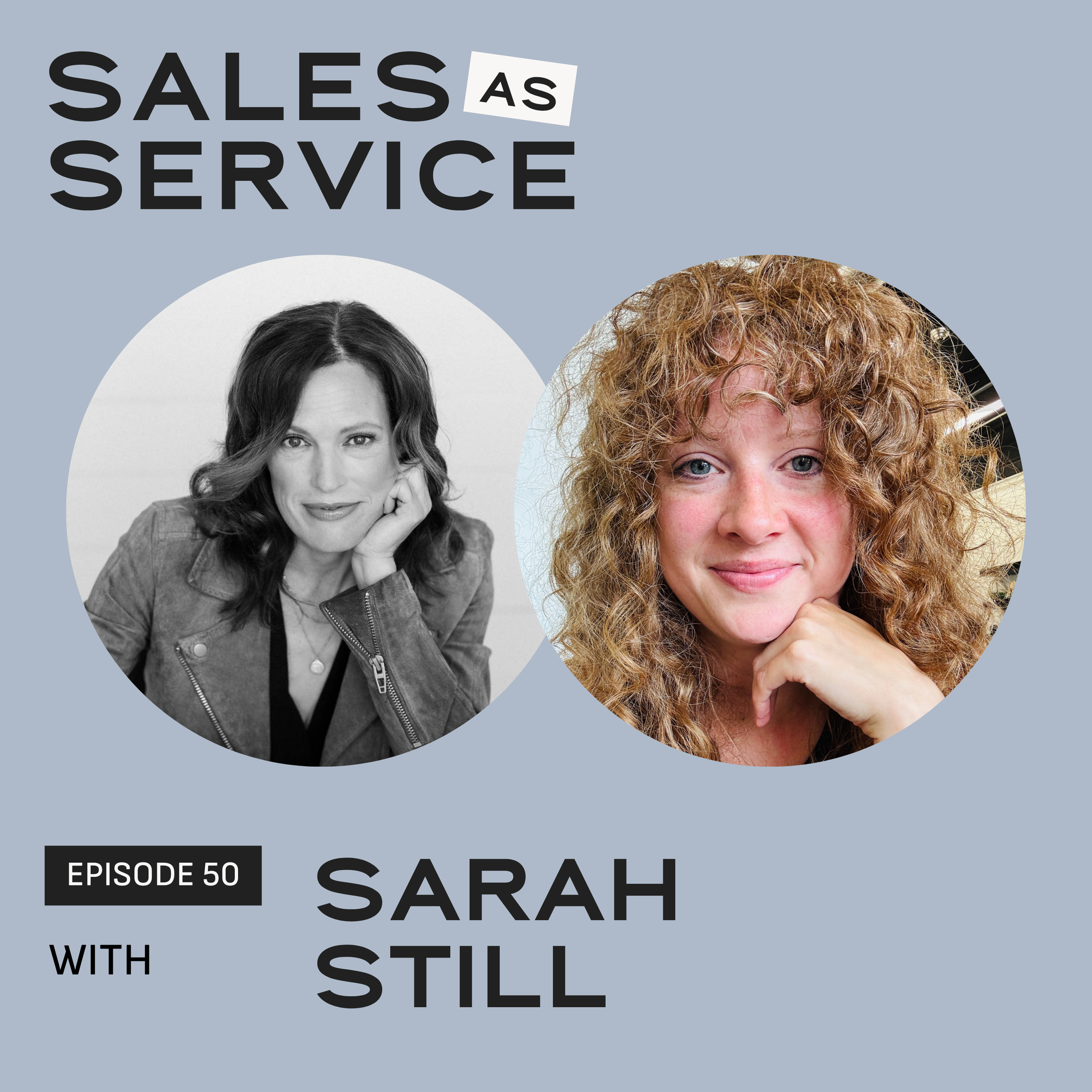
The Difference Between Running a Business and Building One with Sarah Still
EPISODE: 50

There's a point in every founder's journey where doing great work stops being enough. The habits that built the business — staying close to delivery, saying yes, solving every problem — become the ceiling.
In this episode, Sarah Still, COO and Enterprise Value and Exit Strategist with RAYNE IX, joins Tam to talk about what it actually takes to build an agency that doesn't depend entirely on the founder. Sarah brings close to a decade of experience scaling a women-led agency to nearly $10 million, and the conversation gets specific fast — from how values get operationalized into daily systems, to why most founders are still unknowingly showing up like employees in their own businesses.
This one is for any founder who has ever felt like they built a very demanding job instead of a scalable business — and wants a clearer picture of what changes when they start leading it differently.
In this episode:
Why defining your values means nothing if they aren't embedded into your operations and communications
The decision-making framework Sarah used to stop every problem from filtering back to the founder
How the way you show up in a sales conversation is a direct preview of how you'll show up inside the client relationship
The mindset shift from employee order-taker to expert who leads outcomes — and why it's about reconditioning, not confidence
What to do when you've outgrown the version of the business you originally built
LISTEN TO THE EPISODE HERE 👇🏻
-
[00:00:00] I think a mistake that people make is thinking you can actually build and create your culture. You can't, you can't say, "Here's our list of values, now this is our culture." That's not how it works. What you can do is say, "Here are the values that we're gonna live by. This is how we're gonna treat our clients.
This is how we're gonna treat our work. This is how we're gonna treat each other. And we're gonna make that very specific, and we're gonna embed that into all of our systems and operations and communications." And then as we enforce and protect that, the culture is now an outcome of that. Welcome to Sales as Service, the podcast designed to help you change your mind about sales, literally.
I'm gonna help you change the way you think about selling. I'm Tam Smith, your host, sales bestie, and pitch partner next door. If you're tired of bros with biceps telling you how to crush a million dollars in your sleep or battling imposter syndrome on your own, you've come to the right place. All you need to do is listen, then take action.
No gym membership required. Let's get started.[00:01:00]
Hey, Tam here. Most consultants and service-based founders are great at delivery. Referrals prove it. But referrals aren't predictable, and you've avoided sales because you think you have to be something you're not. But sales isn't pressure or cringey tactics. It's connection, starting conversations, recognizing when you can actually help someone.
The hard part, doing it consistently. That's why I built the VIP Lead Gen Pipeline System. It gives you a repeatable way to book three to five sales qualified meetings each week through relationship first outreach, not cold pitching. Ready to create opportunities on purpose? Book a free alignment call at studio349.com.
Sales is a practice. Let's make it consistent. There's a point in business where being great at the work is no longer enough. The same habits that build momentum early on, saying yes to everything, staying deeply involved in delivery, solving problems quickly, can become the very things that limit growth.
A lot of founders hit a moment where they realize, "I didn't actually build a business, I built [00:02:00] myself a very demanding job." Hey there, Tam here, and welcome back to Sales as Service. Today's conversation is about what actually changes when a founder starts thinking less like a service provider and more like a strategic leader.
Sustainable growth isn't just about getting more clients, it's about building the operational clarity, leadership structure, and decision-making systems that let a business grow without everything filtering back through you. Today's guest is Sarah Sill, COO, Enterprise Value, and Exit Strategist with Reign9, where she helps women-led agencies build more valuable, scalable businesses from the inside out.
We talk about the operational habits that create growth ceilings, why values and leadership need to be operationalized rather than just written down, how founders unintentionally position themselves as support staff instead of experts, and how the sales conversation itself is a preview of the partnership, and why that changes how you show up in it.
If you've ever felt caught between being the face of the business and the person holding every part of it together, this one's for you. Let's jump in. Sarah, thank you so much for being [00:03:00] here. Welcome to Sales as Service. Thank you for having me. And I always like to start these conversations, especially for listeners that are meeting you for the first time, tell us who do you help and how do you serve?
Okay. Yes. So my partner Kylie and I have an agency model type of consultancy that supports women who are building agencies. We help them build valuable agencies from two core angles. One, from a, from a strategic perspective, helping facilitate decision-making so that then we can support the integration of those decisions into their operations, make sure that everything that they need to have built in terms of their infrastructure is in place so that when they get to the point of wanting to exit their agency, they know they can get the maximum valuation that they, that they deserve and they've earned by their investment in time, energy, attention, and money.
And there's, I mean, to my knowledge, there's really not another agency that I'm familiar with that's focused on that right now. I don't know. I know there are a, a lot of advisory firms that advise on M&A, and that's definitely [00:04:00] an angle that we're passionate about because that's a big opportunity for women to get the value out of their agency at some point in the future.
But I think it is rare to find somebody that is willing to get into the weeds from an operationalizing perspective and, and actually integrate the decisions that are made so it's not just an idea that's- You know you should do. Like, no, let's go make this happen. Yeah. Let's, let's get, let's go. Let's get it done.
Yeah. Well, to your point, you work with a lot of founders at different stages of growth. What are some of the common patterns you see when businesses start hitting, you know, some sort of plateau in their growth? I mean, there's multiple bottlenecks that can pop up. Often the founder themselves is a bottleneck, and everyone knows that, everyone understands that.
Everyone knows they need to do something about that. But some of the really specific things that I see agencies not doing that, that really kind of push them over a plateau, like once they put these things in place, it's inevitable that they continue to scale and grow, [00:05:00] is first of all defining their specific values and expectations.
And so this is, this is not just talking about expectations from a delivery standpoint, but saying as an agency, what are the values that we are going to advocate for, we are going to preach and, and set as expectations, and then protect as we go forward. And so these are values that really inform this is how we do things here.
So I think a mistake that people make is thinking you can actually build and create your culture. You can't, you can't say, "Here's our list of values, now this is our culture." That's not how it works. What you can do is say, "Here are the values that we're gonna live by. This is how we're gonna treat our clients.
This is how we're gonna treat our work. This is how we're gonna treat each other. And we're gonna make that very specific, and we're gonna embed that into all of our systems and operations and communications." And then as we enforce and protect that, the culture is now an outcome of that. If we don't enforce and protect it, or if we enforce and protect parts of it but not other parts, the outcome of that [00:06:00] is the culture that you now have.
So you can influence the culture, but you can't just magically say, "Oh, this is, this is our culture. Let me go put it on our website and put it in our handbook." And you know, it's, it's, that's not how it works. But once that's so, so, so clear, every conversation you have, every decision you make now can come back to these black and white standards that you've set and say, "Okay.
Well, in this moment, I could handle this situation in these different ways. How am I gonna handle it? Oh, these are our values. This is how we're gonna handle it." Or team members, conversations become very black and white. This is the expectation. This is the standard we've aligned on. When you joined us, when you joined our team, you said you're aligned with these expectations and values.
What we're seeing in terms of behavior or communication or performance or whatever the case is, isn't aligned with this value. What do we need to do? Like, what, what's causing that? Is it personal stuff? Is it clarity? Is it needing a process? Is it..." Like, it could be any number of things, but you have to be able to have that conversation, [00:07:00] and defining your values gives you the basis for a conversation that's no longer personal, no longer like gut feel or, or scary because I don't really know how to address this, or I've not been clear and so now how do I say what I need?
No. Now we just are all on the same page, and if something is not aligned, we can go have a conversation and figure out what to do about it. And this, it's something you've like mutually agree upon in advance, and it's not like, like you said, it's not a, a one, like a one and done, "Okay. We post this on our website.
You know, great. Here's our..." It's a lived experience, and it's something, like it's a daily, weekly, you know, monthly, quarterly lived experience. Right. It has to be operationalized. I am convinced from my own experience as the COO of an agency that I grew to 10 mil- almost 10 million over nine years, like I operationalized our leadership to a level where now These conversations are happening on a consistent cadence, and so if something comes up that needs to be addressed, it doesn't feel like this big, scary, hard conversation that as a leader I'm c- I'm, I'm uncomfortable having or as a team [00:08:00] member feels out of the blue.
It's like, no, we're just, we're just talking about the things that need to improve or need to be addressed. We're, it's all rooted back in values that we've all aligned on, we're all aware w- of and familiar with. It's language we're using all the time. Then escalation or even terminations become a lot more straightforward because we don't have the, the like emotional confusion or the clarity.
Like, were we clear? Do we need to give a chance? What do we need to d- like it's just all, it's all straightforward. A- I think this is something regardless of what size, you know, your team, and w- even if you're just kind of solo, I mean, regardless of what size your team is, you can kind of revert back to the values that y- you've set for yourself in all of your decision making.
Yes. Yeah, because ultimately, a- again, if, if you're defining this is how we do things here, this is how I'm going to relate to you as my team member, this is how I'm gonna relate to my client, this is how I'm gonna relate to my work, and this is, we're all aligned on this. I might be a team of one, I might be a team of 100.
If we're all aligned on [00:09:00] that, then when it comes down to decision making, like What's your client criteria? Are we gonna accept this client? Or you have a client and things start popping up in that relationship. You, you need alignment across the board, so what you expect from the outside needs to also match what you expect from the inside.
If somebody doesn't align with those values, probably not the best partnership to have in place. Two questions. You're talking about operationalizing this and systematizing it. What was the cadence this was reviewed internally? And second question, is this something that was, like, you also recommend sharing with the client upfront in a, in any new client engagement?
Great questions. So I'm gonna start with your second question 'cause it's shorter. We didn't necessarily say, "Here's our list of 17 statement." Like, we had three core values, and then we had, we had definitions. You know, we had, we had breakdowns to say, "This is, this is who we are and what we value and what we focus on," but then h- what does that mean?
Because people will, people will translate an individual word into any number of meanings. [00:10:00] You have to be super clear. So we had 17 statements within that, and that feels like a lot when I say the number, but it doesn't when you understand, like, the picture. And so when we, when we onboarded a client, we did have...
We had an onboarding call where we would walk through a handful of those values that were ones that, like, directly connected to how we are gonna work with you. Like, these are the standards and values that we have. This is how we're gonna work with you, and these are, are our expectations for what this partnership looks like in return.
So that, just like, just like when you hire an employee, if you get down the road and it's toxic and negative and they're not performing the way they need to, they're not giving you the things they need to, you've already, like, set an expectation up front. You're just coming back to that rather than be like, "Oh, by the way, this is what we really need it to be like."
No, you say it up front when things are easy and everyone's excited, and then if it goes do- goes off the rails down the road, you're, all you're doing is coming back and saying, "Hey, let's, let's talk about, you know, that we aligned on this up front. This isn't the experience we're having. [00:11:00] Is there something behind that?
What's causing that?" And then try to solve it or hopefully be strong enough to move away from it. Yeah. Absolutely. It's a challenge. Okay, and then you had a, your first question was, oh yeah, how do you embed this in your system? So I mean, there's, there are so many ways, and as you, as your team grows and as, as you have different people in leadership positions, like, the, it kind of gets embedded in all of these subtle ways, but the, the core operationalized ways that, that we instituted it were a few different ways.
So for one, we had what we called... Well, let me, let me back up a little bit. Every direct report who had people that they were responsible for had to have a minimum of biweekly one-on-one check-ins with, with their direct reports. Sometimes it was weekly, depending on what the role was, how green they were, like, you know, what the need was.
But if it's somebody who's super stable and established, there's not a lot coming up week to week- Biweekly is fine. And so those, those had flexible but still somewhat [00:12:00] fixed agendas where we wanted to make sure that we're giving them the space and the time to raise anything that they need. Like, this time is for them.
But we also wanna make sure we are being thoughtful and intentional with that time, so if there is something we need to address from a coaching standpoint, performance standpoint, whatever, we're doing that soon, sooner rather than later. So we were very intentional about that. And then we had a quarterly cadence of what we called growth and feedback conversations.
So at this point, you know, we were large enough that we had an HR manager, and so we had her join. Well, we actually had a step where she and the director would, would collaborate prior to that conversation so that the director had a safe place to be like, "This is what I'm thinking and feeling, and this is what I'd like to share."
It's a lot easier to say the hard things to somebody else first. But then having the HR manager join that conversation gave accountability to the director, because now the director, who has already said this to someone, has to say it to the team member. You can't just skate by it, avoid it, sugarcoat it.
Like, "No, we're gonna have this conversation." And we have [00:13:00] somebody there who's kind of adding weight. So my perspective on HR is that it is, it sh- they should not be the bad guy. They should not be the ones coming in and having the hard conversations. That should be the direct leader. But there is a lot of protection there, and there is a lot of clarity, I think, that happens when there's a, when there's a person in this conversation.
It's not just one-on-one direct report and leader. It makes it more clear this is a situation that has to be figured out, otherwise we might have to take a path that none of us wanna go down. And so, but then the other, the other great thing about these conversations, 'cause they weren't negative, like almost ev- ever were they negative, but it was an opportunity.
We had a very clear agenda where the, the team member had questions for them to think through and bring feedback to the leader, and vice versa. And then it was focused on, like, what are your goals? Like, where do, what's your aspiration for the future? What's your ideal timeline? 'Cause we wanna make sure we have that in the back of our minds when we're considering hiring plans or, you know, team structure evolution.
Are we considering what our team wants, not [00:14:00] just what we're gonna have to hire for? And so having, having that thought process be a mutual collaborative thought process meant they feel like we're taking their, what they want into consideration. But it also gave us such a heads up into what are their life plans.
Like, are they planning on moving? Are they planning on having a baby? Are they planning on these things that are gonna impact Our capacity and capability, and then what are their, you know, what are their dreams and aspirations? Like, if they're thinking they wanna get into a role that we're just not gonna have available in three years, we know most...
Like, first of all, we wanna support you in getting, in reaching those goals, even if it means exiting our company. But now we also know we need to be looking at how are we gonna fill that role as that timeline progresses. So it's so many things that were valuable in that cadence, but again, all of the feedback ultimately was rooted in what are our values, because that's what we're comparing our experience to.
Like, does our experience with this person and their work align with the values that we've set in place And gosh, just the impact of doing that on a, you know, [00:15:00] regular cadence, I'm thinking, you know, sure, it's the, you know, the culture you're creating, but you know, it's also just in terms of talent retention, the quality of the, you know, products you're delivering because everybody feels, you know, invested in and supported to do their best work.
And it really, it really makes it obvious when someone's not aligned, because it's not... Like, that's not instinctive for everyone to be that kind- that transparent and that vulnerable and that accountable, and those were, those were three core tenets of our values were transparency, vulnerability, and accountability.
And if you're not comfortable with that, it's gonna become clear pretty quickly because these conversations are gonna be awkward and stilted and, you know, they're not really gonna be productive. But you can tell. You can tell when you're talking to someone who's like, "I'm on board. Like, here's what I wanna do.
This is my vision. I wanna participate in this way. Here are things I'm struggling with. Here are things I'm concerned about. Here are things that I need help with." Like, having those conversations just makes the whole team experience more meaningful for everybody. Shifting gears a little bit, a lot [00:16:00] of service providers, myself included, depending on what season of business I was in Have built themselves a very demanding job instead of a scalable business.
At what point do you see most founders kind of... Is there kind of a common point where a lot of founders realize this in, like, a certain stage of growth where it's like, "Ugh," like, "What have I created?" Yeah. I think any founder that is, that is, first of all, just getting off the ground, that is in their first, like, you know, first half a million of revenue, as they're getting to that point and then growing up to one million, like, they're...
You're feeling this way. You're like, "Did I just... Am I j- do I just own a job?" Like, "What do I really have to..." Like, "What benefit am I getting out of this? Because everything's dependent on me. I have to do all the sales and marketing and delivery and all the things." Team management. So when everything depends on you, really it doesn't matter what size you are.
If it all depends on you, it's gonna feel like you just own a job. And, and technically, that is what you own because if everything depends on you and [00:17:00] you are looking towards a future exit event, that's what any kind of evaluation is gonna reflect and say, "Well, if you are not part of this picture, your agency's not worth anything because it's you.
You're the value, and so I could just hire you or, you know, whatever." So I think less than one million, like, you're just feeling it naturally because you haven't... You're still building the resources to be able to start delegating and bringing the team on board that, that you can utilize. And a lot of times you're still kind of figuring out who you are, what you do, what, what your values are, like, who your best client is, what your best services are.
So, so it does feel like, "What? Do I own something of value at this point?" But it's not always about the number. I think it's also a combination of timeline. Like, if you're in the first couple years of your business, it's gonna feel like that a lot more than if you're five, seven, eight years in. You could still be sub one million, but now you've got clear systems, you've got team members that are supporting at very, very specific points.
And so it's, it's not [00:18:00] just a matter of how big are you or how long have you been b- in business or how much revenue do you have. It's about how have you structured the organization so that it's not all dependent on you, especially from a delivery standpoint. If your pipeline feels inconsistent, it's usually the sign of an outreach gap.
I created a free tool called the New Client Calculator to help you see exactly what it takes to land your next client. How many messages? How many conversations? How many follow-ups? No guessing, just clarity. If you've ever wondered, "Am I doing enough or just not doing the right things?" This will show you.
Head to studio349.com to download the New Client Calculator and find out just how close your next client really is. All right, let's get back to the episode You know, so for those founders that are, you know, sub their first, you know, half million or, you know, kind of in between, let's just say, you know, that half million trying to get to that first million.
You know, what habits will help agencies and service providers scale well? [00:19:00] And then what are some that tend to create, you know, the ceilings, those plateaus? Yeah. So I mean, I think my answer is relevant no matter what size. You could be one million, five million, 10 million. If you don't have these things in place, then you're going to quickly realize value as soon as they're integrated.
And as, I mean, the most obvious one as an operator, as a COO personality, like getting clear structures and, and SOPs and integrating those into your day-to-day, not being like, "Well, I have this SOP mapped out on paper." No, it has to be living and breathing. It has to be active in the platforms that your team is working in.
So I mean, I could go all, all day on that, but what I think is often missing, everyone knows they need that. What is often missing is what we were just talking about, which is the operationalized leadership where you create systems for how do you, how do you get these things off of your plate so that you can delegate and, and not just delegate, but also trust that it's going to be handled just as well if not better as if you were the one doing it.
One of the things that was really life-changing for our [00:20:00] agency, and I wish we, I wish we had done it sub one million, but I think we were more like six million when we put this into place. But really it was how do we, how do we delegate and operationalize decision-making so that it doesn't all have to filter up to me essentially?
Like how, how can we stop having to call in the COO for every client problem, every, every, every decision that has to be made? And so we defined a process that we called the problem-solving process, and essentially, you know, we're... I'm a huge Slack, like I love Slack. I live in Slack. I'm an operations person, so I'm gonna operationalize the shit out of Slack.
Like let's- ... let's make this really clean and clear. And so we put a, we put a problem-solving process in place that we trained to the whole team, and essentially it was a Slack template, like, like message template where it's we're gonna plug in these, I can't, I think it was six maybe, these different questions for whatever the scenario is.
This problem pops up, so the AM or the specialist or whatever [00:21:00] role is, you know, is kind of the point person on whatever this problem is. Whoever would be bringing it to my attention now goes into Slack and plugs in these, these conversation starters, and then they and whoever's relevant to the problem goes in and responds to those, essentially defining and clarifying this is, this is the information about the problem, this is what happened, but then also why do we think it happened, what should've happened instead, what do we, what do we anticipate or know that the client is feeling about this?
What needs to happen to resolve this? Like, they go through that whole thought process themselves, and then a lot of times that handled it. They don't need to escalate it. They can just handle it themselves. In the event they're like, "Well, we could handle it this way or this way, but we need to get approval," like if it's a refund or if it's, you know, something, something of significant value, then okay, cool, now escalate that to your direct report.
They can... They now have all the context, and they've probably already seen it in the works because we're all in Slack all [00:22:00] the time. You see the messages. But we're not engaging. We're saying, "We trust you to handle this. You tag us in when it's, if, if it's time to escalate." So then the director would do that.
If it was an event which it, it was very rare, honestly, that, that they then needed to escalate it to me, I s- again, alread- I saw the messages. I just held back. You know, you're handling this. But it also gave this transparency so that if they... You know, some people are more conservative than others, so if they're looking at a problem and they're like, "I think this is how we should handle it," and I'm like, "Go give them three f- three free months, not one free month," like whatever the problem is, if I think that if I would approve a more dramatic solution, then I, I already am in, I'm already aware, so I can just step in and be like, "Hey, cool.
I love your solution. What if you just did this instead?" And so it made it very easy. And instead of these things all blowing up and becoming complicated and it's like this person's talking to this person in DM, and this person's talking to this person, and this person's escalating it but they forgot to give some of the context, and so then you come in and [00:23:00] you're like, "Holy shit, what happened and why did this thing break down?"
It's like, "Oh, no, it's really not." Like, you know, it just helped bring so much peace to problems, and it also meant that now the team's empowered to essentially create, create the decision themselves, and then if we needed to come in and just put our stamp of approval on it, we could do that. Again, that's such a huge...
Just to be able to empower your teams to make their own decisions. And it's so easy to wanna s- like step in and do it for y- and as leaders, and you're really doing your teams a disservice when you do that 'cause you're not really giving them an opportunity to think for themselves, and that is like something And it's so empowering as a team member to have that, you know, know that your leadership trusts you to do that, and that you can do that, that you have the ability to do that is huge.
Right. Well, and yeah, my favorite part of it was the fact that we had them right there before we ever... Like, even if they escalated and called us in, before they did that, they had to answer what they thought should happen. And I know there's a lot of, you know, there's a lot of frameworks [00:24:00] around, like, bring me three solutions or br- but, but all of that just, I don't know, maybe it's my, I'm autonomous.
I assume autonomy. I w- I want other people to feel autonomous. I don't wanna feel like you have to follow... Like, I know that's what I gave them, was a structure, but I want it to feel collaborative. I want it to feel like we're, this is not a structure I'm like building. You put some guardrails in place.
Right. Yeah. Yeah. No, like this is just to keep, keep all of the information flowing 'cause it, it is so hard. And that's the, going back to, you know, integrating SOPs. It's so hard for our brains to retain everything that we need to do, everything we need to say, all of the bits and pieces of c- of things we need to communicate or things we need to think about.
And so it's so helpful to have something that just helps you, like, walk through that thought process. Even as an expert leader, like, for me to be like, "Oh yeah, this is how I can make this really clear for somebody on the other side." And I'm not, like, you know, the curse of knowledge. I know it, so why don't you know it?
No, just put it all out there. And then yeah, then it's collaborative, and it doesn't feel [00:25:00] like... It doesn't even feel this, like, like it's a, I'm bringing this to my boss type of conversation. It's like we're just having this group conversation in a, in a t- in a client Slack channel, and now we've collaboratively decided the, the solution and who's moving forward with it, and boom, go.
Yeah. Love that. Talk about just, you know, operational leadership and, you know, just systems to put in place as you, you know, grow. I feel like there's, uh, some subtle ways I see that it's really... You know, you get busy, you get, you know, overwhelmed, and you can kinda unintentionally start to position yourself as more support staff to your client or, like, service provider to your client versus, you know, expert consultant.
At what point, you know, does a founder really need to stop thinking like someone who delivers work- ... and start thinking like a leader guiding outcomes? I mean, as soon as they're a founder. Yeah. Yeah. Always. If you're a founder. Yeah. Let's, let's stop doing that. And I think this is something really that people can practice before they're a founder, before [00:26:00] they own a company, before they're a leader of people.
It's a, it's mindset. And so a challenge that, that I see often are especially agency owners who- maybe aren't like the classic entrepreneur mi- personality. Maybe they're someone who was bur- like a lot of agency owners are people who were agency employees. They were burned. They were taken advantage of.
Now they're gonna go start their own thing because they can. They're fully capable. So now they've gone and started their own thing. Or they worked within an agency. That agency owner wanted to exit, and so then, you know, maybe a few employees came together and bought the agency, and now they're the owners.
And not founders, but they're the, they're the owners and the leaders. And I think a real challenge for people stepping into that is they... It's not that they don't have vision, and it's not that they don't have confidence, but it's, it's a, it takes intentional transition from this employee mindset to an owner mindset, and from an employee order taker mindset to an expert I'm gonna tell you what should [00:27:00] happen.
And it, and it's not even like we're now order givers. We're ... It's still collaborative, but it's how you show up, and it's how you m- make decisions and how you take action. And this was something I had to... Like, I was a leader of a large team for several years, and then I stepped out and started my consultancy.
And I definitely had to, especially stepping into kind of the sales role, which founders definitely feel the pressure of retaining their current client relationships and gaining new client relationships. And so it can be really easy to be like, "Just tell me what you need and I'll figure it out. I'll make it happen."
Where really what I learned I learned this more because I'm very aware of how I feel. Like, I'm aware of my body, and when I show up in a way where I'm, like, feeling hesitant or feeling like I need you to tell me, like, that does not feel good, 'cause it's not me. So if I show up to a sales conversation, it's not that I feel like I already know the answer, I already know what to do, but I can show up in a way that reflects this is what working with me in the future [00:28:00] is gonna be like.
Like, I'm not... I'm, I'm gonna be very clear. I'm gonna be very direct. I'm going to ask questions. I'm gonna say what I think. I'm gonna make sure, you know, even the logistical things. Like, I'm gonna treat you like I would treat a team member because that's, like, I need, I need to make sure there's follow-through here.
I need to make sure there's decisiveness here. I need to make sure that we're willing to take action. And if we're not, then we're just probably not, like, we're not gonna have the impact for you that we wanna have, and so it doesn't make sense to move forward. So I, I had to work to be like, "Okay, I am gonna be...
I'm just gonna show up the same way I am inside of a team relationship as I do as a consultant or someone who's seeking to partner with somebody." And I think founders, especially ones that have been employees before, kind of get stuck in that employee mindset because they know their owners. It's obviously implied, but it's not instinctive to how they've been conditioned in the past or what they think is gonna work or what feels comfortable.
There's also, you know, so many mindsets from the [00:29:00] perspective of realizing, like, this is my role as the owner is to make sure my business is grounded and healthy and stable, not just to create this really great experience for my team, not just to create a really exper- great experience for my clients.
Those are, those are critical things. But as the owner, as the founder, you have to make decisions that are gonna support the health and success of your, of your agency long-term, not just satisfying the emotions and, and wants and desires of your team right now. And, and I think that often delays strategic decision-making because they're like, "Well, what are people gonna think about it?
What are people gonna feel about it?" Which is valid and I, there's nothing I care more about than the team of, of an organization. But at the same time, in order to retain that team and give that team a great internal experience, you have to have a healthy agency. So you have to make decisions that may not feel good in the short term, but ultimately are gonna set you up for, for ongoing future success.
And, and then you have to take action on it. Like you can't just [00:30:00] think and think and think and talk and talk and talk 'cause we gotta do it. We gotta put it in place, otherwise nothing's really gonna change. And for someone listening who feels like they've outgrown the version of the business they originally built, what is the first shift you would encourage them to make this week?
If you're questioning ... So okay, let me, let me make sure I'm understanding the question. Basically you're saying if I'm sitting in the seat of a founder and I look at my agency and I look at my day-to-day, I'm like, "This is not what I want anymore." No longer working. Yeah. This doesn't feel good anymore. I don't have the vision, I don't have the excitement.
That's what you're saying, like what do you do then? Yeah. Yeah. Oh, okay. So this is flash- this is a flashback really for me, 'cause it's been a while since I looked at this myself or, or I've talked about it. But I put together a, based on, based on a coaching program I went through a couple years ago, I put together a life-led vision guide for agency owners to use to help them go through a thought exercise to help define what is it that you do want.
Because I think it's really easy to look at what is currently happening in your [00:31:00] agency and be like, "Well, based on what I already have in place, based on the people I already have, based on the clients I already have, here are my options. This is what I could do. This isn't working for me, here are the things I could do."
And I think sometimes we either don't carve out the time or we get scared or we don't think there's reason to sit down and be like, "Okay, if I c- if I just scratched everything, what would this look like? What would..." And it might be that the things that would change or that are missing aren't even like big drastic things.
It might be how is your time spent day-to-day? What are, what's your involvement with clients? What's your involvement with team? But if you don't sit down and really think through that, you risk either just throwing away something that has potential and value That you've already invested so much time and energy into, or you don't actually get, you don't get to where you want because you're just thinking about the options that you currently have available.
And I, I just, I think there's a lot more possibility than we often give ourselves or our, our abilities credit for. [00:32:00] I love the call-out of giving yourself the space to think, because it's like in that moment it's so easy to lock yourself into just what you see right in front of you. And to be able to widen your lens to see the possibility is a, a, a huge call-out.
'Cause it is, it's like you just, you're so deep in it, you just can't... And, and to that point, you know, you're so invested in what you have, you just can't see, you know, options outside of what's right in front of you, which is also, you know, Kylie has said it's very hard to read the label from inside the bottle.
Getting in touch with someone like you to actually, like, help decipher what's going on here. Yeah, 'cause just ha- just taking the space, whether it's yourself and just flow writing and being like, "Let me just..." It's, it's crazy how much is inside of us that, that until we start writing it out, we don't even realize.
Like, we have the answers. We already know the answers. Like, the clients I work with already know what they need. We- it just has to kind of come out in a certain way. And then it has to, you know, be decided and take action on, and that's what we support. But at the end of the day, like, [00:33:00] journaling is, is huge, just to get it out, or having, if you're a verbal processor, yeah, just talking to someone and being like, "Here's the things."
And talking to somebody who can, who doesn't have a preconceived idea of where they think you should go, what they think you should do. Like, you know, this is still about you and your life, but who can kind of, like- discern based on the things you're saying what questions are gonna help you kind of pull the threads apart and figure out, like, what's really at the root of the, the dissatisfaction or the frustration rather than I'm stressed and I'm overwhelmed, and this isn't what I wanted, and n- I just have to go take drastic action to fix it.
Yeah. Like, definitely don't make any decisions from that state. Right. Right. Well, let's jump into our fast five. Your I can't live without it software or app. Yeah. I think I know. Slack. For sure. Yeah, so like I said, we... I had a full structure, so we had, we had internal channels for every client, external, you know, shared channels for every client that, that would part- participate with us in that way.
And then every core business [00:34:00] function, and sometimes those business functions were broken out, more specific. As your, as your agency grows and you have more complexity, then you want to get more narrow so that things are, it's very, very clean and clear. Two things I'll call out about Slack. I won't go into, like, step by step how to do it, but if you guys don't have it in place, just Google it.
Slack will tell you how to do it. Using the unread function, game changer. If, because as COO, I was in every single channel, and I wanted to be in every single channel, but I don't need to be, like, drilling into every channel. So the unread feature, if you don't have that turned on, if you don't know what it is, Google it.
It's amazing. And then organizing channels by sections, which is something an operator's gonna do. Probably not something a founder is naturally gonna do. But it, it is so helpful from a, just a mental load organization standpoint. Best advice you've ever received about sales and business development. Yeah.
So I actually worked with a sales coach when I started my consultancy for, I don't know, six months or so. And he was a Sandler coach, and I pushed back [00:35:00] on a lot of his things, 'cause I'm like, "I'm not a salesperson. This feels like a game. This feels manipulative. Like, I don't, I'm not gonna sit in that kind of space and feel that kind of way."
But it was a fantastic learning experience, and he was, he was really great about helping me understand how to take these tactics and make them actually like, no, this is how we, this is how we connect and communicate. Like, the, it's not manipulative. There, it can be. Like, people can use it that way, but anyway.
One of the coolest things that came out of that was any time I have a conversation with somebody where there are future next steps, so y- you're talking about sales process, you typically have, like, I had to have two calls. I'm, I'm not trying to listen to you and pitch to you on the same call because I get into this, like- Tension, anxiety.
No. I just wanna connect with you, hear from you, and then I'm gonna go think about it, and then I'm gonna come back. So on that first call, I'm not leaving that call until we've decided are we having another call and when is it? Then when we have that call... Like, my sales process was the, was essentially a discovery [00:36:00] call.
I called it a breakdown call. Like, let's break down, let's get it all out. And then the breakthrough call, because in my experience, every breakdown leads to a breakthrough. And so that's when we would talk about here's how we could potentially partner together. And sometimes people are ready to say yes in the moment, and sometimes they're not, and that's fair.
Like, I need to think about things, so I fully expect you need to think about things. So the next call would be, if we're moving forward, would be an alignment call to talk about terms and, you know, logistics and all of these things. So if they weren't ready to commit and move into the alignment call, I would say, "Okay, cool.
Let's schedule a no or go call." And it would be 15 minutes, it would be two or three days later, and it's literally just a chance for them to think about it and then tell me, "Yes, let's move forward," or, "No, let's, w- we need to hold for whatever reason." And that was magical because first of all, it like, it, it took away all of this anxiety that I hear from sal- salespeople all the time about like, "I got ghosted," or, "I don't know what they're thinking," or, "I don't know when to reach out and I [00:37:00] don't know how many follow-ups to do.
I don't know if I should follow up." I'm like, "Why didn't you just schedule a call?" Like, and that part of that was coming out of what I was talking about earlier, like, this is how I show up with an employee. I mean, like, we're gonna schedule this next conversation because we need to think about this. We need to prosper.
I'm gonna lead my client partnerships in the same way that I'm gonna show up within that partnership. So this is like the... I look at it as How do I stay consistent with myself? And really from a sales perspective, it's like how do you make sure you don't have to get into all of that second guessing and overthinking, and like if you're gonna systematize it, then make it clean and simple.
Absolutely. Make it really easy for your client to say, you know, yes, or this is not the right time, not the right fit. Yeah. And I made it very clear throughout the whole process, if it's a no, it's a, like fine. I'm not here to convince you. I'm not here to pressure you. I don't care. Like, I mean, I care about you and your success.
I'm not trying to, I'm not trying to force something that shouldn't, shouldn't happen. No. Your morning routine [00:38:00] must-have? Yeah. So I have a 12 and a 14-year-old, so I'm not like get... I'm not doing all of the morning stuff. I'm not getting... I need my full hours of sleep. But I do, I do every morning mix up beetroot powder and creatine, and I feel like it does like help my brain turn on.
And so then when I sit down, I feel a lot more focused and, and, and kind of sharp. And then protein, obviously protein's like the big buzzword right now, but it is critic- it actually is needed. And then something that was recommended to me several months ago is saffron, which is, I think, a flower. So it's just like an herbal supplement.
And the person that recommended it to me has, I can't remember, it's either ADHD or ADD or something like that, and she's like, "This really helped my ability to focus." And it also helps with mood. And I will say like the, the first three, four months of this year have been really personally challenging for me.
Currently going through a divorce, like there's been a lot of very stressful, scary things that have happened, and I think having a supplement [00:39:00] like that in my routine really helped me stay stable. Like, I didn't, I didn't have the high highs and the low lows. I was more like, "Okay, let me process this. Let me think about this."
I can't say that for sure is only because of that, but I think it was very helpful. It didn't hurt. It didn't hurt. I give it to my daughter because, you know, when we're going through puberty, sometimes that stuff is helpful. Strong emotions. Yes. Yes. Your walk-on song, the one song that always pumps you up.
Yeah. I mean, I love music, so there's so many... This was a really hard one for me. I actually just went onto my Spotify and was like, "What feels good right now?" And the one that popped out was Damn, It Feels Good to Be Me by Indie Grammer. I love it. And if you only had one hour each day for business growth, how would you spend it?
Yeah. So I mean, ideally- I'm not the one doing business growth, but the way that I've done it, had the most success, is just by, like, trying to take me and put it into a post and, and add value. Like, share sh- any of these num- you know, ideas that we [00:40:00] talked through today, how can I share this out with the community of people that I want to help and impact?
And then, you know, the whole LinkedIn thing, like comment and question. But I li- I like, I don't force it. If I see something that grabs me, then I'm talking about it. If I don't, I'm moving on. And where can people find and connect with you online? 'Cause I know they're gonna want to. Well, LinkedIn. Sarah C.
Still I think is what it's under. Yeah, I just... That's pretty much where I, where I connect with people. Yeah. Thank you so much for being here. Thanks for having me. This was fun. What I appreciated most about this conversation with Sarah is that it challenged the idea that growth is simply about getting more clients or working harder.
Eventually, growth starts exposing the places where a business still depends too heavily on the founder, the communication, the decision-making, the client management, the problem-solving. And for a lot of service providers, there comes a moment where you realize, "I'm still operating like the person doing the work instead of the person leading the business."
When you're deeply skilled at delivery, it's easy to stay buried in [00:41:00] execution instead of stepping into strategic leadership. So for this week's Sales as Service challenge, I want you to identify one place where you're still showing up like a service provider instead of a strategic partner. Maybe it's over-explaining instead of making a recommendation, waiting for permission before leading the conversation, reacting to client requests instead of guiding outcomes, or staying so buried in delivery that you're not thinking strategically about the business itself.
And then ask yourself, "What would this look like if I approached it as the expert in the room?" Practice leading one client conversation differently this week. Be more direct. Make the recommendation. Guide the next step. Own your expertise. And if that feels uncomfortable, that's worth paying attention to.
Sarah made the point that this isn't really about confidence, it's about reconditioning. A lot of founders came up as employees trained to take direction. I was one of them. Shifting into someone who gives it takes deliberate practice, not just intention. Leadership is often communicated in the small moments, long before it shows up in a title.
Before we wrap, [00:42:00] this episode marks our 50th episode of Sales as Service. When I started this podcast, I had no idea where it would lead, and these conversations have become one of the most meaningful parts of my business and a reminder that so many of us are navigating the same questions around growth, leadership, visibility, and building businesses that actually support the lives we wanna live.
Thank you so much for listening, for sharing the show, and for being part of this community. We're gonna be taking a short break over the summer and returning with an all-new season on July 29th. In the meantime, I'll be re-releasing some favorite conversations from the past 50 episodes, the ones that challenged me and continue to resonate long after the recording stopped.
If you missed any along the way, it's a great chance to revisit them. And until next time, remember, sales is an act of service. It's about what you give, not what you get. And when you serve well, the ROI always follows.
You've just listened to the Sales as Service podcast, [00:43:00] the podcast to help you shift your mindset around selling. If you liked what you heard, be sure to hit subscribe and share it with a friend, because we're all about more sales awesome and less sales awkward. See you next episode
MORE OF A READER? 👇🏻
Most founders don't realize they've built a job until the job gets exhausting.
It usually happens gradually. The business grows through referrals, great work, and word of mouth. The founder stays close to delivery because that's what clients are paying for. Every problem gets routed back through them because they're the one who knows how to solve it. And for a while, this works.
Then it stops working.
The clients keep coming, but the capacity doesn't grow. The team expands, but decisions still require founder sign-off. Revenue stays relatively stable, but growth feels out of reach. And somewhere in the middle of all of it, a quiet realization surfaces: I didn't build a business. I built myself a very demanding job.
This is the conversation I had with Sarah Still, COO and Enterprise Value and Exit Strategist with RAYNE IX, on a recent episode of Sales as Service.
Sarah spent nearly a decade scaling a women-led agency to close to $10 million. What she built along the way wasn't just a client roster — it was a set of operational systems that made the business function without her in every room. And she's now helping other agency founders do the same.
Values aren't culture. They're infrastructure.
One of the most practical things Sarah talked about was how founders misunderstand the role of values in a business. Posting them on a website or putting them in a handbook doesn't create culture. What creates culture is enforcing and protecting those values consistently — embedding them into hiring, client onboarding, team feedback, and daily decision-making.
When values are operationalized that way, they stop being aspirational statements and start functioning as a decision-making framework. Difficult conversations become less personal. Performance issues become clearer to address. Client relationships have defined expectations from day one.
Decision-making shouldn't live with one person.
The other bottleneck Sarah sees consistently is founders who have become the single point of contact for every problem. Her agency solved this with a structured problem-solving process — a simple framework that empowered team members to work through a situation before escalating it. Most of the time, they resolved it themselves. When they did need to escalate, the relevant context was already documented.
The result was a team that felt trusted and a founder who wasn't constantly being pulled out of strategic work to manage operational fires.
The employee mindset founders don't realize they're carrying.
Perhaps the most useful reframe in the conversation was this: the shift from service provider to strategic leader isn't primarily a confidence problem. It's a conditioning problem.
Many agency founders came up as employees. They were trained to receive direction, execute well, and stay in their lane. When they start their own businesses, that conditioning doesn't automatically disappear. It shows up as over-explaining instead of recommending. Waiting for client approval instead of guiding the next step. Positioning themselves as support staff when the client actually needs an expert.
Sarah's point was that this shows up in the sales conversation too — before a client ever signs. How a founder shows up during the sales process is a direct preview of how they'll show up inside the relationship. Which means the shift has to happen earlier than most people think.
What to do when you've outgrown what you built.
For founders who feel like the business no longer fits the direction they want to go, Sarah's recommendation was simple: create space to think without the constraint of what already exists. The options available when you're deep inside the business will always look smaller than the ones available when you step back and ask what you'd actually build if you started from where you are now.
That kind of clarity doesn't come from working harder. It comes from giving yourself permission to think like an owner.
✦ YOUR SALES AS SERVICE CHALLENGE
Identify one place where you're still showing up like a service provider instead of a strategic partner.
Maybe it's overexplaining instead of making a recommendation. Waiting for permission before leading the conversation. Reacting to client requests instead of guiding outcomes. Or staying so buried in delivery that you're not thinking strategically about the business itself.
Then ask yourself: What would this look like if I approached it as the expert in the room?
Practice leading one client conversation differently this week. Be more direct. Make the recommendation. Guide the next step. Own your expertise.
If that feels uncomfortable — that's worth paying attention to. This isn't about confidence. It's about reconditioning.
RESOURCES & LINKS
Learn more about RAYNE IX
Connect with Sarah on LinkedIn
Simply sales with the VIP Power Hour - download the FREE guide
Learn how to consistently book 3–5 sales-qualified meetings each week - book an Alignment Call
SUBSCRIBE & REVIEW
If you loved this episode, please take a moment to subscribe and leave a review on Apple Podcasts! Your support helps us reach more creative agencies and service pros who need these insights. Thanks for tuning in to Sales as Service—see you next week!

TAM SMITH
I’m Tam Smith-Sales Growth Strategist and Founder of Studio Three 49. I help service-based founders find, connect with, and convert right-fit clients through predictable, sustainable outbound sales solutions.
No pushy pitches. No bro-marketing. Just simple, structured systems that turn connections into clients.