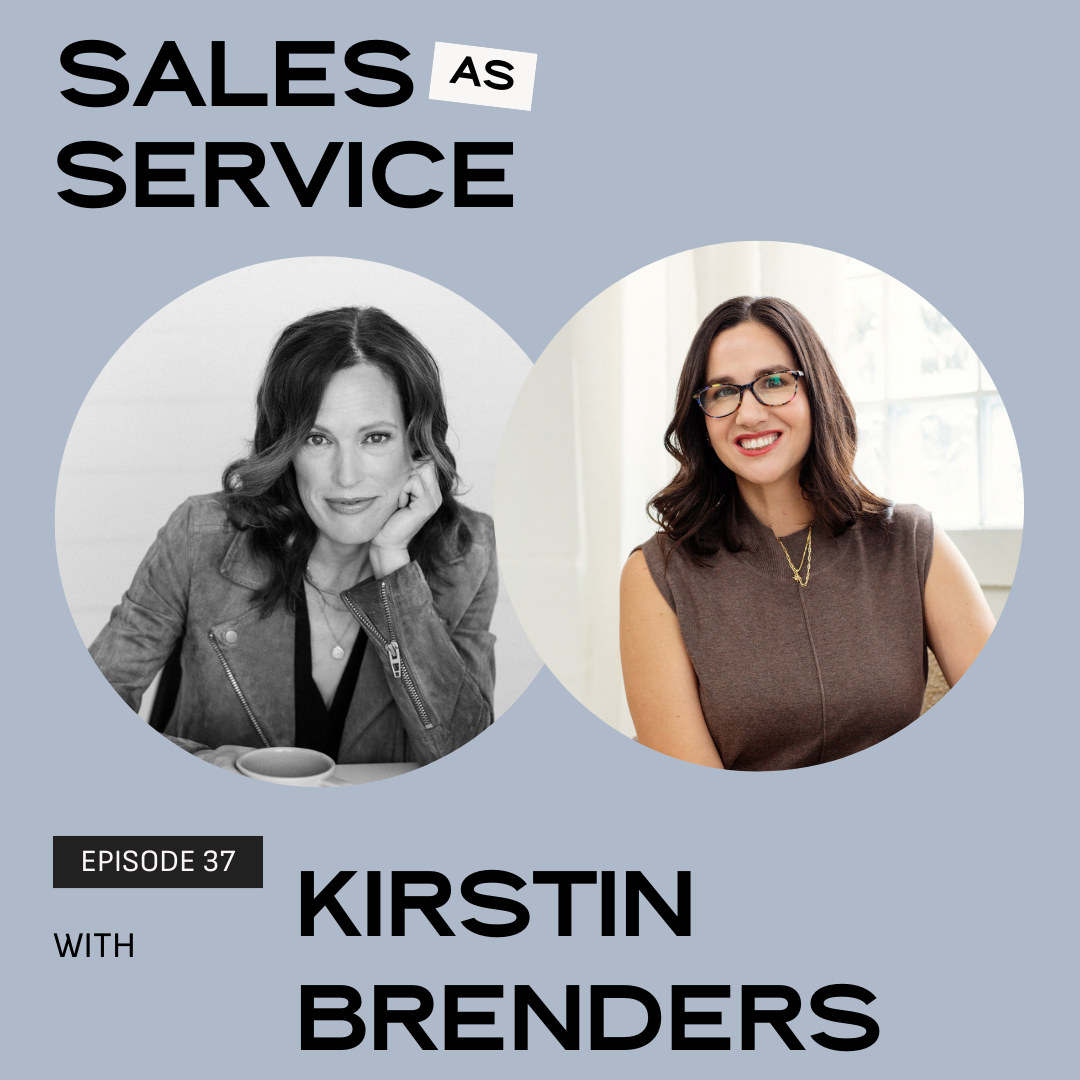
Initiate, Don’t Wait: The Mindset Behind Sustainable Growth with Kirstin Brenders
EPISODE: 37

For so many women — especially those of us who built our careers inside structured environments — waiting to be chosen becomes second nature. We wait for the promotion, the opportunity, the client, the seat at the table.
But at some point, the waiting stops working.
In this episode of Sales as Service, I sit down with Kirstin Brenders, Online Business Mentor and Founder of Kirstin Brenders & Company, to talk about what shifts when you stop waiting for permission and start initiating your own growth.
Kirstin shares her transition from corporate manager to entrepreneur and how she now mentors women who want to pivot into online business — without building an empire, burning out, or abandoning their values.
We explore:
Why high-achieving women are conditioned to wait to be chosen
The hidden cost of “more time” thinking in corporate and entrepreneurship
How visibility builds confidence before revenue follows
The difference between selling for validation and selling from self-trust
How one small proactive step can unlock new momentum in business
LISTEN TO THE EPISODE HERE 👇🏻
-
Speaker: [00:00:00] There was this moment of feeling like, but I've spent so much time building my career. I went to college for this, and there was just this feeling of like, but I've put so much time and money into this, and why would I walk away with that? On the Flip It side, it was like, no, all of these things. Are transferable, right?
Everything that I've done is through volunteer work to, to being a corporate manager. It's all helped me build my business.
Speaker 2: Welcome to Sales Is Service. The podcast designed to help you change your mind about sales. Literally, I'm gonna help you change the way you think about selling. I'm Tam Smith, your host.
Sales bestie and pitch partner next door. You're tired of bros with biceps telling you how to crush a million dollars in your sleep or battling imposter syndrome on your own. You've come to the right place. All you need to do is listen, then take action. No gym membership required. Let's get started.
Before we get started, this [00:01:00] show is shaped by real questions from agency owners and service based founders who want sales to feel relationship first and values led minus the cringe. If you're wrestling with warm outreach, follow up. Asking for the opportunity or how to lead your own sales process without sounding like a salesy weirdo, send your question in, find me on LinkedIn, or email me at Hey tam at studio three 40 nine.com.
If it's something you are dealing with, chances are you're not the only one. Alright. Let's get into today's episode. Hey there, and welcome back to Sales as Service. I'm your host, Tam Smith, sales growth strategist and founder of Studio 3 49. For so many women, especially those of us who built our careers in structured environments, waiting for permission becomes second nature.
We wait to be chosen for the promotion, the project, the client, the seat at the table. We learn to perform, to exceed expectations, to prove ourselves, and for a while, that works until it doesn't. I know that moment. Personally, I had always wanted my own [00:02:00] business. I grew up watching my dad build his, and I admired the independence.
But for years, I believed entrepreneurship meant inventing something external, that it had to be an external product, a storefront, or something separate from me. I didn't see or understand that my experience was the business plus at that time, I had the title, A Great Salary plus Commission, the 401k with stock options.
I was doing what I quote unquote. Should do, regardless of how unfulfilled I might be. Entrepreneurship just didn't seem like a real option. It only took two layoffs in less than 90 days, a family health crisis and a global pandemic to finally push me out of the nest. And not because I felt ready, but because waiting was no longer an option.
And what I've learned since working with female agency owners and service-based founders is this the moment you stop waiting to be picked for someone else to decide your path. Everything changes your energy, your confidence, your growth, and my [00:03:00] guest today, Kirsten Briers, understands that Pivot deeply once a corporate manager and now a proud corporate Escapee.
She's the founder of Kirsten Briers and Company and an online business mentor who helps women step beyond the non to five and build calm. Purpose-driven online businesses. They actually love her story didn't begin with a master plan. It began with curiosity. A simple LinkedIn post about a virtual business that planted a seed, then came the research, then one client, then another.
Not an empire overnight, just one brave decision at a time. And today we're talking about what happens when you stop waiting for permission. Because growth doesn't come from way to be chosen, it comes from choosing yourself. Here's my conversation with Kirsten. Kirsten, thanks so much for being here. It's great to see you.
Speaker: Oh, thank you so much. It's an honor to be here.
Speaker 2: I always like to start these conversations off with the same question. Tell us in your words, who do you help and how do you serve?
Speaker: Okay. Well, who I help is, I like to say kind of the, my former self, who I was four years ago. So I help women pivot out of corporate and [00:04:00] start online businesses.
So I would say women in their forties that feels. Stuck in their career and looking for a new opportunity and wanna create that opportunity for themselves.
Speaker 2: Ugh, I'm so excited for this conversation. You've described yourself as a corporate escapee. What was the moment that made you decide to trade the corporate ladder?
For entrepreneurship.
Speaker: It wasn't like one moment, it was actually a series of moments that came to be, and here I am today and like one of those moments where I've recently shared with you is just like being in corporate and coming back from mat leave and seeing somebody post, like, I just launched a virtual business and it, I believe it was January, maybe February of 2020, and it, it was like that.
Seed was planted in my head back then before pandemic. And I remember thinking, what is a virtual business? And then very lo and behold, we were all scrambling a month and a half later figuring out how to work from home. [00:05:00] And you know, I think that for me was a silver lining that, that it proved that I could.
And so it was like I said, a moment and then that. Hearing that word, virtual business like that, that seed was planted and it got roots and started Googling after I left my job at at Quick Corporate, started Googling virtual businesses and just the whole world of opportunities opened up for me and I just, I would say research.
Took action, started working one-on-one. At that time I was offering basically project management services and just started one foot after, you know, one foot in front of the other and was like, I could make a career out of this. I could make, could make this into a business. And so that was a, I think it was a series of moments over a year.
Speaker 2: I so. Appreciate and celebrate the fact that you took that first right step. Because I think you know that, we think we have to have it figured out. And until you take that, you know, first right step and then you see like this whole [00:06:00] world opens up the opportunity in front of you, but just having the, the confidence to take that, you know first right.
Action. In your work, what patterns do you see among women who maybe are ready for that change but just don't know where to start or how to take that first right step?
Speaker: I think the pattern that I will. Will continually see is that they think that they need more time or when things slow down or you know, after this one project ends, or maybe if that new boss comes in, it will work out.
Like it's, the pattern I always see is just like, give me more time. And one of the things that I've experienced or, and now no, it's not more time. You don't need more time. You just need to kind of shift your thinking and, you know, take a, take a chance and start doing things differently. 'cause you to do things to change your life or your career.
You gotta do things differently.
Speaker 2: Do you feel like it's expressed as. Time, you know, waiting for the quote unquote right time. Is there something else underneath that? What beliefs or [00:07:00] fears is really underneath that that keeps women from waiting?
Speaker: I think the other time, but for me it was kind of like, um.
There was this moment of feeling like, but I've spent so much time building my career. I went to college for this. I was here in my corporate, this role for 18 years, right? And there was just this feeling of like, but I've put so much time and money into this, and why would I walk away with it? And so that for me was.
Something that held me back for a couple of years when I would get into these crossroads of like, where, where's this kind of going? But I think it was thinking about, it was like kind of an opportunity cost sink or along those lines where I just would have wasted time or something like that. And it's like on the, on the flip side, it was like, no, all of these things.
Are transferable, right? Everything that I've done is through volunteer work to, to being a corporate manager. It's all helped me build my business. So once I had a shift that thinking that I wasn't giving [00:08:00] things up, that I wasn't starting over, that was another theme that came up in my journey. I just, that feeling of starting over.
It felt so good to start with experience and that it's mine. Like this is now something that no one can take away from me. You know,
Speaker 2: I can so relate to that. 'cause I had always wanted to be an entrepreneur. I just had always been, I think just maybe, you know, the, the home that I grew up in, my dad was an entrepreneur and you know, seeing that example of mine, I always wanted something of my own.
But I had been looking outside of myself. You know, thinking it had to be some external product or service. And I, you know, appreciate you pointing out that, you know, all of your experience, you know, it's easy to get precious about it and get attached to it, but that all of that transfers and I, you know, would love to believe that it, you know, wouldn't have taken a, you know, global pandemic and a family health crisis for me to realize that.
But, you know, it was in that moment that I, you know, when I started to, you know, explore and learn about, you know, the opportunity for online business. Like, oh wait. Like I have a skill set and [00:09:00] experience that, you know, is transferrable that has a lot of value that Oh wow. People would, might actually pay for.
Speaker: Yeah.
Speaker 2: So I really, you know, appreciate that, that all of those skills are totally transferable for, you know, something that, you know, you can create that your own many, myself included, you know, service-based founders start out saying yes. To anything that pays and I, you know, probably it's kind of part of the process, but how do you help the folks that you work with evolve from, you know, taking what's offered to confidently, you know, start asking for what they actually want and then pricing that accordingly.
Speaker: Yeah, that for sure we do. When I'm working with some of the women in this mentorship container, we. I really spend a lot of time focusing and making sure that they're not offering what they don't like. Right? Like they're, do you know how we're like, oh, well I should do, like, you know, I should do this 'cause that's what I was known for.
But if that should do drains you and [00:10:00] it's really doesn't light you up, don't go off and do it, right? You're just, you're just, you're just taking one job and creating another for yourself. So we really focus in on energizers and, and trainers and this is like tasks. Services, just roles in general. So we focus in on that.
So we make sure that they're gonna offer what they are. Like that lights them up and you know, what comes natural to them. And then we just, I encourage them to get their foot in the door, right. Some roles. You know, you're looking at market research and we're saying, Hey, in this particular niche that's, or this business, you know, virtual assistants costs around this range, online business managers, this range, or social media.
So we kind of look there and then set the price according. To what they need to, to take home. So just because like, okay, well that's what a, a VA charges or, or a fractional business manager charges, we have to make sure that that is aligned with what you need to collect. Mm-hmm. So, uh, so we focus on, on, on that as [00:11:00] well.
And then I encourage them just to get the experience, ask for it, and then. Be communicative about it, of like, this is what's working. If you are hired as a service provider and say, this is what's working, this is not working, having a quarterly check-in, just like you would've done with a boss, having that quarterly check-in and say, you know what?
I am, I'm really feel like I'm serving your business. Better when I take on these responsibilities and just showing a little bit of ownership and that you're thinking on the behalf of their business. That goes a long way. It just absolutely goes a long way and helps you raise your rates. It helps you ensure that you're doing the right tasks for that business, that that is just copacetic for both your business and theirs.
Speaker 2: As someone who you know. Created a business, you know, based on what I could do. And it was really, you know, two plus three years into the business and I'm, you know, grateful that I had the opportunity, you know, at that point to say, Hey, what do I really wanna be [00:12:00] doing? And realize, you know, that I had built something again based on what I could do and not necessarily what I wanted to be doing.
And I wonder if, if you see this where. I'm coming from that mindset of, and I, maybe it's just kind of my, you know, success equals suffering. And that if I, if it's not hard, you know, it doesn't have value and I'm not doing it right, and it has been a real, you know, I'm still working through the mindset shift.
You know, now, you know, I'm focused on sales, business development. I'm doing, you know, what I really love and what lights me up, but there's such an ease and flow to it that. I like, I would do it for free if I can't, 'cause this is a business, but, right. You know. Do you find that the, you know, that when women are starting businesses and like moving from that, you know, grind to flow or you know, the effort to ease that it is that there's a difficulty with that or kind of a common struggle with that?
Speaker: A little bit. I think for where I'm, where I'm kind of. Taking your story or thinking about your story is that it [00:13:00] just, the fact that we, we, we are kind of similar where we started off with offering a set of services and we got our foot out there, right? We, we started a business, we did what felt natural to us coming out of those corporate roles.
And what's great about, about being in the business, it's like, you're like you, we did our big pivot, but now we're just evolving inside of the role. And so once I started. Like other opportunities came up about how else I could be of service, where it started coming out, where more of the mentoring and the coaching is what was being asked of me.
I just, it was like that felt natural, that felt like the right place to go and I just started shifting into that direction and. I think some of the things that I experience with some of the women I'm working with, they're, they're worried about like, oh, I'm gonna launch a business. What happens? I'm gonna launch it and I'm gonna say, I'm X and I decide I don't really like X, I don't like the title.
Right. [00:14:00] Because I think a lot of people are always shifting into that title. Like they, they wanna title, but what happens they don't like X. And I was like, you can change your mind.
Speaker 2: Yeah.
Speaker: You're, it's okay to change your mind and evolve you. This is you evolving. Mm-hmm. Yeah.
Speaker 2: Hey, Tam here. Most founders and agency owners are great at delivery referrals prove that, but referrals aren't predictable and you've avoided sales because you think you have to be something you're not.
But sales isn't pressure or cringey tactics. It's connection, starting conversations, recognizing when you can actually help someone. The hard part. Doing it consistently. And that's why I built the VIP Legion app, powered by Flow Chat. It helps you build a repeatable practice that supports three to five sales qualified meetings per week, ready to create opportunities on purpose.
Book a free strategy session at Studio three 40 nine.com. Sales is a practice. Let's make it consistent. You're your own success story. Uh, others, uh, within your work that you can share are just kind of. Making that, taking that first step and then the, the businesses [00:15:00] that they've created through the work that you're doing.
Speaker: Yes. One of the women that I'm just really excited to work with, she, I met her, she started her virtual assistant a few months before I actually met her, and so she just. I don't even remember how she discovered a virtual assistant program, but she is in corporate still. She has really no rush to go out of corporate, but she, she just felt this calling that there was something else that she could be of service and doing.
And so she started dabbling with virtual assistant. She and I luckily met inside of a, a Facebook group. You know how we're doing networking inside of, um, online platforms. She and I met there, and then she came in under, you know, into my program and just seeing the amount of like, confidence, growth, just transformation, just completely open.
I, she's just completely open to now seeing her career in a different way and she's able to, she's able to do virtual [00:16:00] assistance as a side gig, right? And, and still have her corporate job and just. Really stay, like, learn about is this for me is entrepreneurship for me. And that's the, that's what I like to showcase to other women.
It's like, you don't necessarily have to do what I did and totally burn yourself out. 'cause that's what I did. I just pushed and I just pushed and kept on pushing and corporate where I burnt out. And I, and this path of becoming an entrepreneur was actually through the ashes of being burnt out. But for her, she's.
She's doing both right. And she's kind of building that kind of a portfolio career, if you will, of different things. So if something does happen at work and there's a layoff or a merger, she no longer feels like she's stuck, or if she just feels like she has a whole new door and a whole new path of opportunity.
Mm-hmm. Ahead of her.
Speaker 2: I love that. And it, it, it kind of, there's a lot of different paths to entrepreneurship and there's just a lot of different past periods. Like, like, you know, I don't know if women of a certain age or [00:17:00] I just, I'm included myself in that, that, you know, we are just, the culture we were brought up in, you know, it's the limited choice as far as the past you can choose.
It's like, you know, you have this, this, this, and then now it's like in the. Oh wait. You know, we can create our own. And even inside of that, once you make the choice to create your own, there's so many different paths within the path. You know, it's just, again, it comes back to taking that, that first next step.
You know, if a listener was to take, like after hearing this episode, like what is. The first are just one small step. If this is speaking to them in, you know, some way that they could take to, uh, to get started, what should it be?
Speaker: I, I think it would kind of reclaim a little bit of time making, if you are feeling like you're, you're, you're burnt out in corporate, it just kind of reclaiming a little bit of time where you have some space to start dreaming and thinking about bigger things.
And then I would. Say, get around people that inspire you and get, [00:18:00] for me, it was like the moment I like really kind of stepped out of my niche, my networking circle, and started getting in new rooms with just different women doing different things. And that's when, like I said, like I, I didn't know a lot of entrepreneurs in my, in my day, uh, before this, but once I ex got exposed to.
So many different entrepreneurs like that. Again, it just opened the doors for me. So I would say kind of reclaim your time. Give yourself a little bit of space to get out of your comfort zone and get in different rooms. Just network it locally with different people or find Facebook groups. That was my go-to,
Speaker 2: and I'll say that.
Do that sooner rather than later. Was, you know, it was just kind of the climate of COVID when I started the business, you know, it was, uh, just by the nature of the season we were in, you know, wasn't able to make those, you know, initial, you know, face-to-face connections and, you know, it was not. In the habit of, you know, doing that virtually.
So it was kind of a, a new muscle to build, but, you know, getting in those rooms, whether they're [00:19:00] virtual or in, in person, and making those connections and just, you know, meeting those people that are doing it and maybe, you know, a little bit further ahead that, you know, can give you some inspiration.
Outside of the Facebook, were there particular Facebook groups that were most valuable to you? Like what were the groups that were the, the most valuable for you? That season?
Speaker: Yes. In that season, when I was focused on my niche of architecture and interior design, that was my background. So I was helping entrepreneurs run their, their small design firms.
So I was in groups that were focused to that niche and, and that was one of those things when I was taking time off, I was realizing when I was in those Facebook groups, I was responding to interior designers and architects about how to hire and how. With tools and project management, I kept on realizing, I'm like, I keep on answering.
There's a theme of why I always feel like I can jump in and provide value. And so I was like, that's kind of the, the little light bulb for me that said I could do X. Uh, so at that time it was in those niches dedicated to the service that I [00:20:00] was used to, uh, corporate wise and where I started, where I wanted to just.
Support those types of businesses. So if you, if a woman is listening to this and there is a particular niche, you know, I would start there trying to find those Facebook groups and then eventually it evolved out to other entrepreneurs. It's like a wider group of entrepreneurs that I would find different groups through there.
Speaker 2: And it still comes down to just, you know, making connections and building relationship.
Speaker: Absolutely, yes.
Speaker 2: Yeah. Yeah. Is, is there any, like, what piece of advice would you give your, like your early stage business self? Like the whole, like, if I, if you knew then what you know now, what would you tell yourself?
Speaker: Oh, there's so much. Yeah. There's so much. I always like have, I guess the, my moment or I think the, the advice that I would have is entrepreneur. Ship is, it is hard, right? You're coming. For me, that meant so much visibility and marketing in a way that I never had to do in my corporate career. And, and so yes, entrepreneurship I think is [00:21:00] difficult and sometimes not gonna lie.
And sometimes I'd be like, Ugh, I just wish I could just like not think, just, you know, just give the, give me the projects, not go after things. On the, even on my worst day as an entrepreneur, it's still better than, than my worst day, you know, like than a day in corporate for me, because it's, again, it's something that I'm working hard towards.
It's my goals. So I would say get used to being challenged. And that's what the point is. Like you are going to be challenged. But I mean that in a very, and I mean that in a good way. Like I do mean that in a very good way. So just get under, get into the mindset of this is gonna be challenging, but it's gonna be worth it.
Speaker 2: Talk a little bit about that visibility piece. 'cause I, I still have conversations with, you know, brands and businesses that that's a nice to have, you know, versus a, you know, a necessary part of, you know, business development, you know. This business development. So talk a little bit about that visibility and piece and why it's so [00:22:00] important.
You know, as a, a founder and entrepreneur
Speaker: or, I think even now, like, or, or in corporate, I, I just really encourage people to, whether you like it or not, I think we all are personal brands. Like I, I kind of am becoming that mindset of believing those That's true. So I think just. Being authentic, especially now in a sea of AI and things like that.
Just, I just really love it when people show up and just like talk about what they're up to and just like, oh, this is, I went out networked or did lunch with so and so and it was a great day and this is what I, what we talked about. Like I feel inspired by those people showing what a day in the daylight looks like in their life.
So with the visibility, I think it's just. Showing yourself and what, you don't have to be an expert at things. You just have to be human. And if you can start exercising or, or kind of creating that muscles and putting in the reps when you do get into entrepreneurship, it'll be a little bit easier to [00:23:00] start marketing, start writing about yourself.
Start writing about the services that you provide and things like that,
Speaker 2: you know, and it's in you and I come from the same, you know, back industry background in, uh, design build. And it was, you know, talking about that, just the, the behind the scenes, you know, day in the life images. Like even in my, you know, I guess retail showroom sales days when I was still with Anne Sachs, you know, we had, you know, the big branding, you know, or marketing department engine that had the glossy, you know, marketing photos.
But what. Was always the most valuable was just the iPhone snaps of, you know, the product or, you know, you're at a job site and you took, you know, the, the completely unpolished, just, you know, quick snap of, you know, real life, real example that pushed every projects over the line more than the glossy, you know, marketing.
I mean, both are necessary, but as far as like what really, you know. Close the deal. It was the just real behind the scenes, you know, images that, you know, people respond to and react [00:24:00] to. And I consistently, you know, see that in any of the, you know, when I was still, you know, doing strictly just content marketing in the early stages of my business and even, you know, now it's like the.
We, we wait so long to think it has to be polished and perfect. But I've seen the data, you know, I've seen the analytics and I know, you know, as far as impressions and reach and what people respond to, it's the, just the real photo, the imperfect photo of a real life moment, you know, and, and maybe a lesson learned in that, that people just, people wanna connect with people,
Speaker: that's for sure.
And same with my analytics. When I was reviewing things over the summer and there was. Uh, the speaking opportunity. I was at a conference. I was one of the panelists, and so there was the promotional stuff and then I was sprinkling in personal stuff. It was those personal. Posts that got the, the most reach or, and the, with the, the better analytics, if you will, like the, the, the reach or the engagement that we all wanted, or it was that at another speaking opportunity.
It really wasn't the best picture of me standing in front of the group of women that I was speaking [00:25:00] with, but it was like, that's what the room felt like that day and. That was the one I posted and it wasn't the one polished with me standing, you know, in front of the presentation or anything like that.
But again, that one, that, that post that I shared, that it got a lot of engagement. So that's the message that I like to tell the women who are just getting started. The good news is like when I started my business, that was still when the, you know, that stocked imagery, there was a lot of, you could be a member of.
Stocked images and there, you know, there's that perfect Instagram square image that you could post. And it didn't, back then, it didn't have to, like, you could post a picture of a sunset and talk about whatever, but you know, like, so that was the day where it was like all stocked images and it felt a little bit easier of a lift though.
But that's what I do laugh about it now. And like, luckily now, it is not the pretty polished Canva templates. It's the personal, it's, it's like behind the scenes, like you said, a, a quick iPhone snap.
Speaker 2: Kind of going back to just getting that first client to actually, you know, have a [00:26:00] business. Where did your first clients come from?
I mean, I'm assuming it's probably just your network, but you know what, what has been, you know, in your own business now, your business development, you know, what has been most successful for you?
Speaker: My first client did come through Facebook. I, it's surprising I reached out because I was in the industry and I was like, I reached out.
I tried to, you know, I, I was told like, you know, if you wanna have, you know, one client, it's kind of a number game. If you wanna find one client, you gotta reach out to 40 people. You know, some, something along those lines, right? So I tried to reach out to a lot of people in my network since I was still in that niche.
And I had a lot of people locally say they just weren't ready for my type of role or. A lot of like, oh, you should go talk in so and so, and I would, and but me being virtual based, that just. That wasn't in their vocabulary of, or, or what they were looking for. So I just went into Facebook and like I said, those groups.
So the first two clients came through Facebook groups that, like I said, I just kept on [00:27:00] answering questions. I started realizing, I kept on answering a particular woman's questions that she had. She kept on crowdsourcing a lot in her business, and I finally just sent her a DM and said, I would really like to hop on a call and just introduce myself.
We've, we've shared so many messages now, but. I would like to introduce myself and see if how I can be of more service so you don't have to keep on, so you don't have to ask these questions in Facebook and you have a sounding board and boom, we, we booked a call and that was my first client.
Speaker 2: I love that.
And you value led and you're proactive and value led and you, you made a connection, built a relationship, and then made a connection, started a conversation, you know, builds relationship. Then you had that opportunity. Identify opportunity to be able to. To help her as a client. I think that's, that's fantastic.
That kind of continue to be how you're building the business. What other tactic strategies have been successful for you?
Speaker: Yeah, getting on a directory, then, um, evolving and then when I kind of settled in like, yes, this was, that was that niche that I was serving was inside that kind of more online business.
Management. I did get into [00:28:00] a directory where that was a, a great, you know, backlink to my website, great leads. People would reach out to me from there. And then just the power of showing, like on Instagram, talking about a testimonial that I got from a client and, and, but telling the story of how these kind words came to be, that.
Just one post that was great. It was like, you know, I was offboarding one client and it helped open up the door to work with two different clients at the time by just sharing something like that. But now that since, since I've been pivoting out and leading more into the online business mentoring space that has now just through.
Instagram and basically connecting with other women on LinkedIn. LinkedIn has been actually a little bit more fun than it used to be for me, when back in my corporate days, so I'm enjoying LinkedIn now. Uh, but now it's just, uh, conversations and, and speaking, being in networking groups, having the opportunity to speak on stages or or on podcasts.
That's what's been [00:29:00] helpful now to help share what I do and women find me.
Speaker 2: Yeah, and it goes back to that visibility piece. You know, I kind of think it's, it's not a. Either or as far as, you know, the visibility and then the, you know, kind of proactive outreach, networking as kind of parts of a whole where you know, you're doing those things to stay visible where people can find you, but then proactively reaching out to start those conversations with, you know, potential right fit clients, you know, partners, collaborators, they've worked together just to keep that, you know, that engine.
So you're constantly, you know, have new opportunities for continued growth. Let's, let's jump into our fast five. Your, I can't live without IT software or app.
Speaker: It's my HoneyBook CRM platform. So it helps me send invoices, you know, sign contracts digitally. It really is like become a right hand, like of an assistant for me so much down that it.
It helps schedule my, my meetings that I have, my, my mentoring one-on-one calls. And what's great is that I do have a, [00:30:00] like a note taker with it and it can record conversations and it'll help me say, Hey, remember, these are the things that we talked about, but more importantly, what I do like also about it is.
It's using AI and it's helping me create notes that I have been able to turn into blog posts or social media content, and that has been like I, I guess where when something saves me energy and saves me time, that becomes like, oh yeah, that's my favorite app. So that would be my, that would be mine.
Speaker 2: Best advice you've ever received about sales and business development?
Speaker: For me, being the architecture business from a long time ago, I know they said, you know, you think you're in a design business, but you, you're really truly in the people business. And, and so even still, I will always stick that with me. It's not about the, you know, it's not about coaching or previously designed or whatever it is truly serving.
The people that you work with in building relationships with
Speaker 2: your morning routine must have,
Speaker: uh, slow, very slow mornings. I, I, I have to have a slow morning, kind of one of the reasons [00:31:00] why I started my business, but he said a slow, like you said, a morning routine. Must have having breakfast with my son.
Speaker 2: Your walk-on song, one song that always pumps you up.
Speaker: I'm not sure if you're familiar with a band called LCD Sound
Speaker 2: Systems. Mm-hmm. Mm-hmm.
Speaker: Okay.
Speaker 2: Yeah.
Speaker: Any, their music? Yeah. There's, um, a couple of songs. I can't think of the name right now, but they'll always get my feet tapping. Yeah. Just a smile on my face.
Speaker 2: Agree,
Speaker: agree. Mm-hmm.
Speaker 2: And if you only had one hour each day for business growth, how would you spend it?
Speaker: Get in a room with, with other women? Whether that's virtually or locally, like I know I'm predominantly online, but the best thing that's for been for my mental health running this business is building a local community around my online business.
Speaker 2: Mm-hmm. Well, and to that point, where can women find you and connect with you and get in the room with you?
Speaker: Ah, yes. So I am here, uh, I'm based in Houston, Texas, but I also serve, uh, virtually, you know, across the US and Canada. But where they can find me is my website, kirsten briers.com. I [00:32:00] am on LinkedIn and I'm also on Instagram.
Speaker 2: Thank you so much for being here. This has been such a valuable conversation.
Speaker: Thank you. Thank you so much.
Speaker 2: Thanks again to my guest, Kirsten, Brenda, and no matter where you are right now, if you're feeling stuck in an unfulfilling corporate environment, if you've just had your first thought about starting something of your own, if you're in the messy early stages of trying to land your first clients, or if you've been at.
This for years, and it just hit a plateau and aren't sure what your next move is. What Kirsten modeled and what I've lived myself, is that growth doesn't begin with the perfect plan. It just begins with one small, tiny action. So here's your sales as service challenge for this week. Stop waiting and take the next smallest visible step.
Not the five year strategy, not the full rebrand, not the complete pivot. Just the next small action. Send the message you've been drafting. Reach out to someone you admire. Share one post that reflects what you actually care about. Ask for the meeting instead of hoping they'll book it. [00:33:00] Raise your rate on the next proposal instead of discounting preemptively.
One small act of initiation, because growth doesn't come from being chosen, it comes from choosing yourself. Until next time. Remember, sales is an act of service. It's about what you give, not what you get, and when you serve well, the ROI always follows, I'll see you right back here next week on Sales is service.
Speaker: You've just listened to the Sales Is Service Podcast, the podcast to help you shift
Speaker 2: your mindset around selling. If you liked what she heard, be sure to hit subscribe and share it with a friend. Because we're all about more sales. Awesome. And less sales awkward. See you next episode.
MORE OF A READER? 👇🏻
There's a pattern many high-achieving women follow.
We build strong careers inside structured environments. We learn how to perform, how to deliver, how to exceed expectations. We raise our hands. We stay late. We earn the trust. And eventually, we're rewarded.
Until one day, we're not.
The promotion doesn't come. The role feels smaller than it used to. The work no longer fits the life we want.
And still — we wait.
We wait for the right timing. We wait for more clarity. We wait for someone to notice we're capable of more.
Waiting feels responsible. It feels strategic. It feels mature.
But at some point, the waiting stops working.
In my recent conversation with online business mentor Kirstin Brenders, we explored this exact turning point. Kirstin spent nearly two decades in corporate leadership before a simple LinkedIn post about a "virtual business" planted a seed. That seed turned into research. Research turned into small experiments. Experiments turned into clients.
Not because she had everything figured out. But because she stopped waiting to be chosen.
Her story isn't dramatic. There was no overnight reinvention. Just a series of small decisions made consistently.
And that's what makes it powerful.
I relate to that shift. I always wanted my own business. I grew up watching my dad build his. I admired the independence. But for years, I believed entrepreneurship required an external idea — a product, a storefront, something separate from my existing experience.
I didn't see that my expertise was the business.
And if I'm honest, I didn't think it was really an option for me.
It took two layoffs in less than 90 days, a family health crisis, and a global pandemic to push me into exploring what had quietly been possible all along.
Not because I felt ready. But because waiting was no longer an option.
What Kirstin and I both experienced — and what I now see in the agency owners and service-based founders I work with — is that the real pivot isn't tactical.
It's internal.
When you're waiting for permission, your business reflects that energy.
You hesitate to raise your rates. You soften your positioning. You overdeliver to prove your worth. You hope referrals will appear instead of initiating conversations.
When you stop waiting, something changes.
You reach out instead of hoping someone finds you. You clarify your offers instead of listing everything you could do. You speak about your work with ownership instead of apology.
And sales begins to feel different.
Not pushy. Not aggressive. But intentional.
Kirstin now mentors women — particularly moms who feel stuck in their careers — to explore online business in a way that feels calm and sustainable. One of the most powerful themes from our conversation: you don't need a five-year plan to begin.
You need the next small step.
That might mean carving out two hours a week to explore possibilities. It might mean responding to questions inside an online community to build credibility. It might mean sending a direct message to someone you've already been helping informally.
It rarely requires a dramatic leap.
And this applies whether you're still in corporate, in the early stages of business, or years into entrepreneurship but feeling plateaued.
Growth doesn’t begin when you feel ready. It begins when you decide to move.
Sales, at its core, is not about being chosen. It's about clearly articulating how you help — and giving someone the opportunity to say yes.
That only happens when you decide you no longer need permission to start.
And often, the most powerful move isn't the loudest one. It's simply the next small action.
Send the message. Ask the question. Start the conversation.
Not because you feel fully ready. But because waiting isn't serving you anymore.
✦ YOUR SALES AS SERVICE CHALLENGE
This week, identify one opportunity you’ve been quietly waiting on — a collaboration, a client, a raise, a conversation, or a new direction.
Instead of waiting for clarity or confidence, take one small visible step:
Send the message.
Ask for the meeting.
Share the post.
Raise your rate.
Not the five-year plan. Just the next right move.
Sales growth doesn’t come from being chosen. It comes from choosing yourself.
RESOURCES & LINKS
Join us for the next SAS LIVE Office Hours Event!
Simply sales with the VIP Power Hour - download the FREE guide
Learn how to consistently book 3–5 sales-qualified meetings each week - Book your free strategy call
SUBSCRIBE & REVIEW
If you loved this episode, please take a moment to subscribe and leave a review on Apple Podcasts! Your support helps us reach more creative agencies and service pros who need these insights. Thanks for tuning in to Sales as Service—see you next week!

TAM SMITH
I’m Tam Smith-Sales Growth Strategist and Founder of Studio Three 49. I help female agency owners and service-based founders find, connect with, and convert right-fit clients through scalable, sustainable outbound sales solutions.
No pushy pitches. No bro-marketing. Just simple, structured systems that turn connections into clients.