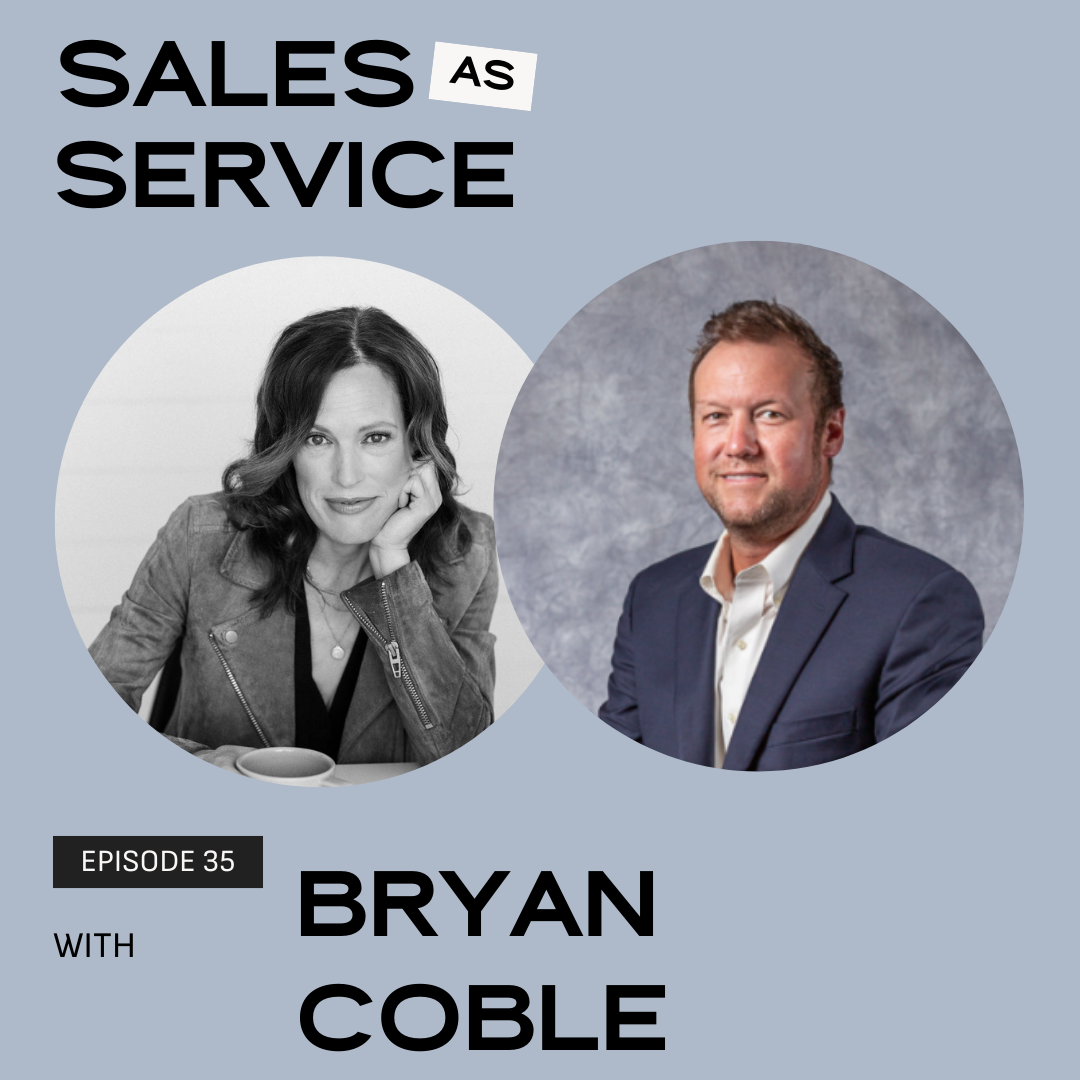
Stop Waiting. Start Initiating: Building Predictable Pipeline Through Relationships with Bryan Coble
EPISODE: 35

Sales has never been more automated.
AI can write your emails, personalize outreach, and schedule follow-ups. But as tools multiply, something important is getting lost: the discipline of direct, human connection.
In this episode of Sales as Service, I sit down with Bryan Coble, President of ACC Go to Market Consulting, to unpack why relationship-based business development is not passive — it’s an intentional, structured practice. We talk about the difference between marketing visibility and real pipeline creation, how AI should enhance (not replace) relationships, and why predictable revenue is built over years, not weeks.
If you’ve been waiting for pipeline to “kick in,” this conversation is your reminder to stop waiting. Start initiating.
In this episode, we cover:
Why automation is increasing noise — and making genuine connection more valuable
The difference between posting content and practicing business development
How to build an intentional referral network (beyond just client referrals)
Relationship-driven KPIs that matter more than vanity metrics
Why consistent outreach over time creates sustainable, predictable revenue
LISTEN TO THE EPISODE HERE 👇🏻
-
Speaker: [00:00:00] Investing in sales and sales growth and marketing and all this stuff. It, it takes time. The three most successful business development sellers I've ever worked with, they, they've worked for me, I've worked for them. They'll tell you any opportunity they go into. It takes three years to set up, it takes three years of all this hustle and all this business development work.
To where you get to a point of predictable revenue.
Speaker 2: Welcome to Sales is Service. The podcast designed to help you change your mind about sales. Literally, I'm gonna help you change the way you think about selling. I'm Tam Smith, your host Sales Bessie, and pitch partner next door. You're tired of bros with biceps telling you how to crush a million dollars in your sleep or battling imposter syndrome on your own.
You've come to the right place. All you need to do is listen, then take action. No gym membership required. Let's get started.
Before we get started, this show is shaped by real questions from agency owners and service based founders who want sales to [00:01:00] feel relationship first and values led minus the cringe. If you're wrestling with warm outreach, follow up. Asking for the opportunity or how to lead your own sales process without sounding like a salesy weirdo, send your question in, find me on LinkedIn, or email me at Hey tam at studio three 40 nine.com.
If it's something you are dealing with, chances are you're not the only one. Alright. Let's get into today's episode. Hey, Tim here and welcome back to Sales of Service. We are living in a moment right now where sales has never been more automated. AI can write your emails, schedule your follow-ups, even personalize your outreach at scale.
I even recently saw an ad bragging about removing face-to-face client interaction entirely from the sales process. And I gotta say, I respectfully disagree. Success in business development has been so distorted to this point by this idea of instant gratification. We've been conditioned to think that if we post once, send one email or launch one funnel, the money should show up yesterday, but sustainable, profitable growth just doesn't work [00:02:00] that way.
It still comes down to people conversations, intentional relationships, because here's the hill I will die on when everyone is minimizing human interaction. Genuine connection becomes your competitive advantage. The more digital we become, the more valuable real conversations are, and that's exactly what today's episode is about.
My guest today is Brian Cobble, president of a CC Go to Market Consulting. Brian is a people-centric analytical operations focused leader who has spent more than two decades building and scaling B2B sales organizations. He works with founder led and growth sage companies to install the sales infrastructure that supports real.
Predictable growth, not just activity, but momentum. And what I appreciate most about Brian's perspective is this referral-based growth isn't passive. It's active, it's deliberate, it's structured. It's not about waiting to be served opportunities. It's about initiating them. In this conversation, we unpack the difference between marketing, visibility, and true business development.
Why direct outreach is still a discipline, even in the age of ai. How [00:03:00] to refine your KPIs beyond just money in the bank. Why predictable revenue is built over years, not weeks. If you've been waiting for pipeline to show up, this conversation is your reminder to stop waiting and start initiating. Let's get into it.
Hey, Brian, thank you so much for being here on the sales of Service. It's great to see you again. It's been a minute.
Speaker: Hey, Tam, thanks for having me. Great to be here. Looking forward to the conversation.
Speaker 2: Definitely. Well always start these conversations off by asking, tell us who do you help and how do you serve?
Speaker: Okay, who do I help and how do I serve? So I help businesses. Primarily owners. So CEOs, business owners grow their companies at a high level. I do that through sales, so sales infrastructure, getting them world class in their sales organization. So I'm ultimately a builder of sales organizations. So how I serve, only how I serve is in growing those businesses.
It's bringing in the fundamental best practices. [00:04:00] Of growing a sales organization. So that all ties in with sales operations. Really, it's very heavy in, in sales leadership and the the service part really what gets me up in the morning is growing and helping those sellers in the sales organization, so.
Working with the VP of sales, the sales directors, the heads of marketing to en ensure their, their careers are growing and the business is growing at the same time.
Speaker 2: Just for clarification, you're typically working with organizations that are, is there like a revenue threshold, like kind of size of organization that you're coming in to partner with?
Speaker: That's a great question. Typically, yes, it's 5 million up to 50 million. I've got some larger clients on a larger size, but generally. It's in that, that lower middle market strike zone.
Speaker 2: I would say like regardless of the size of the organization as far as the discipline and practice of sales and like what it takes for, you know, consistent, sustainable business development is relevant regardless of, [00:05:00] you know, everything from, you know, solo professional all the way up to like, you know, 50 million plus organization.
That discipline is really the same. As far as like sales process, I mean, there may be some things to tweak, you know, obviously the size of the team and the organization, but as far as the, the underlying discipline and practice, I think it's all kind of rooted in the same thing.
Speaker: You are accurate.
Speaker 2: Yeah. And I say that like, because I don't want someone listening to this conversation to tune out and think, you know, okay, if, if you are a solo professional or you have a small team of, you know, 10 or less that this is not relevant for you.
Absolutely. You'll use the same principles to grow your company, you know, regardless of the size.
Speaker: Right. It's, I'd say, for clarity.
Speaker 2: Mm-hmm.
Speaker: Yeah. We, we don't want the honest to think, Hey, this is just for startups, or this is just for larger companies, or even industry. I mean, it, it can be very industry agnostic.
I would say anything business to business. Okay. There are 35. World class things that the commercial sales organization [00:06:00] needs to have in place. Those 35 things are, it's that infrastructure. So I won't get into like the details of it, but it's all the blocking and tackling, not to use a football analogy, but it works.
This is what, this is what world class companies do, and this is what startups, founder led companies do to scale up and, and you're right, you know, all go into business is a different size and it's. It's either building or fixing, but I'm taking them all back to those 35 world class fundamentals. That's what I do.
I've seen it. I've been in. Multiple organizations led sales organizations. I've exited two tech companies. It all comes back to those that, that fundamental baseline, that center of gravity, no matter where they're at. It can be an easy go back to basics or we can do some building. So, uh, just to tie into your comment there
Speaker 2: Yeah.
And talk about the, the 35 fundamentals when you're going into, you know, a new business, you know, new client, partner. Kind of what are your, the, [00:07:00] are there the same consistent sort of three to five that you are like, looking at first or evaluating first to see kind of the health of those and what are they?
Speaker: It it's really in a, in a high level, let's say it's three things. So what I do is whether the business knows it or not, I mean, I tell 'em this, I, I, I initially, if I'm meeting with a CEO or a founder or president, I'm gonna audit their sales organization, right? And. How I kind of tie that into the 35 world class things.
On the front of it really is, it's always the strategy. And this may sound basic, so like strategy is one, and that is, hey, as simple as it is, can we articulate the business can a valuable way, right? So call it your elevator pitch. Call it whatever you wanna call it. That's the main thing. I I, I, I really see when I'm auditing, it's not just, Hey, can, can you, as the owner talk about the business?
Can your sales resources talk about the business, but what's unique and [00:08:00] valuable? And are we verifying that with the clients? Like, did the clients see the business the way you do? So that's the strategy piece. And it, it's a little more complex than that, but that's the, that's the basics of it. The second really is just the.
The, the process side, right. So, you know, when I audit it's, most businesses will say they have a sales process, but when I ask the. The awkward question, can you show me the sales process? Mm-hmm. Most people can't do that, right? Uhhuh Or they'll say, Hey, I've got, uh, my CRM. Okay, great, you have a CRM, but here are the stages.
I'm like, no, that's not the sales process. That's a stage. Literally what is the buyer journey and then how is, you know, how are we moving our prospects and clients through that in a tactical way? Is it, is it operational? So that's the process side. The third thing is really the. I, I'll kind of bundle up in just the overall leadership and management of the sales organization.
So that's where I look at, you know, that's, that's the people [00:09:00] side, you know, really what the management structure is in place. So I'm trying to uncover, hey, are we just, you know, do we have a, a seller or a couple sellers out there just. Doing the sales motion and what's the management structure like? So what good looks like in management structure?
It truly is a it, it's a coaching mentality, right? So if there's a sales manager, b VP of sales director, yeah. What I often uncover is, is like, hey, we promoted the top salesperson into the sales manager role. Okay, great. And then guess what's happening Now None of the sellers are performing and that sales manager's just.
Managing the deals best they can. So I'm a, on the sales organization side, I'm trying to uncover really what the management structure is and if the leadership, I mean maybe the founder, maybe a sales manager. Are they managing people and growing them or are they managing deals because they need to be managing people and growing them to [00:10:00] get the quota versus them try to super wrap and.
And, and go that route. So those are the three things I, I look at
Speaker 2: all three. Super important. And I appreciate that you led with strategy because I see so often I feel like that gets skipped or there's not enough time spent on it because people are jumping to like, you know, the fun part of, you know, the tactic of the, the tactics are fun, actual, actionable, you know, how are we gonna market and promote this?
So you'll get it in front of, but. In front of our, you know, prospective clients and you know, all of the action stuff. But if that's not informed by a solid strategy. It's just, it's kind of wasted effort 'cause it's not gonna land. So I really appreciate the attention on that upfront strategic piece. And then, you know, regardless of the size of the organization, like examining process and then, you know, even within a, a small, you know, startup, you know, or a founder, you know, where it's, you know, just the founder organization.
It's, you know, how are you leading yourself, like in your, in holding your [00:11:00] yourself accountable to do you have a process and what are you doing to proactively build your business, you know, versus just. Waiting for it to show up in your inbox or waiting for it to show up at your front door. Which,
Speaker: yeah, the, I mean the, I mean, on that point, I don't know if it's useful, but with the, the founder led stuff, you know, I, I, I say I do a lot of time in network.
It ends up being quite a bit of mentoring, I can say, but it's, you know, I've, I've been on trainings and webinars with. Founders and like, and they're, yeah, they're after this like, Hey, how do I sell? Or how do I grow the business? The truth is the number one entrepreneur hat they have to wear. Is VP of sales, like they have to sell.
Now, if they're a technical founder or they don't like sales or whatever else, they've, they've gotta figure out the ownership side of that. And I can be helpful with the, the strategy and the, what good needs to look like. But to your point, it's, they have [00:12:00] to align with the ownership. That, that's their, that's their number one job is wearing that, wearing that hat.
Speaker 2: We live in a, like a numbers first sales culture, you know, more leads, more automation, more meetings. How do you personally define success in business development today?
Speaker: I mean, to me the, yeah, I, I don't, I don't dive too much into the indicator side, but on the metrics, it's actually pretty simple. You know, the, the three, this, any sales organization, I mean there's, there's three key.
Metrics that we should be looking at. Yeah, they're leading indicators, right? So it simply put the number one thing is, is new meetings.
Speaker 2: Yeah. Yeah.
Speaker: It's like, what? What do you want? Like that's what good looks like, is like you can make all the phone calls and LinkedIn outreaches you want, but if we're not getting high quality, high intentional meetings on the calendar, then what are we doing?
The second thing is, you know, new opportunities created, so new pipeline added. Right. [00:13:00] So again, all the leads, everything else, but if we're not converting, you know, what are we doing? So that's the second metric. The third metric is I like to look at some form of, you know, we call it pipeline velocity. And this is where I think a lot of organizations get really held up.
It's really, Hey, knowing our data, we have a close rate. We know our equation of what, what pipeline needs to be added, what's gonna convert in the days. So I like to look at that as a blend of just. Velocity and understanding that we're looking at that constantly. So how I personally look at it, like in, in my business of management consulting and sales coaching, it's really that intentional referral.
So how I do my business development, believe it or not, I'm not cold calling CEOs, you know, I'm connecting with them on in front of them. We're all on LinkedIn. I'm branded. But the reality of it is, and this is. Most B2B businesses are referral based businesses, so they [00:14:00] mean they come on a relationship. And I don't look at it as those referrals.
They're not just client referrals. Client referrals are great, but to fill my pipeline, you know, I only have so many clients at a time and we have good relationships and all that good stuff, but I like to look at other. Referral lead sources, so meaning I spent a lot of time, my business development is heavy and intentional meetings with, you know, the investor community, other consultants.
Like yourself. Yeah. We, we spend time just doing intentional networking and it's, it's organized. I spend a lot of time in the, in the financial groups. So your, your fractional CFOs, your CPAs, wealth managers, and all these people, by the way, have the same ICP, same ideal client profile. As I do try to answer your question on what does good look like?
Speaker 2: Yeah.
Speaker: For me. My business development's heavy in those intentional meetings.
Speaker 2: Mm-hmm.
Speaker: So, Tam, this won't be the first time, the, the second time we meet.
Speaker 2: Right? [00:15:00] Right.
Speaker: You know, there'll be, there'll be follow up and it'll be a servant leadership approach where, Hey, I'm having an agenda, but it's about helping you help your clients, serve your clients.
What can my network be, what can my network do to help you? And all the while you're getting educated on what Brian brings to the table. How he helps clients, and that's how intentional referrals happen. That's how leads come over. So that's how I define success. It's intentional networking that's structured.
It's a lot of hustle. It's fun. But how I define success is when. My referral partner, my referral network is referring me over leads. That's success.
Speaker 2: Need a better system for getting clients consistently. Grab my VIP Power Hour, a free daily rhythm designed to help you stay visible, nurture your network, and spark new conversations in just 60 minutes a day.
It's not about cold pitching or chasing algorithms. It's about showing up with intention. Do it for 30 days and I promise you'll start to see more
Speaker: confidence. More [00:16:00] conversations and yes, more revenue. Download it free at Studio three 40 nine.com/freebies. Now, back to the episode.
Speaker 2: I feel like so many businesses, you know, service-based businesses, it's like trying to bypass, having to have that face-to-face interaction or trying to ha you know, have a con the need to have a conversation and sort of, you know, it's just, there's this.
The age that we live in, I feel like there's this perception that the money is just gonna show up in your bank account, you know, without, you know, any effort or, you know, overnight, like the, you're just gonna get those, you know, Stripe transactions or whatever, however you process your payments. It's just gonna happen overnight with, with no.
No effort. You know, it's the whole kind of, well, you know, I built the website. It's just, you know, the money's just gonna come in and that there's no, you can eliminate, remove that, you know, one-to-one meeting interaction. And the second thing that I am, I spend a lot of time as well, you know, coaching clients, is that, you know, the [00:17:00] definition of success, like the system only worked.
If it was revenue, you know, it generated revenue and I appreciate, you know, the su the success here. You know, you kind of broaden that. It's an over time, you know, done consistently that it's, you know, it will lead to, you know, ultimate revenue, you know, and money in the bank. But you know, the success is the.
The new connection with the referral par, new referral partner, potential collaborator. You know, it's a smart idea that, you know, led to your next right move. Like there's a, a broader way to measure the success of any one interaction. And it's not just. The mo the money is like that over time, you know what it builds to, but those small I many successes along the way to kinda reframe that a little bit, I think people miss that now.
Speaker: It, it's a great point. You know, I, I look at it like, I mean, I've, I've been in sales roles and I've carried a bag and run territories and all that kind of stuff, and the, the reality of it, from what I've seen and [00:18:00] what I've seen, several successful. Sales leaders, salespeople do is, is just really understanding the, the timing of what it takes to build that, that brand pipeline.
Speaker 2: Mm-hmm. To
Speaker: produce leads, to produce revenue.
Speaker 2: Mm-hmm.
Speaker: I mean, it may differ an industry and types of size and all that kind of stuff, but from my experience, just going into a opportunity like a ter, like a sales territory or a market segment where you're trying to set up a, a sales pipeline, manage expectations with yourself.
If you're the business owner, just know. It's not gonna be instant like it investing in sales and sales growth and marketing and all this stuff. It, it takes time. Now, you'll get value out of the journey. But the, the most successful, I can tell you this, like the, I can, I'm not gonna name 'em, but the three most successful business development sellers I've ever worked with.
They, they've worked for me, I've worked for them. I, I wanna keep working with 'em. They'll tell you any. Any opportunity they go into, it takes three years to set up. [00:19:00] Okay. It takes three years of all this hustle and all this business development work to where you get to a point of predictable revenue.
Speaker 2: Yeah.
Speaker: Now, that's not to say you're not gonna have the wins,
Speaker 2: right.
Speaker: Do the right things in in a year, but to get to that point of predictable revenue, like, Hey, I've got this coming in and I can. I can forecast out and know all this stuff. It's a, uh, it, it comes from a, I'd say it's a data-driven answer, but it's three years.
Mm-hmm.
Speaker 2: Mm-hmm. Now, I like if, if no one hears anything else, like, I think that is so important to hear because the age that we're in, we're just, we've just been conditioned to think the system's broken. If it's not instant gratification, like, you know, we, we've posted one time or we've sent one email, or we've done this one thing and we didn't get that immediate like.
You know, six figure deal close and we think the system's broken. And so to hear, you know, the best of the best in industry professionals, you know, are are saying like, it's not broken, [00:20:00] it's just you. It takes a period of time to build and to build that consistency, momentum. I think it's so, yeah. 'cause PE like you and I are both career sales, business development.
We understood we, we are. We know the process. We know, you know, the, the time that it takes. But, you know, for those that you know, didn't get into, they didn't start a business to sell, they started a business 'cause they had a great product or service they cited to bring to market. And they're, they've, like you said, they've had to learn, oh, I have to, I have to be the.
I have to be the seller in this too, at least in the short term until you build out team. But to understand that process, that it does take time. If you hear nothing else, it takes time and it's not broken, and you're not doing anything wrong.
Speaker: Right, right.
Speaker 2: Yeah.
Speaker: And be consistent. And be consistent. Yes. Be consistent with the right things.
Speaker 2: Yes, with ai. Like the age of AI that we're in. And I, I know, you know, you and I have both been the recipient of what is very obviously like AI generated outreach messaging, you know, and it's all promising, you know, instant personalization and pipeline at scale. Where do you think [00:21:00] these new tools are helping and where do you feel like it's hurting our ability to build genuine relationship?
Speaker: I'll say where it's helping, I mean, where AI is helping is in the optimization side. So what I encourage is, you know, absolutely like you should have the note, the AI note takers, ask chat GPT to give you ideas on emails and follow ups and that kind of stuff. Have 'em have it recap. Anything that you can do that could easily be automated, like that's a super manual task now, like I'm just using the example of follow up sales emails or prospecting outreaches and stuff like that.
I mean, the tools are there like. Why not use 'em? Like, it's, it's kind of silly at this point not to do that. Now on the AI process side, and this might leak into how it's hurting, so I look at AI in a couple different ways. Like AI in a, in a, with a solution, right? [00:22:00] Like with a, you know, in the world I live in and in tech and stuff like that, and SaaS, and SaaS, ai, if those products don't have AI capability right by now, they're.
It, it's, it's over. Right? Like they, they have to put generative AI in the solution because that's what the market demands. And, and most companies I see are, they have that they, they've taken that step
Speaker 2: like overnight. Suddenly everything has an a ai,
Speaker: yeah. Compatibility. Yeah. It should, whatever tool you're using it, you should be able to ask it a basic question.
And the report it generated for you that took you 20 steps and calling to support two years ago should just be put out for you. And then, and. Tools. I see they, they have that. That's great. The second piece of the AI thing is when you look at how, you know, AI is optimi optimizing businesses now, so like how companies, you know, the new, the new greatest role is like the chief AI officer.
You know, like that kind of thing. You know, the reason is, [00:23:00] you know, there's all this optimization that could happen. Like go to market for example, like your sales marketing organization or your product organization or your accounting or your finance organization. That piece of the business, you know, what's happened is all these tools have come out and the executive team saying, oh we can, we can get ROI here, we can optimize, et cetera.
And they're buying tools here and there. But the ROI hasn't come to fruition. Right? Like the last study I saw was like. Of last year of all the AI investments put into business for business optimization, I've only seen a 9% return on investment. So the reason that is, in my opinion, is if you're putting AI on top of a House of Cards process, like the sales process, for example, like, you know, yeah, I, I tell clients this, it's like, Hey, what AI tool should I buy?
What enablement stuff I should, should I get? I just pause it and [00:24:00] say, look, I think it's. Awesome. You're considering this stuff, but if you throw an AI agent on top of a broken HubSpot, for example, or Salesforce, you know it's just gonna be a house of cards, you're not gonna get the ROI. So fix the process first.
Alright, second part of your question. It, it was really where I heard it was really around the, the human interaction side. Uh, how it's hurting the human interaction side is, I mean, you see this, I see this. But the constant just, yeah, the LinkedIn messages. The, the emails and lot, I mean, and just, it's generally marketing fodder right now.
To me it's like AI in the age of financial planning or whatever the thing they're trying to sell is, I, I, I think the world is understanding, like it's just clickbait at this rate. So how it's hurting is, is it's creating a lot of noise. Right. And what I wanna find, and I think what you'd like to find is like, I wanna talk to the people.
I think any buyer, any buyer [00:25:00] that's buying a solution or a service, they wanna talk to the people too. You know, they, yeah, they'll, they'll, they wanna do the research, you know, they wanna understand what's out there, et cetera. But if they're gonna make an investment, there's gotta be a relationship there.
So, answer your question, how it's hurting is just creating a lot of barriers, you know, especially for salespeople that are, that are trying the, you know, the outbound methods and stuff like that, which. To me, it's really about, yeah, if you're gonna outbound and reach out, it's gotta be personalized, right?
Like, and it's not like, Hey Brian, I saw you went to NC State. Go Wolf Pack, whatever. It's, Hey Brian, I saw you're tied in with this company and they just took on an investment, you know? Would love just to, you know, get your thoughts and have a networking conversation where I could be helpful. Like something like that I would respond to more than, alright, I never respond to the other ones, but something personalized, it is how it's done.
And then on top of that, the, the most meetings I would, I take and the most [00:26:00] meetings I get, again, it's all through personal referral. Introduction. So it, it's kind of back to looking at the people. Understanding, you know, if you've got a potential targeted buyer to get in front of them, yeah, you're not gonna cold call 'em and get the, the gatekeeper to push you through.
I think that's like a less than a 0.2% thing. Now, I don't know what the, the stats are, but it's not good. But it's the, the more you can make the, again, the personal message, the helpful message, the servant leader message, the messaging, and then ultimately it's gonna, it. Aligning connections and referral to to your buyer.
Speaker 2: Definitely, definitely. I, you know, I work with kind of second part of that question. I've, or extension of that question. I work with a lot of founders, small teams that confuse marketing and sales. You know, that they're doing, you know, oh, I'm, you know, posting [00:27:00] on LinkedIn or, yeah, basically, you know, like social media is kind of where it stops, or they're, you know, they're posting content and waiting for response and they think that's.
You know, sales or that they're, they're, they're doing like a, some business development effort and they have not taken this step to do any kind of, you know, direct outreach, relation, you know, networking, relationship building. And there's, you know, frankly, I, I would say a lot of fear and hesitation for, you know, they've been the recipient of so much, you know, bad.
Outreach or a bad messaging, there's this hesitation that, you know, I don't wanna be perceived as salesy. I'm not, you know, they're just not comfortable. There's some fear around doing that. I think it is an essential, you know, it, it is an essential step to be proactively networking, building relationship, making connections.
You know, if you have. A service, you know, product service that can serve someone, help someone else, you know, feel like obligation to reach out and, and share that, but long, long way around to say what is a, like, how [00:28:00] do you coach folks to get over that resistance to, you know, be the ones to initiate. Take the first step in reaching out and like, what's a simple, repeatable.
Process, if you will, that they can incorporate to get started?
Speaker: It's a great question. So one with some, I, I'd say with some words of encouragement, if it's a founder, sometimes it's, it's, it's a positive conversation, but it, it's a founder. If we're talking small companies, and I mean, this could go into big companies too, but yeah, if it's a founder or if it's the.
If, if it's the sales person just getting them to understand like they are the brand on the founder side, they're in a very, very good position because nobody's gonna be as well received as, as them because, because they're the founder. It's like, it's their baby. They own it, they're, they're gonna come across as passionate about it.
I, I, I think the sales resources. They have to have that same passion. I mean, that's what I coach too, is like, like if you don't care about this thing that go sell something else mm-hmm.
Speaker 2: Yeah.
Speaker: You gotta care [00:29:00] about it. That delivers impact. It makes the world a better place, whatever it is. So how I give a framework to that and give them some visuals on how they should go about it.
So I, I tend to go back to, I may have said this before, like this could be any, any business is a referral based business. Okay. Like that's where you're gonna get it. So when I say that, I get them to think about like, Hey, when you think referrals, don't just think, you know, you have like 10 clients. Okay, great.
Five of 'em love you. Okay, that's a great referral source. So kind of put them in a bucket and you need to be intentional about how you get out and share with them, network with them, you know, indicate how you're looking to grow the business and they'll naturally want to help you. Right? So that's just a.
I kind of put it like in a circle. It's like, Hey, there's your clients. That's only one. That's only one referral source. By the way, I mean, this is how I do it in, in management consulting. I think I explained this earlier, you know, like I spend time with investors, [00:30:00] with leadership coaches, with financial groups, with fractional CTOs.
So all those people I just mentioned all have the same ICP as me. So with business owners, I just build them out This. Intentional referral networking wheel and get them to think about, Hey, who else in your network has the same client that you can, that you can get out there and intentionally network with?
So that gives them the, that gives them the ability to go have higher level conversations. You know, it's not, like I told you in my model earlier, like, I'm not cold calling. CEOs,
Speaker 2: right?
Speaker: But example, like, I did this with a, it was a, it's like a moving and storage company, stuff like that. Like I was just like in a session and we, we just whiteboard this thing out and I'm like, Hey, you got your clients?
Like, who else could give you referrals? He's like, well, you know, I know like a couple real estate agents. I'm like, perfect. When was the last time you had [00:31:00] a, an intentional outreach or a coffee meeting with, you know, like two of the biggest real estate agents in the area? When was the last time you, you talked to them and like light bulb went off and it's like, yeah, all you have to do is go be intentional with them, get them educated on your business, help them and what's gonna happen, you're gonna get referrals.
Um, so I'm just trying to give you an example of like Yeah. How you would book. What I do is I, I help. A founder, owner, salesperson, whatever, build out that networking wheel. That's not just the client referral. Client referrals are great and that that's the, the gold of what you want.
Speaker 2: Mm-hmm.
Speaker: But if you gotta build a pipeline and you only have a couple clients, or, I mean, I've got.
I've got companies that have 10,000 clients that, that are looking at that as that it's, it's still to build more pipeline, look in the world, categorize your referral partners, and then go do those high yield activities with them and that, so that's how I, I tend to drive confidence [00:32:00] and, you know, get them to understand the, they, they can wear the biz dev hat.
Speaker 2: What I'm just kind of having a little light bulb moment for myself in this conversation is I think. Many of the folks that I talk to, you know, my own clients, prospective clients, they hear referral. It is like a passive term, like where it's, you know, someone serving you up, someone and I, what I'm hearing in this conversation, like referral led, you know, business development, it is an active process that you're doing on the daily to proactively either start nurture, you know, deepen those strategic relationships.
And I think that reframe of, you know, a referral is not. You know, just someone, what's being served up to you as an opportunity. It's a what are you doing to actively generate that consistently? And I think like that, you know, is kind of the, the mindset shift of, I just, I hear it. Like I said, when I. Talk to folks when they, it's a very passive term and thinking it more in an, an active [00:33:00] way of what are you doing to drive and generate, at least that's how I'm gonna start talking about it more, is that, hey, this is, this is a verb, not a noun.
Speaker: No. That I think you make a great point. I mean, I've, I've been using the, I think the most overused word this past two years is intentional, but it's, I think it's, I like how you're positioning it works,
Speaker 2: so, yeah.
Speaker: I, I like how you're positioning it uhhuh, like, this is active and I'll, I, I don't wanna get, this is, I guess this is.
Quasi important story. So, and when I set this up, when I'm talking to sales teams and stuff like that, I, I just tell this story and it's a story about how I failed. So I get a lot of, yeah, you get a lot of attention that way. It's like, Hey, I screwed this up tremendously. So I was, I'll try to be quick about it.
So I was in a tech company, you know, we, it's a grow tech company, doing really well, and I was, I'd just gotten promoted up into like a regional manager position. So I had like a sales team of like. Four people, but I was still, I mean, I was still selling and I thought like, and we were doing, we were doing great, but we were just using the [00:34:00] traditional methods of lead generation, right?
Like going to trade shows and we're spending a lot of money. The company spent a lot of money on that and we're kinda becoming a problem. And then, you know, cold calls, you know, doing the, just the traditional stuff that we thought we would do is like, Hey, go talk to marketing, see if they can run a email campaign for you, kind of thing.
And you know, we were doing okay, but, so I was over this one region and there was another guy, he was kinda my peer in this other region and they were like just kicking our. You know what, like
Speaker 2: you can say it, you can say it.
Speaker: I mean, I was just getting my ass kicked. Yeah, we were doing well, but this guy and his like team of three Uhhuh were like 20% ahead of us, ahead of us in new logos.
Like the revenue was better. And like I got all, like, I got all butt hurt and I'm like, what is he doing? You know, like, and I, I, I'm friends with a guy like I, I, I knew him for a couple years. The one thing I I noticed about him is like, one, he was always on the, I mean, we would be in the office, whatever else, or we'd be at a, a convention or a trade show, always on the [00:35:00] phone.
Like no matter what we were doing, it's like this constantly. I'm like, who is he? Is he talking to that many clients and prospects? But the reality was he wasn't so. I would also see him just visibly like going to, just talking to other vendors constantly. Like thinking back the days of like trade show booths.
Like, yeah, you want to, you know, get out there, move and shake, try to connect with as many clients as you possibly can. Like not sit in the booth. Like we, we weren't doing that, but this guy was out like at the sponsored event for like the furniture vendor. Right. We're selling to facility managers if that helps.
But so what he was doing was he was just building solid relationships with all these other. Service providers, vendors, I mean, you name it, bankers, et cetera, that had this same client, and so that's why his phone was always ringing because they knew this guy when it came to. What we were selling is like facility management software for the public sector.
Mm-hmm. They knew this guy was like, Hey, he's your guy. Because he built [00:36:00] those relationships over time and he made his, he made his mind share competitors, his friends.
Speaker 2: Mm-hmm. Mm-hmm.
Speaker: And so that shift for me was like, okay, this is what we're gonna do. So I took my team and I was like, look, start going out.
It's not, yeah. Keep doing the client referrals. Keep on the outbound, but where we're gonna get the most pipeline. Is gonna be from this active referral.
Speaker 2: Mm-hmm.
Speaker: Motion. Mm-hmm. Mm-hmm. So that's how, that's like a little story of how it worked in a sales organization.
Speaker 2: Yeah.
Speaker: And it was where like, hey, I was failing.
This other guy was doing it great with his team.
Speaker 2: Mm-hmm.
Speaker: And then once I made that shift, then we. We leveled up.
Speaker 2: Yeah.
Speaker: And we're still good friends to this day, by the way.
Speaker 2: Well, it, it goes back. It's, it is an, it's an active process. It's just, it's something that you are, you are actively doing and participating in, in like on the daily, you know, it's not a, you know, I've kind of started.
Encouraging clients to stop waiting and start [00:37:00] initiating. And it is that, you know, being, I mean, back your word, you know, it's intentional, you know, deliberate and intentional that you're doing that consistently. Like I, you know, I've. I think back to this is when I was still with Neman Marcus on, you know, retail sales and the actual like selling floor and, you know, we were tasked with, you know, opening up credit cards and it was literally just making the ask, you know, and being in, like, being deliberate intentional at the end of every transaction to just ask and yeah, you know.
More often than not, they said no, but you know, for one out of five or one outta 10, whatever said yes. But it was just the embedding that in the process of the sales transaction to ask that question. And so this, I, I say that, you know, to say just in embedding. That daily action and intentionality of, you know, your feeding your referral network, which is part of your, your daily practice and, and a habit in your business.
'cause it's not gonna show up for, [00:38:00] you know, at least 90 days, whatever you're doing now, to your point, you know, as far as consistent sales pipeline, three years, I mean, you'll have some wins, but you know, it's that the consistent practice that builds that momentum.
Speaker: Absolutely.
Speaker 2: Yeah, let's jump into our fast five.
Speaker: Okay, cool.
Speaker 2: Your, I can't live without it. Software or app?
Speaker: This is gonna sound, it's ba, it's it's A CRM. Like I got ath HubSpot or Salesforce, you know, or just a CRM. Period.
Speaker 2: Yes. Yes. And people ask me what's the best one? And I'm like, the one that you will use.
Speaker: Exactly.
Speaker 2: So like, we all have, I mean, you know, all all have our preferences, you know, but on some level they all do, you know, some basic level of the same functionality, but it's the one you will use.
Yeah. And I even think back to when you, I
Speaker: I'm not a, I'm not like a, I'm not a reseller or whatever. Yeah,
Speaker 2: yeah.
Speaker: But it's like, I have the same, same mantra. It's like, it's what you'll, what you use, I mean, you're. A good one you're paying for, [00:39:00] so
Speaker 2: Yeah,
Speaker: you, you gotta use it.
Speaker 2: Yeah. My house, my house is built in HubSpot too, so at this point, like I'm so deeply embedded that it's like, it's not even a thought to move, even if I've, but I've been very like happy and satisfied.
Love HubSpot.
Speaker: Oh yeah. I got people that run their lives in HubSpot.
Speaker 2: Yeah. Yeah. The best advice you've ever received about sales and business development?
Speaker: So, my uncle told me this when I first, I kinda graduated college and yeah. As you go into sales, you just kinda land there. But he told me this, it's like you're never as bad as you are on your worst day and you're never as good as you are on your best day.
If you can remember that, you can be in this for a long time and be successful at it.
Speaker 2: Your morning routine must have
Speaker: Tam. I'm not a morning person, I'm gonna be honest with you. So the mu the must have is me just getting to the morning. First thing I do, it's coffee. Like I, I have to have a coffee. I do. My routine is it's simply put like I sit.
Five minutes. Drink my coffee, then go.
Speaker 2: Yeah, your [00:40:00] walk-on song. The one song that always pumps you up.
Speaker: Uh, juicy, notorious, BIG.
Speaker 2: Nice. And if you only had one hour each day for business growth, how would you spend it?
Speaker: Building new connections.
Speaker 2: This has been. Such a valuable conversation on one of my favorite topics.
Where can folks find and connect with you online?
Speaker: The, the, the best way is my LinkedIn profile, that that's the best way. I do have a website. It's there. I don't use it for lead generation. They can go there, but LinkedIn is the best way to get in touch with me.
Speaker 2: Awesome. Thanks again so much.
Speaker: Absolutely.
Speaker 2: Thanks again to my guest, Brian Cobble, and before we wrap, I wanna leave you with this week's sales of service challenge, because conversations like this are so powerful, but only if you take the action to do something with them. Here's the shift I want you to sit with for a minute. Business growth. Isn't passive.
It's a discipline. And discipline lives in your calendar. So here's your challenge. For the next seven days, block out time on your calendar to initiate three to five intentional conversations with people who share your ideal client. [00:41:00] That could be a current client you haven't checked in with recently, a past client who loved your work, a referral partner.
You should be nurturing a potential collaborator or someone you. Genuinely admire in your space. Your only goal here is to start the conversation or to reconnect, to learn what they're working on and to ask how you can support them and to make sure they clearly understand who you help and how you serve.
That's it. And here's the KPII want you to track strategic conversations initiated, not revenue, not proposals, sent not likes on LinkedIn. Connection and conversations because revenue is a lagging indicator. Conversations are the leading indicators, and if you build the habit of initiating consistently, I promise you revenue will start to feel more predictable and sustainable because you're no longer waiting for opportunities to just show up.
You're creating them. And if this episode resonated, share it with someone who's been relying too heavily on automation and not enough on relationships. And if you're not already a sales or service. Email insider, make sure you're signed up at the link in the show notes. That's where I go deeper each week with practical, [00:42:00] non cringey strategies that support long-term growth.
As always, thank you so much for being here. And remember, sales is an act of service. It's about what you give, not what you get, and when you serve well, the ROI. Always follows. I'll see you right back here. Next week on Sales is Service.
Speaker: You've just listened to The Sales Is Service Podcast, the podcast to help you shift your mindset around selling.
Speaker 2: If you liked what you heard, be sure to hit subscribe and share it with a friend because we're all about more sales. Awesome and less sales awkward. See you next episode.
MORE OF A READER? 👇🏻
Sales has never been more automated.
AI can draft emails, summarize meetings, personalize outreach, and sequence follow-ups. Efficiency is at an all-time high. And yet, many founders and service-based business owners are feeling something unexpected: pipeline still feels inconsistent.
Why?
Because automation cannot replace intentional human connection.
We are living in an era that subtly promises instant results. Post once. Launch once. Send one email and expect immediate ROI. When revenue doesn’t show up quickly, we assume the strategy is broken.
But sustainable growth has never worked that way.
In my conversation with Bryan Coble, President of ACC Go to Market Consulting, we unpacked a critical distinction that many founders miss:
Marketing visibility is not the same as business development.
Posting consistently on LinkedIn builds awareness. Sharing thought leadership builds credibility. But neither replaces the discipline of direct outreach.
Business development requires initiation.
It requires reaching out to the referral partner.
Scheduling the coffee.
Following up on the introduction.
Asking how you can help.
It’s active, not passive.
One of the most important reframes from this episode is how we think about referrals. Many business owners treat referrals as something that “happens” to them — an opportunity that lands in their inbox unexpectedly.
But referral-based growth is built intentionally.
It means identifying who else serves your ideal client.
It means nurturing those relationships consistently.
It means becoming top-of-mind through real conversations, not just digital presence.
And here’s where the KPI shift matters.
Most business owners measure success only by revenue. If a conversation doesn’t lead to immediate dollars, they label it unproductive.
That mindset quietly kills momentum.
Revenue is a lagging indicator. It reflects the work you did weeks or months ago.
Conversations are leading indicators.
When you consistently initiate strategic conversations, you are planting seeds. Some will convert quickly. Others will take months. A few may take years. But over time, those conversations compound into something far more valuable than sporadic wins: predictable revenue.
Bryan shared a powerful insight from his own experience in sales leadership. The highest-performing sales professionals don’t rely on trade shows, cold outreach alone, or marketing campaigns. They build intentional referral ecosystems — relationships with adjacent service providers, financial professionals, investors, consultants — anyone who shares their ideal client profile.
When those relationships are nurtured, referrals don’t feel random. They feel designed.
This is especially important in the age of AI.
Technology should enhance your ability to connect. It should reduce friction. It should increase efficiency.
But when everyone is automating every touchpoint, human connection becomes your differentiator.
The more digital we become, the more valuable genuine conversations are.
If you want more predictable revenue, don’t just improve your funnel.
Improve your habits.
Start initiating.
Track conversations.
Nurture your referral network.
Build momentum deliberately.
Pipeline doesn’t become predictable because you automated more. It becomes predictable because you showed up consistently.
And that is the long game of sales as service.
✦ YOUR SALES AS SERVICE CHALLENGE
Initiate five intentional conversations in the next 7 days.
Reach out to:
A current client you haven’t checked in with recently
A past client who loved your work
A referral partner you should be nurturing
A potential collaborator
Or someone you genuinely admire in your space
Your goal is simple:
Reconnect.
Ask what they’re working on.
Look for ways to support them.
Make sure they clearly understand who you help and how you serve.
That’s it.
Build the habit of initiating consistently, and revenue will start to feel more predictable — because you’re no longer waiting for opportunities to appear.
RESOURCES & LINKS
Join us for the next SAS LIVE Office Hours Event!
Simply sales with the VIP Power Hour - download the FREE guide
Learn how to consistently book 3–5 sales-qualified meetings each week - Book your free strategy call
Get on the list -Become a SAS Email Insider
SUBSCRIBE & REVIEW
If you loved this episode, please take a moment to subscribe and leave a review on Apple Podcasts! Your support helps us reach more creative agencies and service pros who need these insights. Thanks for tuning in to Sales as Service—see you next week!

TAM SMITH
I’m Tam Smith-Sales Growth Strategist and Founder of Studio Three 49. I help female agency owners and service-based founders find, connect with, and convert right-fit clients through scalable, sustainable outbound sales solutions.
No pushy pitches. No bro-marketing. Just simple, structured systems that turn connections into clients.