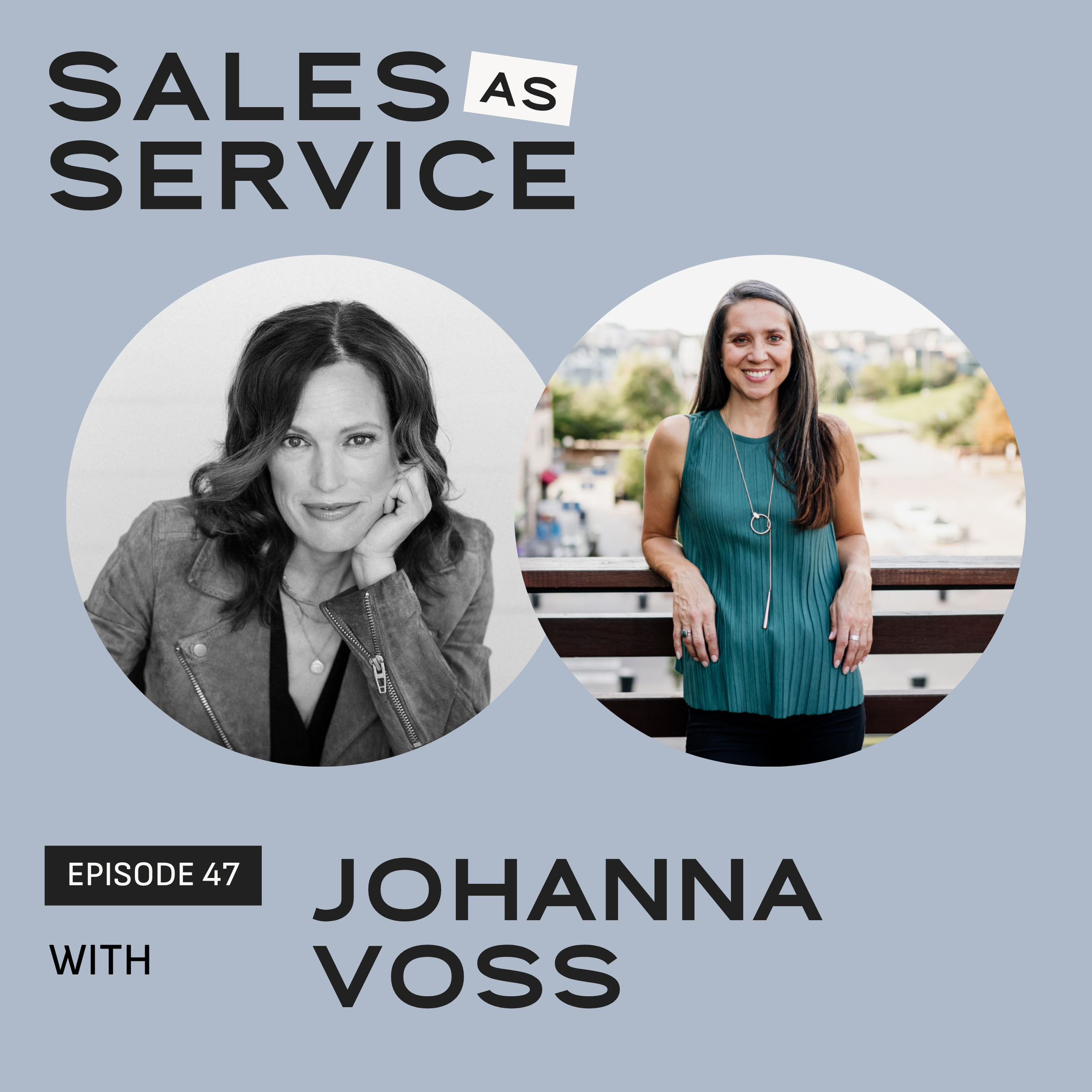
It’s Handled: The Hidden Cost of Doing It All Yourself with Johanna Voss
EPISODE: 47

For a lot of women founders, being “the one who handles everything” becomes part of our identity.
At first, it feels like a strength. We become dependable, resourceful, capable. We figure things out. We solve problems. We carry the business on our backs because that’s what it takes to get something off the ground.
But eventually, the same habits that helped us build the business begin limiting its growth.
In this episode of Sales as Service, I’m joined by fractional COO Johanna Voss for a conversation that goes far beyond systems and operations. We unpack the emotional weight many women founders carry inside their businesses, the resistance to asking for help, and why “I’ll just do it myself” often becomes one of the biggest barriers to scaling sustainably.
Johanna shares what she sees behind the scenes when founders hit a plateau, how over-responsibility quickly creates operational chaos, and why gratitude and ambition are not mutually exclusive.
Inside this episode, we discuss:
Why women founders often become the bottleneck without realizing it
The hidden cost of over-functioning and “doing it all”
How founder identity impacts delegation, hiring, and leadership
Why asking for help feels emotionally difficult for so many entrepreneurs
The mindset shift that allows businesses to grow beyond founder dependency
LISTEN TO THE EPISODE HERE 👇🏻
-
Johanna: [00:00:00] As a founder, when you are seeking help because you wanna grow and scale, you're actually doing a huge disservice to your business because you are dragging your feet on probably hiring or bringing on a tool or a platform that could streamline and help facilitate. So it's some financial investment, but it is too-- the, like, you can't do that without going forward.
Like, there's no way forward without doing that.
Tam: Welcome to Sales as Service, the podcast designed to help you change your mind about sales, literally. I'm gonna help you change the way you think about selling. I'm Tam Smith, your host, sales bestie, and pitch partner next door. If you're tired of bros with biceps telling you how to crush a million dollars in your sleep or battling imposter syndrome on your own, you've come to the right place.
All you need to do is listen, then take action. No gym membership required. Let's get started.
Hey, Tam here. Most consultants and service-based founders are great at delivery. Referrals prove [00:01:00] it, but referrals aren't predictable, and you've avoided sales because you think you have to be something you're not. But sales isn't pressure or cringey tactics. It's connection, starting conversations, recognizing when you can actually help someone.
The hard part? Doing it consistently. That's why I built the VIP Lead Gen Pipeline System. It gives you a repeatable way to book three to five sales qualified meetings each week through relationship first outreach, not cold pitching. Ready to create opportunities on purpose? Book a free alignment call at studio349.com.
Sales is a practice. Let's make it consistent. I used to love the ABC series "Scandal," and if you've watched it, then you probably remember Olivia Pope's famous line, "It's handled." No matter how chaotic the situation, no matter how high the stakes, no matter how much pressure she was carrying, she handled it.
And I think a lot of women founders have built businesses around that same identity. We become the person who can manage all the things. We're the fixer, the problem solver, the one everyone depends on, the one [00:02:00] holding the business, the clients, the team, the relationships, the operations, all of it together.
And at first, that capability feels like a strength, but at a certain point it stops being something to be proud of because what built the business can very quickly become the very thing limiting its growth. The inability to let go, the resistance to asking for help, the belief that we should be able to carry it all ourselves, the fear that wanting more support somehow means we're failing or ungrateful for what we've already built.
And today's guest, Jana Voss, is usually brought in at exactly that moment. As a fractional COO, Johanna works with women founders who have outgrown the systems, structure, and support that hustle alone can sustain. But what I appreciated most about this conversation is that we didn't just talk about operations or scaling.
We talked about the emotional weight women carry inside their businesses, the identity wrapped up in being the one who just handles it, and why gratitude and ambition can absolutely coexist. Because [00:03:00] you can appreciate everything you've built and still want more ease, more support, more growth, and more capacity.
Here's our conversation. Joanna, thank you so much for being here. Welcome to Sales to Service. Thank
Johanna: you, Tam. Excited to be here. We are... I can already feel it's gonna be a good conversation. We're like vibing high. Yeah. Yeah. Well, first off, tell us who you help and how do
Tam: you serve?
Johanna: I work with female founders, service-based businesses, who are...
I enter the company and they bring me on when there's an inflection point of needing to grow in scale, not really sure the way forward. What's the strategy? What's the leadership? What are we doing with the team? How are we growing revenue? We need to standardize or maybe even create some systems and processes, and then how do we roll that out across either the different team members or the different departments, depending on how big the company is.
You know, how do we take the vision of the founder that has some legs but probably needs to really be more fleshed out and thought out and actually brought to life? So how do we take that vision [00:04:00] and then execute it into a plan with everyone so that we can, you know, go further faster together kinda thing.
Tam: You said, you know, you're usually brought in when there's a bottleneck. Do you see kind of ty- is that a symptom of, you know, maybe something else that's going on underneath?
Johanna: I will actually refer to it not so much as a bottleneck. I feel like everyone, and for the longest of time, I'm like, "Oh yeah, bottleneck," because the founder's bottlenecking everything.
Tam: Yeah.
Johanna: But what I realize more now is when you are building a company, whether you intend to build a company or you have this idea and something gets legs and all of a sudden you're like, "Oh, I'm an entrepreneur and I have this thing," and I'm like, "Wow, I'm making money and I need to put a little bit more intention behind it."
Whatever the case may be, however it is you got there to having a company, you have built the whole thing around yourself. There was never this bigger, larger plan of... Or even if there was, you didn't really know what it looked like or how to get there. So I don't think it's so much bottleneck, because bottleneck to me implies you can get out, but you're just either mentally unable or you're [00:05:00] too grippy or whatever.
What I usually see is there's so much infrastructure built around the founder- That they actually are physically unable to, to step aside and take a day off, or hand a project over to a team member or even me, because there's so many other components of it that are all linked up that they're like, "Oh, I can't just give you this one piece because I'm actually still holding this other piece in my email."
Tam: I have found, just in my own experience, that this is, I guess, delegation is one of, if not the har- has been one of, if not the hardest thing for me to do. You know, and I've, you know, fall back on that, "Oh, I'll just do it myself." How does that ... I mean, do you see that show up a lot with the founders that you work with?
Yes. How do you work people out of that?
Johanna: Find me a woman who doesn't have relatability with that statement, either in their business, in their personal life, in their relationships. I mean, I will raise my hand first. I am the, also the worst offender of it. I think it is a lifelong journey to get better at.
I talk about these things all the time with my clients, and I [00:06:00] still hear myself talking and I'm like, "I need to take that advice. Like, I need to do that thing." It is ... Yeah, it is just pervasive. I don't know if it's in our DNA. I don't know if it's in our wiring. The part that where I always see is it means that as a founder, when you are seeking help because you wanna grow and scale, you're actually doing a huge disservice to your business because you are dragging your feet on probably hiring or, you know, outsourcing, whatever, however you wanna describe it, or bringing on a tool or a platform that could streamline and help facilitate.
So it's some financial investment, but it is too ... The ... Like, you can't do that without going forward. Like, there's no way forward without doing that. So it is costing you revenue and costing you business and costing you growth. And when I have been brought in and when people hire me, I'm like, "Oh." And I ... And, and no shade.
Like, I say this with all love, 'cause, like, I get it. This is what we're all dealing with. It's also just like, "Oh yeah, I can see how this has been building. I can see how we got here." And so for ... I'm grateful [00:07:00] for the people that are ... And I, I talk about this in some of my Substack articles. I think some of the best founders, they're not necessarily, like, the smartest or the most book read or educated or, you know, whatever, have a family of entrepreneurs.
It's the ones that can make decisions quickly. And so the ones that are like, "I need to make this decision. I don't exactly know what the decision is or how I'm gonna make it," but they, they have decided to decide and then can take action rather than, "I should be hiring someone. Okay," and then they put in, "But I'll do it after this, we hit this revenue goal.
I'll do it after we finish this cl- finish this client project. I'll do it in Q2." Okay, you're still dragging your feet on it, but the ones that even can just decide and then know, 'cause at that point you're looking for people that are experts in their lane. You're starting to break off little chunks of your business, and you wanna hire people that are better at doing the thing than you are.
You may not have access to that person yet, but at least just going, "Okay, I need to hire X, Y, Z person. I don't know who they are, but let me reach out to my network. Let me start asking around. Let me start moving my feet while I pray," African proverb that [00:08:00] I live by, to just- Get the thing in motion. That has been...
Like, I love working with those founders that are decisive, even without knowing what the decision is. They're just like, "I need to do this thing. Guide me."
Tam: And it sounds like you help them. You know, so much of the, I guess, delay, resistance, it, it, it can feel overwhelming. You know, that whatever that big decision, that big a- you need to take, but okay, make the decision, but then chunk it back to smaller steps and what's that first right action to at least get the momentum going.
Absolutely. Yeah. Yep, you're not...
Johanna: And I feel like there's this thought around, "Oh, if I hire," or, "If I delegate this one thing," you're like give- like, here's the whole company or something. It's like, it's like, no, you're just, you're just hiring an admin assistant, assistant, or you're just hiring someone to schedule some stuff for you, or do your invoicing.
Like, that's always a great first hire is, like, to have someone do your invoicing, your bookkeeping. Most people don't like getting into the business and their accounts and their money stuff. Yeah, hire, hire out that. Like, that's [00:09:00] not something you wanna mess up. So it's, it's also, like, I think in our heads we make it out to be such a, there's this emotional weight around it, where it's like this bigger thing.
And then so many people when they get on the other side of it, right, like so many big decisions we have, personal, business, in our relationships, we get to the other side of it, we're like, "Oh, I'm good. That actually wasn't that bad."
Tam: Why didn't I do that sooner? Yeah.
Johanna: Exactly, exactly. So the people who can just, yeah, get there,
Tam: I love them.
So let's talk about this tension. Being grateful for what you have while also wanting more. And I, you know, I wonder if, you know, uh, again, so much of the, like, the s- the symptoms we see as far as that hesitation, you know, the, you know, the connection between control over responsibility, resistance to asking for help, do you see that show up a lot?
You know, it's like I feel like we think it's this either/or when it can be both, you know, this and. That we, we can, you know, I, I want anybody listening to give, you know, permission to bringing someone like you [00:10:00] in, that you can be grateful for what you have and still it's okay to want more and bring in the support to help you achieve that.
Do you see that happening a lot, where there's, there's kind of this emotional, like, feeling bad for wanting to continue to grow in scale?
Johanna: Yes. And also feeling really awkward about owning what you're good at and what you've done and being grateful for. I was just talking to someone the other day on the phone, and right at the...
I can't remember what the thing was, but right at the end she's like, "Well, I don't wanna, you know, I don't, I don't mean to toot my own horn." I'm like, "Toot your horn. Like, blow it from the rooftop. Scream it to everybody." And whatever it was that she told me was amazing. And I'm like, "Why? Tell people that," because there's no...
Sure, are there gonna be some people who look at that and are, like, envious and jealous? Absolutely. Well, that's them projecting their stuff on you. Like, that's, that's not you. And I think when people can start to realize that it's not personal, people come for them on social media comments or whatever, you're just like- I'm always like, "Oh, I feel sorry for you that you have that mindset."
You know? I'm like, that's about you. That's not about [00:11:00] me. But to own what you're good at, to me, exists in tandem with then being able to say, "And also, this is where I wanna go. This is what I wanna do next. This is my next idea I wanna put into play." To me, it's like, not that they can't exist without, you know
It's not like only one can exist in a vacuum. They can, but you have both of them together. People are telling me amazing things that they're doing, and accomplishments, and revenue goals, PR. They launched a new product. They built a website. I don't care what it is. It's like, let's celebrate that momentum because you have to be your biggest cheerleader.
And sure, you're may have people in your court, in your corner, but at the end of the day, it's like you gotta be the person cheering about you from the rooftops. And it's like if you're not cheering and supporting your own stuff, well then who is anyone else? And if you don't believe in it enough to talk about it to strangers or to anyone or, you know, celebrate it, it's like there's not gonna be other people picking up that mantle and sure, maybe on occasion raving about you.
But like you, at the end of the day, [00:12:00] have to be the person who owns all of it, and celebrates it, and believes in it. And that energy, when people see that, that's, that's attraction. That is like people are like, "I want, I want, I want her as my speaker. I want her as my coach. I want her to do my website." Like whatever it is.
I'm like, that's business development. People are gonna come wanna work with you, you know? And, or refer you business. People are attracted to success. Yes. Yes. Yes. Wanna work with
Tam: winners. Totally. Yeah. Absolutely. Absolutely If your pipeline feels inconsistent, it's usually the sign of an outreach gap. I created a free tool called the New Client Calculator to help you see exactly what it takes to land your next client.
How many messages? How many conversations? How many follow-ups? No guessing, just clarity. If you've ever wondered, "Am I doing enough or just not doing the right things?" This will show you. Head to studio349.com to download the New Client Calculator and find out just how close your next client really is.
All right, let's get back to the episode. I mean, can you think of a specific example or project you [00:13:00] worked on, you know, where you came in and, you know, initially what might be perceived as a, you know, kind of stalled business or a bottle neck, you know, and underneath that was just a, you know, kind of founder resistance, and the impact of, you know, putting systems, you know, delegating, bringing in the right talent, like the impact that it had on that business?
Johanna: Oh, yeah. I can think of multiple examples. So the one that is coming to mind is around staff and hiring. So I came in, and this founder who I adore, who's become a very good friend of mine, she had a team of people who were good. They weren't great, but they were good. She hired without having sort of total clarity on like what her interview and hiring process was, what her company culture was, like what is she actually hiring for.
Like, there wasn't a lot of clear boundaries around expectations or responsibilities and sort of all of that. Which again, that's what happens when you're starting. You're just winging it. You're probably running it through ChatGPT now and trying to figure out how, you know, how to do it. And so she did the best she could for where she was at in that [00:14:00] moment.
And so then I came in, and we were... One of the things was she was expanding team and growing her revenue and roster. So we were just looking at like what's her interview process and who's the ideal candidate and h- how are you affirming a good fit? What's the culture? Like, all of these things, expectations, boundaries, responsibilities.
Who are they reporting to? How would you like them to be, you know, personality wise? Like, what do you work well with? And so she had these couple people who, you know, were not the best. From day one of me working with her, so much of our time was taken up by these people who were either basically toxic, not doing a good job, infiltrating the rest of the company culture in not a good way.
Just being time and energy sucks. There's always those people. And inevitably, you have two choices. You can either keep them And deal with the consequences of it, or fire them. And most people choose option one because they don't like firing people, and they think it's harder and it's personal, and they don't wanna hurt people's feelings.
But by choosing the first option, you are s- wasting so [00:15:00] much time and energy, and you are stalling the growth and acceleration of your company, rather than just nipping it in the bud and getting to the other side of it. So anyhow, fast-forward a few months, both of these people ended up leaving the company in dramatic, unprofessional fashion.
And I remember very clearly when she called me about it, it was ... A lot was happening in her personal life, and you're just like, "Oh, of course the universe is, like, burning things to the ground, like, right now, like, all the time," you know? Like, oh God, right? But she called me, like, very upset, you know, because now all of a sudden it's, "Oh, I should've fired them," and like, wait, they went out on their terms, and they're saying all these things, and, you know, all these other worries now.
And I'm like, "Oh, this is great." Like, they did the thing that you couldn't do earlier in time, that you were dragging your feet on, and I'm like, "Oh." You know, she's so upset, and I'm just like, "This is fabulous." Yeah, this is a gift. You give me the clean slate. Yeah, this is truly a gift. Yeah. I'm like, "You're gonna be fine.[00:16:00]
You're gonna get to the other side of it. The world is not falling apart. Your company is not falling apart. Like, this is genuinely a very good thing." And so we were able, in that proc- you know, in that timing, we had figured out sort of some better interview processes and systems, and where to find talent, and what she's hiring them for, and better just communication within the team and, you know, in the hierarchy of how people are reporting and when they're communicating and stuff, to better nip these things in the bud, better systems and processes.
But that was just something that I think about, and I've seen that play out so many times when people don't wanna get rid of someone for whatever reason. And as soon as that person comes up in my work with them, I'm just like, "Oh, am I gonna have to hear about this person for the entire duration of our time together?"
Or, "I hope they come to a place where they can let this person go." And I will say it is very rare, that usually they end up firing them. Most people are ... choose to deal with it. But I think once you have that situation, you get on the other side of it, those people then become better at firing because they're like, "Oh, I now have [00:17:00] the core memory, the muscle memory of what that felt like and what I could've done, having some agency, could've done differently moving forward."
So I mean, when it happens, I'm also just like, "This is a great learning opportunity. Great, you'll never do that again." Right. Yeah. You couldn't listen to me, which is fine. Yeah, people gotta get there on their own way, but now it's like, cool, you're not gonna do that again. Right. Right.
Tam: Learn every, every, I guess, you know, pers- mistake is an op- it's a opportunity to- Mm-hmm
to learn. It's an op- learning opportunity. Yeah. And that there are, there are no mistakes. There's just, like, yeah, learning opportunities. How do you- Help someone move from, you know, some of these a- a- awareness of what the actual, you know, challenges are to actually taking that aligned action. I mean, I think that's so, like w- I, I, I've, you know, in my own, you know, work with, you know, sales and business development, we all know what to do, you know, on some level.
It's really just taking the action and taking that step. I mean, to your point about, you know, so many, you know, [00:18:00] founders and business owners, you know, sit with, you know, talent that's not necessarily a- aligned with the business goals, you know, versus taking the action to coach them off or, you know, or ultimately fire them.
You know, how do you help people to take that, you know, practical right next action?
Johanna: Yeah. At the end of the day, as you said, it, it's up to the person to do the thing, right? Like, I can't make them do anything, and I'm human, and I bring a lot of just human compassion and lens to the work that I do. Like, sure, I write the pr- the strategy and the plan and this and that, but I'm not just gonna shove it down someone's face if their, you know, kid was sick all night and they didn't get enough sleep, you know?
So, like I, I fully come into my work with a lens of, okay, we're all humans trying to do the best that we can. It is... What I do is serve as a mirror to them. You hired me to push you out of your comfort zone and to make this... This is gonna be difficult. And I always say when I start working with someone, I'm like, "So just a heads up, some point during our time together, you will not like me.
You will be really [00:19:00] annoyed by me, and you will also know that I am telling you what you need to do. Like, I've got your best interest in mind." I don't need to be right. I'm like, I don't need to be that person, but I'm just like, "Yeah, you're gonna hate me." And also, depending on how they hire me and how we engage in our work, if I'm doing work with their team, I'm like, "Your team's gonna hate me, too, and that's fine.
Like, I, I don't care. That's why you brought me in, to have these sort of hard conversations." So I am not there just to exist in an echo chamber with them of agreeing and saying, "Oh, yeah, no, she is awful." I will give them a couple minutes. I'm like, "You have two minutes to vent," 'cause I understand sometimes you just need to get it out of it.
And then I'm like, "Okay. Where are you for, like, how open you are to hearing feedback?" You know, if they're like, "Oh, tell me everything," or just like a little hudst- I may just be like, "Here's one thing. Like, here's one little thing of reflection." So I serve as a mirror. This took me a while. This took me a while, but this is something that I lean into in this, in these situations, [00:20:00] is I am much better about owning what I'm good at and realizing that I can dispense feedback and reflection to people, which is also, you know, it's hard to do.
And, like, I want people to like me. Like, I'm friendly. I'm a Pisces. Like, I'm, I'm an extrovert, like, just very cheery and sunny personality. So, like, it's hard sometimes to call people out on their BS. But I realize that I'm doing them a disservice if I'm not doing that. So I have gotten so much better. I've been doing this work for 15-plus years, so, like, it has been a journey for myself as well, but I'm very cognizant of the power in that, and I'm like, "That's what they hired me to do."
I'm doing them a disservice if I'm not holding them accountable or holding their feet to the fire. Or say, "You told me you're gonna do this two times and you still haven't done it," like, what's the, what's the larger underlying thing of what's going on? This is... I don't, I don't wanna just feel like that whole do the same thing and expect a different circumstance makes you crazy.
Like, I don't wanna be in that space, you know? And I've left clients who continue to just... I'm like, "I think you just need a therapist." Like, I'm not here to just listen and, like, agree with you, you know? I'm here to help you do the work. [00:21:00] And so my role is mirror and then hold the space for them, and sometimes give them some, have some really hard conversations.
And also be like, "We can get through this. I'm here with you. We can do this together, but, like, you're the one who needs to do the thing."
Tam: But it's hard for everybody. It's the thing in my own business, you said that, you know, you, you act as a mirror. In my own business that I... I don't have regrets, but what I would have done sooner is invite that outside perspective in sooner, because it is very hard, I know folks have heard me say this, read the label from inside the bottle, and having that- Oh, yeah
outside perspective to see- I love that. I- it's not... I, I stole it. The first person, uh, shout out to Kylie Peters, one of my coaches. I think I- she's the first one that I heard say that, and I have repeated, have repeated that a lot because it is very true. It is very hard to see. You know, you're so buried in it, it is very hard with outside...
Or you're, I shouldn't say buried in it, but you just, you're so deep in it and have such narrow focus, it is very hard to, you know, to see the full picture without that outside [00:22:00] perspective, and it's so valuable. 'Cause I, yeah, yeah, I've... I love these conversations so much 'cause it, you know, I've... Just my own lived experience in my business, you, there was a, a lot of resistance where, you know, you think you're supposed to be able to handle it.
It took me longer than it should have to raise my hand and be like, "Uh, no. You know, I, I need, I need help here."
Johanna: Well, it's like every time you do it just builds that muscle. It's like negotiation, you just... You... The only way to get better at it is to practice.
Tam: Yep. Yep. Absolutely. And, and for that founder listening who, you know, feels stuck and maybe knows they're, you know, they've hit a plateau in the business, knows they're carrying too much, what's the first, you know, kind of honest question they need to ask themselves or start asking themselves to explore, okay, who is the right person to bring in to help me solve this?
You know, kind of what aspect of the business is really most w- that they're most challenged by. You know, where can they kinda start to look first?
Johanna: Ask their network. Uh, hopefully they have a network of other founders and [00:23:00] entrepreneurs and CEOs online, digital, virtual, real life, whatever. If you don't have one, you need to have one, 'cause this is a very isolating situation, uh, or, you know, experience being an entrepreneur.
So I would just start to float that out there because they're by no means the first person, even if they're like, "But this is so niche and random and no one could have ever possibly experienced this before." Guaranteed somebody has. Lots of people have. So ask, and then also ask those people not just, "Oh, who do you recommend?"
But like What questions do I need to be asking? Sometimes it's that. You don't know what you don't know, so it's like, okay, when you're hiring someone, here are some questions that you need to ask to make sure that it's the right fit. Also, them sitting and just getting really clear on, like, what is it that they want and need so that you're hiring someone for the right...
You know, if it matches your expectations of the experience and, like, what area they're actually gonna help you with. Do you think it's your sales, but is it actually your client pipeline? Do you think it's your marketing, but it's actually your digital footprint and your social copy sucks? Or your, you know, your copy sucks.
Having some outside eyes just [00:24:00] look at their stuff, and of people that they trust that are already doing the work. Don't ask your random friend who's not an entrepreneur. Ask someone who is that whole, like, you only take advice from people that are in the ring with you. I think it's a Teddy Roosevelt quote that Brené Brown made famous.
But make sure you're asking people, and your peers, too, who maybe it's a bit ner- makes you a bit nervous to ask them because you're afraid of their feedback. Those are the people you should be asking. Like, those are the real people that you need to be, "Hey, this is what I missed out. This is where I'm at.
This is what I'd love for you to look at." Again, be clear, not just like, "Can you look at my website?" But, "Hey, this, this is where I'd love your input. This is what I'd love your specific feedback on. I'm asking you because of X, Y, Z reason." And then send them a thank you note and send them, like, a $10 gift card to Sephora, because everyone's time is very valuable.
And if they charge you $300 an hour, well, also pay for it. Yes. Yeah. You want that expertise.
Tam: Yeah. Mm-hmm. Absolutely. Let's jump into our fast five. Your I can't live without it software or app.
Johanna: Notes on my [00:25:00] iPhone. And
Tam: I'm really getting into voice notes,
Johanna: too. Oh, and the voice memo. I voice memo myself when I'm walking all the time.
Tam: Best advice you've ever received about sales and business development.
Johanna: Take the meeting. Showing up is half, literally half the battle. Especially in today's day and age when everything is so digital. Show up. Morning routine must-have. Work out. I have got to move my body. I swim three times a week. I walked a few miles this morning.
I lift. So some sort of movement, and then 32 ounces of water with electrolytes. This is my second mason jar. I live in Colorado, so I, you know, it's perpetual dehydration. Yeah. But yeah, those two things, movement and water. Your walk-on song, the one song that always pumps you up. Oh. Okay. So many, but this is the one I'm landing on.
For context, I'm Gen X. I was born in 1979. I'm 47 years old. This is gonna hit with some people. C+C Music Factory, Gonna Make You Sweat . I
Tam: can hear it now. It's gonna be in my mind, like, the rest of the day. And if you only had one [00:26:00] hour each day for business growth, how would you spend it?
Johanna: I'm very excited to tell you what I'm about to tell you.
I think it is going to be what nobody expects, so any conversation around it from your listeners, please tag me in because I wanna chat about this. I would cut the noise. I would sit in silence with a journal.
Tam: Tell me why. What comes out of that for you?
Johanna: I... What comes out of that is the clarity of what you need to do.
Yeah, yeah. We are s- A, there's so much noise. We're bombarded with how many bajillion bits of information every second, and I was at a entrepreneur event experience last week put on by Eleanor Beaton of Safi Media, which was amazing, and one of the things that she said was, "We do not need any more information.
We just need to make better decisions." That is one of the few things I c- I can't stop thinking about, and personally, one of the best things that I ever did in my entrepreneur journey way early on was... 'Cause everyone's always recommending, "Oh, read this book, The 4-Hour Workweek. Read this personal development type book."
And it felt [00:27:00] to me like it reinforced not trusting yourself on what you wanted to do and what you knew how to do, and giving away some of that confidence. And so once I cut out all of that, like, what everyone thinks I should do, I'm not gonna listen to, like, Jay Shetty talk to me about building a company.
We are two completely different people with different access to resources and building different companies, different vibes, different attitudes. I don't wanna read his book. The whole, like, traction and 10X and all those people. Side note, a lot of them are men. A lot of them are white men. No shade on white men, but I'm just like, it's a different vibe.
Different vibe. You know, that heavy, like, "Let's go make a lot of money and, like, build YouTube and..." Uh, this is not my jam. So for me, sitting is just whatever that noise is in your head, what rises to the surface? What settles? What keeps pinging your head to be like, "Oh yeah, that's the thing I sh- I, I need to do that I've just been avoiding"?
And I think that's the best thing you could do for business development.
Tam: So good. Ugh, I needed to hear that [00:28:00] today. Thank you. You're welcome. Where can folks find and connect with you online?
Johanna: Oh my gosh, I am all over the internet. Google my name, Johanna Voss, J-O-H-A-N-N-A. I've got a Substack, The Negotiation Network.
I've got my website. Pretty active on LinkedIn. Love any sort of conversations about this work that we do.
Tam: Thank you so much for being here. It was a delight. Thanks, Tam. Thank you so much, Johanna, for this conversation, and let me ask you listening, where have you become too responsible for everything? For so many founders, that identity gets rewarded for a long time.
Being dependable, being resourceful, being the one who can just, quote-unquote, "handle it." But eventually, the thing that helped us build the business becomes the very thing keeping us buried inside it, and I know for myself, this conversation was a really important reminder that asking for support is not weakness.
Delegation isn't failure. Success does not have to equal suffering, and it doesn't have to be hard to have value. Wanting more ease, more capacity, or more growth does not make you ungrateful for what you already have. So this week's Sales [00:29:00] as Service challenge is simple. I want you to identify one place in your business where you're still operating from, "I'll just do it myself."
Maybe it's a task you should have delegated months ago, a conversation you've been avoiding, a hire you know you need to make, or a hard conversation you need to have to let someone go, or an area where you know you simply need outside perspective or support. And then ask yourself honestly, "Is this actually serving the growth of my business or just protecting my comfort zone?"
And here's the second part. Take one concrete action this week. Not someday, not next quarter, this week. Send the inquiry, ask for the referral, post the job, delegate the task, book that strategy call, start the conversation. Because momentum really comes from having everything figured out. It comes from deciding to stop carrying it all alone and then taking the next right action.
Thanks so much for listening to this episode of Sales as Service, and if you found this conversation valuable, I'd love for you to share it with another founder who may need the reminder that they don't have to build their business entirely on their own. All right. [00:30:00] That's it for me this week, and I'll see you right back here next week on Sales as Service.
You've just listened to the Sales as Service podcast, the podcast to help you shift your mindset around selling. If you liked what you heard, be sure to hit subscribe and share it with a friend, because we're all about more sales awesome and less sales awkward. See you next episode.
MORE OF A READER? 👇🏻
I used to love the ABC series Scandal.
And if you watched it too, then you probably remember Olivia Pope's famous line: "It's handled."
No matter how chaotic the situation, no matter how much pressure she was carrying — she handled it.
I think a lot of women founders have built businesses around that same identity.
We become the fixer. The problem solver. The dependable one.
And for a while, that works.
In the early stages of business, resourcefulness is often necessary. You wear multiple hats because you have to. You figure things out in real time. You move quickly. You survive on instinct, grit, and sheer determination.
But eventually, something shifts.
The business grows, but the founder's role often doesn't evolve with it.
Instead of building systems, support, and structure around the business, many founders continue carrying everything themselves. Client communication. Team management. Operations. Sales. Marketing. Decision-making. Emotional labor. All of it.
From the outside, it can look impressive. From the inside, it's exhausting.
That's why this week's conversation with Johanna Voss resonated so deeply with me. Johanna is a fractional COO who works with founder-led businesses to build the operational structure that allows them to actually grow. And what she sees inside those businesses isn't usually a simple "bottleneck." It's a business that has become completely dependent on the founder's ability to hold everything together.
Underneath that is often something much more personal: conditioning.
Many women have been taught that asking for help is weakness. That delegation means losing control. That wanting more support somehow makes us lazy, difficult, or ungrateful.
So instead, we over-function.
We tell ourselves: "It's just faster if I do it myself." "I'll hire later." "I can handle it."
Until eventually, the founder becomes the ceiling.
One of the most important points Johanna made is that growth requires support. Not because you're incapable, but because no business scales sustainably when everything lives inside one person's head. That applies operationally, emotionally, and financially.
And it shows up in sales, too.
Founders who struggle to delegate internally often struggle externally as well — hesitating to ask for the sale, underpricing their work, overexplaining in conversations, resisting visibility, avoiding support.
Because underneath all of it is the same question: "Am I allowed to want more?"
More revenue. More ease. More capacity. More help. More leadership. More life outside the business.
The answer is yes.
Gratitude and ambition can coexist. You can appreciate everything you've built and still want to build something bigger, healthier, and more sustainable.
And maybe the next level of growth isn't about proving how much you can carry. Maybe it's about finally deciding you don't have to carry it all alone.
✦ YOUR SALES AS SERVICE CHALLENGE
This week, identify one place in your business where you are still operating from: “I’ll just do it myself.”
Maybe it’s:
A task you should have delegated months ago
A conversation you’ve been avoiding
A hire you know you need to make
Or an area where you know you simply need outside perspective or support
Then ask yourself honestly: “Is this actually serving the growth of my business… or just protecting my comfort zone?”
Finally, take one concrete action this week: Send the inquiry. Post the job. Delegate the task. Book the strategy call. Start the conversation.
Because momentum rarely comes from having everything figured out. It comes from deciding to stop carrying it all alone.
RESOURCES & LINKS
Learn more about how Johanna runs companies
Connect with Johanna on LinkedIn
Follow Johanna on Substack
Your next client - calculate what it takes
Simply sales with the VIP Power Hour - download the FREE guide
Learn how to consistently book 3–5 sales-qualified meetings each week -book an Alignment Call
SUBSCRIBE & REVIEW
If you loved this episode, please take a moment to subscribe and leave a review on Apple Podcasts! Your support helps us reach more creative agencies and service pros who need these insights. Thanks for tuning in to Sales as Service—see you next week!

TAM SMITH
I’m Tam Smith-Sales Growth Strategist and Founder of Studio Three 49. I help service-based founders find, connect with, and convert right-fit clients through predictable, sustainable outbound sales solutions.
No pushy pitches. No bro-marketing. Just simple, structured systems that turn connections into clients.