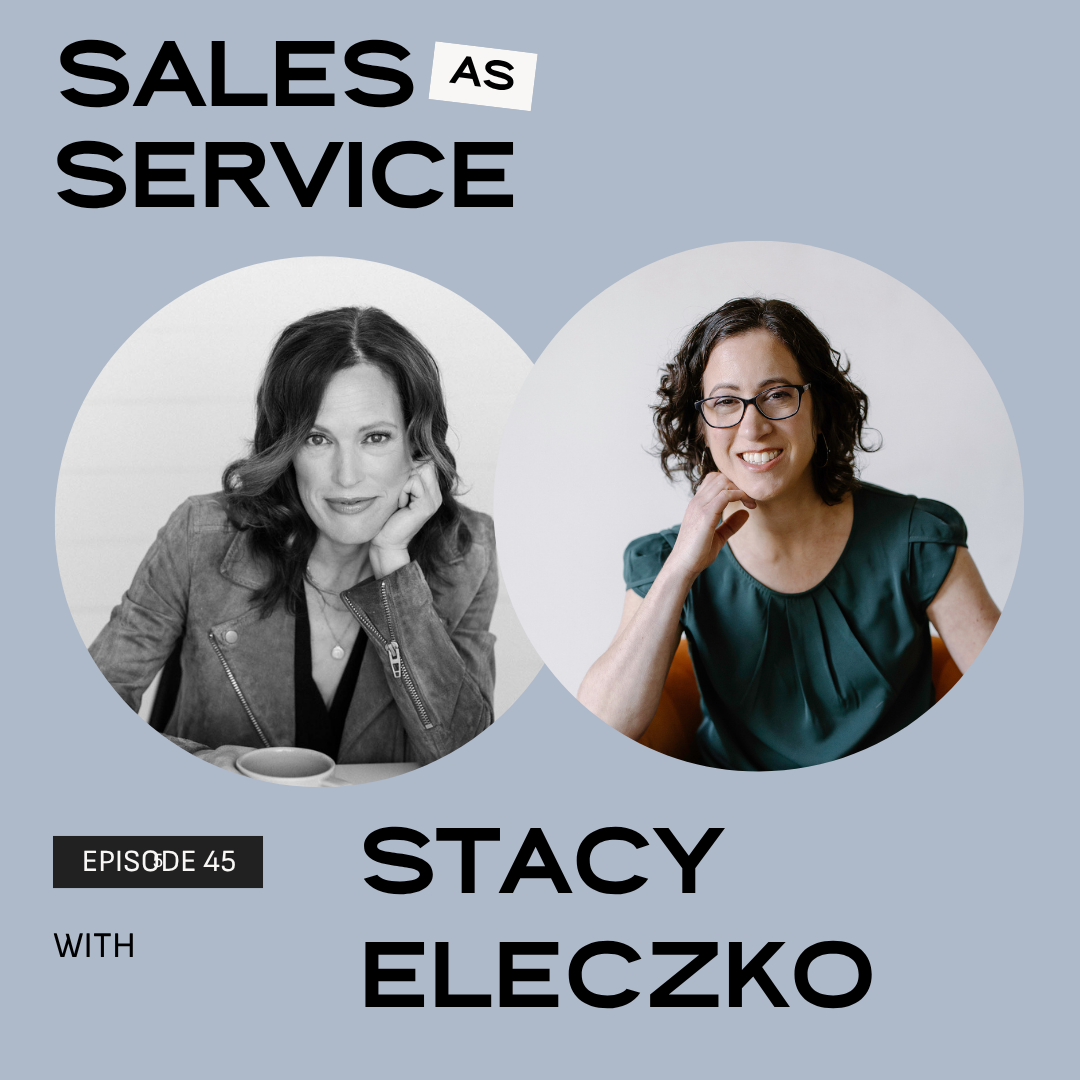
You Don’t Have a Lead Problem—You Have a Clarity Problem with Stacy Eleczko
EPISODE: 45

If your pipeline feels inconsistent, it’s easy to assume you need more leads, more content, or more visibility.
But what if the real issue isn’t volume—it’s clarity?
In this episode, I sit down with messaging strategist Stacy Eleczko to unpack why so many service-based founders struggle to convert interest into real conversations—and how unclear, overly safe messaging is often the root cause. We talk about the discomfort around hearing “no,” the tendency to soften your message to stay likable, and what actually changes when you get clear on who you’re for (and who you’re not).
This is a grounded, practical conversation about messaging that supports real sales—not just attention.
In this episode, we cover:
Why unclear messaging creates more rejection—not less
The difference between being liked and being understood
How people-pleasing shows up in your sales conversations
Why “no” feels personal—and how to reframe it
What to prioritize on your website to actually convert
LISTEN TO THE EPISODE HERE 👇🏻
-
Speaker: [00:00:00] People are so worried about excluding people. There are so many people out there in the world. You're not for everybody. And you're doing them a service by clearly communicating who you're for, what you're for. You can be bold without being contrarian. You can be bold and still be deeply human. And I think that people don't realize, like, that's what builds trust.
Speaker 2: Welcome to Sales as Service, the podcast designed to help you change your mind about sales, literally. I'm gonna help you change the way you think about selling. I'm Tam Smith, your host, sales bestie, and pitch partner next door. If you're tired of bros with biceps telling you how to crush a million dollars in your sleep or battling imposter syndrome on your own, you've come to the right place.
All you need to do is listen, then take action. No gym membership required. Let's get started.
Hey, Tam here. Most consultants and service-based founders are great at delivery. Referrals prove it, but referrals aren't [00:01:00] predictable. And you've avoided sales because you think you have to be something you're not. But sales isn't pressure or cringey tactics. It's connection, starting conversations, recognizing when you can actually help someone.
The hard part? Doing it consistently. That's why I built the VIP Lead Gen Pipeline system. It gives you a repeatable way to book three to five sales qualified meetings each week through relationship first outreach, not cold pitching. Ready to create opportunities on purpose? Book a free alignment call at studio349.com.
Sales is a practice. Let's make it consistent. More isn't always better. Okay, stick with me here. I think we've been taught to think about sales in a very specific way. More leads, more visibility, more activity. And when things aren't working, the assumption is, well, we just need more. But what if that's not the problem?
What if it's not that you need more leads, it's that the right people aren't hearing themselves in what you're saying? Welcome back to Sales as Service. I'm your host, Tam Smith, sales growth strategist and founder of Studio 349. I [00:02:00] help coaches, consultants, and B2B service providers build predictable sales systems so new business doesn't depend on referrals or random inbound.
And this is what I see all the time. Founders who are very good at what they do. They've built a business. They've grown through referrals. But when it comes time to actually talk about their work clearly, confidently, and in a way that moves someone to a decision, it gets, well, anything but. The message softens, the point of view completely disappears, and suddenly we're trying to be liked instead of understood.
That's where this week's conversation starts. Today's guest helps founders get out of that gray area and into clarity. Stacy Olesco is a messaging strategist and keynote speaker who works with impact-driven B2B service businesses, helping them get clear on what they stand for, who they're for, and how to say it in a way that actually connects.
In her words, "You don't have a lead problem, you have a clarity problem." So today we're getting into what that actually means. We're talking about why unclear messaging creates more rejection, not less, why no feels so [00:03:00] personal and how to stop letting it hold you back, and what changes when you stop trying to be liked and start being clear.
Because the goal isn't to get everyone to say yes, it's to make it easy for the right people to recognize themselves and move forward. Let's get into it. Stacy, thank you so much for being here. Welcome to Sales as Service.
Speaker: Yeah, thanks for having me. I'm excited about this conversation.
Speaker 2: Well, I always like to start these conversations off by asking, tell us who do you help and how do you serve?
Speaker: Yeah. So I help impact-driven B2B service-based businesses. So, like, the short of that is I love working with good people who do good things, and that's who I love to help. And generally they are businesses that are, are great at what they're doing. They've grown through referrals. They've kind of hit the ceiling.
Their expertise has evolved, but maybe their messaging hasn't. And so I help them with positioning, figuring out, you know, what they stand for, who it's for. Their messaging, how do we translate that into language that connects, that builds trust, and then ultimately executing on that and doing things like website copy, sales [00:04:00] pages, emails.
And then I also do speaking in workshops, helping founders and teams apply all of this in real time.
Speaker 2: And I love how you say your audience doesn't have a lead problem, they have a clarity problem. What does that mean practically for founders and business owners?
Speaker: Yeah, so it's, you know, we tend to jump to tactics.
When something's not working in our business, we're like, "Oh, well, it must be our sales process," or, "It must be our lead generation," or, "We need to be more visible," or, "Maybe we need to tweak the funnel." But what happens is we do all of those things, and then it's nothing's still quite working, and it's usually 'cause there's a strategic layer that we missed before we jumped into the tactics.
So we don't really think about who exactly are we talking to? What is it we actually wanna say? What do they really need to hear? Why should they choose us? And so you then lack clarity, and all of those other tactics, just the messaging misses on them. Your content feels disconnected. Your leads don't convert.
And it's [00:05:00] not necessarily because we have a lead generation problem. It's because maybe your underlying positioning or messaging isn't getting the right leads to you. And so it's about fixing, you know, the issue that is really not the symptom, which is what we tend to fix. It feels productive to do that, right?
Speaker 2: Yeah. I always love people's kind of origin story. You know, how did you land in this work and get so focused on
Speaker: clarity? Yeah. So it's funny 'cause I used to say that I landed into this, like I did this, I landed into it accidentally, right? So back s- you know, back story is I was in education for a lot of years.
I was really disenchanted, and I wanted to shift. And so couldn't find anything that seemed like a good fit for me, and I'd kind of resigned myself to the fact that like, "Okay, this is just what I'm gonna do." And then one day, I was on Facebook kind of just, you know, doom scrolling, and I saw an ad for a copywriting course, and I clicked.
And I started reading about it, and I was like, "Oh, I think I could do this copywriting thing. This sounds really interesting." So I told my [00:06:00] husband, and he used to be in IT, and he did graphic design work, and so he's like, "Oh yeah, you'd be great at that." And so I never actually took that course, but I went down a proper rabbit hole just studying all these things and learning about copywriting.
And then I realized, like it wasn't an accident at all. It was the power of copywriting. It was the exact right message at the exact right time to the exact right person. And so I started off doing that, doing website copywriting, and then what I realized as clients were coming to me- And again, it was a tactical fix.
They didn't have the strategy underneath. And so in education, one of the things that I did is I was an instructional coach, which means I worked with teachers on the job to do embedded professional development. And what I learned in that role is really how to ask good questions and understand, like, what's the piece, what's the part that you're not saying?
And that's the work that I then bring in. So, you know, now I do the messaging, the positioning strategy, all the way to the [00:07:00] execution, and I really just draw on all that experience that I had previously to be able to do that.
Speaker 2: I love the story about your... when you were introducing yourself at a networking event, and kind of that drove your own sort of exploration into message clarity.
Can you share that?
Speaker: Yeah, absolutely. So it was my first in-person networking event as a business owner, and I had no idea what to expect. I was super nervous, and the one thing I knew was like, "Okay, I'm gonna have to introduce myself." So I pulled into the parking lot, and I sat in my car probably for 15 minutes, like, just practicing my introduction before I walked in.
And I was just absolutely positive. I was like, "All right, I've got this nailed. I'm ready to go." So I walked in. I'm really nervous, and I kinda edged to this group of people, and it's my turn to introduce myself, and I launched in. And I... It was the worst introduction on the planet. Like, I had been so prepared, and then I was like, "Yeah, so I'm a copywriter, [00:08:00] but, like, the kind who does words, not the legal kind."
And I went down this, on a whole tangent about it, and they very, very politely listened, you know, and they were really gracious, even tried to ask me questions after. But they were asking me questions about literally everything but what I did. And I realized, I was like, "Not only was that not clear, like, I'm not even in the ballpark here."
And so if I can't even clearly explain to people what I do, how are they ever gonna remember me? And if they can't remember me, how am I ever gonna be top of mind to grow business? And it was, like, this really eye-opening piece to me about just how important being so clear is so people can understand and remember what you do.
Speaker 2: And I feel like it's, it's really hard as business owners because we know... Like, we're so close to the work, you know, and, and the, and everything that we do and can do.
Speaker: Yes.
Speaker 2: And it's so easy to wanna jump to, you know, over-explain and really overcomplicate when it's, you keeping [00:09:00] it just really crisp and simple so someone can get it and be able to, you know, eh, explain it, share it with someone else.
Speaker: Exactly. Exactly. And I think that it's like this double-edged sword because so many of the business, you know, business owners that I work with are so frustrated because they have so much expertise. They feel like it should be easy to explain it, but what I have found is the longer you do what you do- the harder it is.
But we feel like, how hard should it be? I actually, my nephew, when he was six, asked me one time, he was like, "So Aunt Stacy, tell me what it is again that you do." And I was like, "I help business owners explain what they talk about in a way that's clear so, you know, other people understand what they do and why they should work with them."
And he was like, "Well, that shouldn't be that hard. Why can't they just say what they do?" I was like, "Right, you would think it wouldn't be that hard." So people internalize it as, like, something's wrong with them or they should be able to explain it, but it's just, it's so [00:10:00] hard because we don't talk about what we do in the way we talked about it when we first, you know, were in that space, and that's just the plain human language we need to use.
Speaker 2: Yeah. And I've feel like I'm stepping into my contrarian era. And you know, I, I feel like, you know, for my first few years in business there was, you know, I was maybe a little too cautious, a little too, a little too polished, a little too, you know... I think it, maybe there's some, you know, fear about, well, more focused on wanting to be, you know, liked than really, you know, putting a, a, a bold point of view out there.
Where do you see people softening their message to avoid that discomfort? Or like I said, prioritizing likes and popularity over a clear point of view.
Speaker: Yeah. So I think it's kind of, it's kind of twofold. So one thing, like with the businesses I work with in particular, most of them are impact-driven, right?
Like, they genuinely wanna make a difference, and they are [00:11:00] really led by that. And they wanna make this impact, but at the same time, they don't wanna disrupt the status quo, right? And if what you really wanna do is make an impact, then you have to do that with your words, with your voice. And you're right, like they tend to soften their message because they care so deeply about helping, and they, they wanna avoid pushback, they wanna stay likable, they don't wanna say the wrong thing.
But when you do that, what you end up doing is really your language becomes very vague You drift into jargon, right? You say what everyone else is saying, and then you just end up blending in, and you're not getting your message out there. And if you don't get your message out there, you can't make that impact, right?
And I think, you know, the other thing you said as far as, like, being contrarian, I don't have a problem being contrarian, right? Like, some people do, but I think that that's also a misconception. Bold messaging doesn't necessarily mean contrarian always. It can, right? And, like, it doesn't mean loud. It [00:12:00] just means that you have clarity in what you're saying, and you have conviction in what you're saying.
It's like you know who you stand for, you know who you help, you're clear on what you're for and what you're against. And what that actually does is it attracts aligned people to you, and it's okay if it excludes people. That's the other thing. People are so worried about excluding people. There are so many people out there in the world.
You're not for everybody, and you're doing them a service by clearly communicating who you're for, what you're for. I mean, like, one of the things I communicate all the time is I'm, I'm a bit anti-agency. There are some great agencies out there, but most agencies prioritize speed and volume over depth, and that's a problem.
And that's why I have so many people come to me, and they're like, "Well, we did this work. We've already invested thousands of dollars. We have this point of view deck. We have this." And I look at it, and it's this surface level work that, you know, they probably just copied and slapped somebody else's name on.
So, like, you can be bold without being contrarian. You can be bold and still be deeply human. Those things [00:13:00] aren't opposites. And I think that people don't realize, like, that's what builds trust. When I know exactly who you are and what you stand for, now I can relate to you, and I feel a connection
Speaker 2: If your pipeline feels inconsistent, it's usually the sign of an outreach gap.
I created a free tool called the New Client Calculator to help you see exactly what it takes to land your next client. How many messages? How many conversations? How many follow-ups? No guessing, just clarity. If you've ever wondered, "Am I doing enough or just not doing the right things?" This will show you.
Head to studio349.com to download the New Client Calculator and find out just how close your next client really is. All right, let's get back to the episode. You and I have had some conversation about, you know, the word no, and, and, and, and people, you know, not liking you or, you know, or s- not s- not liking you, but, you know, hear- hearing the word no, and that, you know, you kind of touched on it.
Like, you're not for everyone, and that's okay. Like, why do you think [00:14:00] it's... it feels so personal? I mean, and you t- kind of touched on it a little bit for, you know, those founders and business owners.
Speaker: Yeah, I think especially when you're talking about solo founders, small business owners, right? As a founder, you're close to your work, and we tend to conflate business with our identity.
And so no feels like a rejection of you, not a rejection of your offer. And so, you know, those no's tend to happen even more when our message isn't clear, 'cause then you don't know what's not working. And so you're on the call and, you know, somebody ghosts you or, you know, they just... You're not getting the traction in the conversation that you want, and you don't know, like, "Is it me?
Is it my offer?" And so I think we tend to just internalize it too much.
Speaker 2: Well, c- can you share an example where no or simply expressing a bold point of view actually moved a business or brand closer to the right opportunity? Or where they s- you know, really saw, uh, you know, significant growth, you know, once they were able to express that clarity of message?
Speaker: Yeah, so I think this is more kind of a [00:15:00] trend or a pattern that I see. But generally what happens with a lot of the businesses I work with is one of the first places where they notice this clarity in their messaging and the shift is on those calls and in those conversations. And so we won't even be done with the work yet, but because we've been having these conversations and collected these customer insights, they start testing that language out, and they're more able to clearly have conversations where maybe these red flags are coming up from clients that might not have otherwise.
Because I can so clearly explain what I do, who I'm for, how I help, that now those people can ask the right questions. They have a better understanding. And so I find that they find that they're getting more aligned offers, and in the first place, they're getting more qualified leads, right? And so they're actually experiencing less no's because they're attracting the right people in in the first place.
And when they do get a no, a lot of times it's [00:16:00] because- Well, now I'm clearly articulating this, and we can see this is not a good fit. Maybe this isn't for them, and it's not about me. And
Speaker 2: I think there's sort of like that intangible... There's a level of
Speaker: confidence,
Speaker 2: too, that when you have that clarity of message and you know what you stand for, for, and your point of view, you know, even in the way, you know, you show up to those calls and you speak about what you do, I think there's, you know, it's kind of an intangible side effect or, or bonus, you know, impact of that.
And that's, you know, probably a lot of what the, you know, your clients and prospects feel too, is just your ability to show up with more confidence.
Speaker: Absolutely. That's one of the first things they say. Like, "I have so much more clarity. I have so much more confident. I can talk about what I do." And it's little things that you don't even realize that are tied to your messaging.
Like when you're at a networking event and you introduce yourself, right? Can you do that without having to change the message every single time and crossing your fingers to be like, "Did that land? Did it work?"
Speaker 2: Mm-hmm.
Speaker: But you just know how to explain what you do so people get it. They understand [00:17:00] right away.
Speaker 2: That brings to mind one of your recent emails, which for folks listening, if you're not on Stacy's email list, I highly encourage you to subscribe. It is one of the, the few that I actually read consistently, and I get so much insight out of each week. So, thank you. Oh,
Speaker: thank you.
Speaker 2: But the recent, where you're talking about the, you know, s- your different audiences, you know, how many...
Like, in, in, when folks are considering who they're speaking to, you know, how many real audiences should they con- consider when they're developing that message?
Speaker: Ooh. Okay. So there's no one size fits all answer, so let me just put that out there to begin with. So I think there's a few different things we need...
a few different ways we need to think about our audience. We tend to think about our audience first as just who's my ideal client? That is part of your audience, but your audience also consists of who's gonna potentially amplify your message, right? And then who are potential referral partners? There, there's all these different people that you need to consider.
So I think that's the first part of it, is who's my broader audience? [00:18:00] And then when you're honing into the who is my ideal client, that's where I think we start to make mistakes too, is 'cause we tend to think, like, let me just create this one, this one client avatar, right? Usually it's fictional. I'm gonna make it up, and then it's gonna be like marketing Mandy, and I'm gonna...
You know, everything I'm gonna direct toward her. That's a conversation for a whole nother day, 'cause that's all about, you know, that's a superficial level. But you do need to know, like, who are all the people that you need to impact along this decision-making journey? So even if you do work with solos- We're not a monolith, right?
And so you're gonna have different people you need to speak to, but if maybe you are selling into small businesses or mid-size businesses, then the person who comes across your content first or your website first might not be the actual person who's writing the check, you know? And then there's all these different people that your message needs to go through, and it [00:19:00] needs to hit for each of those.
So without really answering it, it's really just about knowing, like, what is that buyer's journey? Who's involved in the process? What do each of those people need to hear along the way? And then what do they need to hear at the different stages when they come across your message? So, like, I don't really have an answer for that.
Speaker 2: Well, I ask 'cause I, it, and I want... If you find this in your work, because for many, uh, you, you and I serve, you know, very similar client profile, you know, clients that have, you know, been in business, you know, for a minute. You, the majority of the bus- that these, like you said, has been built on referral, and they're at that stage where that warm network has kind of slowed down and, you know, they're looking to kind of, you know, continue growth and have more, you know, predictable, sustainable, you know, revenue moving forward that's not, you know, necessarily entirely reliant on that referral network.
But, you know, I ask the question, you know, who is your ideal client? And, you know, [00:20:00] when your business has been built on really kind of, you know, inbound and whatever has, you know, been referred to you, it's the first time you're thinking about, "Oh, hey, if I'm, you know, doing, starting doing more consistent outreach and going to ask those right fit clients, like, who is that?"
And really def- defining who that is. So that's a lot of that, that upfront work, and it's the first time a lot of the folks that I work with consider. And it, and there's a lot of, they get a little nervous about, you know, they feel like they're, I'm asking you to only work with that... No, it's just for the purposes of starting a conversation and having that clarity of message for someone to be able to see themselves inside your world.
Who is that?
Speaker: Exactly. Yeah. Yeah. 'Cause it's, it's deeply knowing and understanding your buyer, right? And when you do, then you can speak to what those needs are, what their desires are, what their hesitations are. And so getting really narrowed in and focused and understanding. Like I, I like to think when people are confused and they're not sure where to start, my thought is [00:21:00] like, "Okay, well tell me about a recent client you worked with that was incredibly satisfying to work with, like the kind you'd clone and love to have more, you know, more of.
Let's start there." Because what's gonna happen is generally the objections they have, the fears they have, the goals they have are going to relate to so many other people in the same situation that you're not narrowing it down as much as you think you are, right? It's not necessarily about I need to speak to this person.
It's I need to speak to this problem, and that's where people see themselves in your message.
Speaker 2: Absolutely. And you're- Going to create a, you know, heard it referred to as like the halo effect. You focus on the one and you're, you know, going to attract all of the, you know, kind of surrounding profiles,
Speaker: uh, in that.
Yeah Exactly. Like I was just talking with a lawyer who works with women startups generally, right? And like all of her marketing is toward women startups, but she has male clients. And so, you know, [00:22:00] they're not repelled by the fact that she speaks to women startup founders. She still reaches them because what she's talking about are still the things that impact them and their businesses.
Speaker 2: Mm-hmm. Absolutely. So when it comes to messaging, let's just talk specifically on your website, what are the most critical elements to get right? And I, and I would say, and where do you most often, like what do you most often get asked to audit? Like when someone comes to you and like there's, you know, they're...
I guess what's the, typically the, the problem you're solving for first when someone reaches out to you first?
Speaker: Well, the problem they're asking me to solve for is not usually the problem they need to solve for. So what they usually think, so generally when people come to me for website audits or they wanna update their, their website, is they really generally think it's just about the words on the site, right?
Like, "I can't get this headline right," or, "This just doesn't sound right," or a lot of times it's, it's outdated, right? Like, "I, I created this website when I started my business, I'm five years in, and now it's just time for a refresh." And so what I [00:23:00] find when I do those audits is, again, it goes back to that strategic layer a lot of times.
So like the most immediate priorities are clarity, right? Can somebody look at your website and know that it, who it's for? Buyer alignment, so is it speaking to what they need to hear at the stage where they need to hear it? And then clear differentiation. Can I tell why I should choose you? So this is a...
I always love, this is a story that really hits home for a lot of people. So I was doing research for a client one time, and I was doing competitor research as we were figuring out her messaging, and I was pulling up her competitors' sites, and I was getting really frustrated 'cause I thought I kept clicking on the same tab.
So I finally pulled all three of them up side by side that I was looking at. It was three different websites. They were so similar in not only just look, but in how they sounded, that I could not tell. I could have swapped anybody's names and the websites would've been fine. It would've totally worked, right?
So there was no clear differentiation there. There was [00:24:00] no clarity about, "Am I in the right place? Is this for me?" So some of the biggest kind of culprits I see are, again, this really vague headlines, this generic messaging. You know, and a lot of times weak or missing CTAs. So the question that I ask during onboarding that usually creates the biggest aha moment for people is "Well, what's the main goal of your website?"
And they're like, "Oh, I've never actually thought of that before." And so we always have to start with, "Well, what is it that you actually want people to do?" If what you want them to do is book a call, then your website should be leading them to book a call. If you want them to subscribe to your newsletter, then that's what it should be leading them to do.
So really helping them understand, like, your homepage is there to navigate people throughout the rest of your site, but even the whole rest of your site needs to be... It's a journey that they're going on. Like, can they quickly and easily find the information that they need to find? Because if they can't, they're just gonna go to another website where they can.
But, you know, biggest bang for your buck, start with that homepage headline. It's, you know, it's called the hero section, and it's called [00:25:00] that for a reason. And, you know, it's like it makes or breaks your site. People, if, if they don't immediately know that you're for them, as soon as they land on your site, they're just gonna go to another one where they can see that.
Speaker 2: Well, let's jump into our fast five.
Speaker: Okay.
Speaker 2: Your I can't live without it software or app.
Speaker: It's Fathom to record my calls. I am, like, obsessed with collecting customer insights. I am constantly going back through transcripts, so it, it captures real conversations, and it's always, it's the best s- best source for messaging.
Speaker 2: Agreed.
Speaker: Best advice
Speaker 2: you've ever received about sales and business development.
Speaker: Win ugly.
Speaker 2: Ooh.
Speaker: It, I, yeah, I was really, like, it was this profound moment for me, 'cause I'm very much this, like, felt like everything had to be perfect. And sometimes you just need to go for it and do the thing, and it's okay if you're sending something on a Google Doc instead of in a beautiful form.
Like, just win ugly. Morning routine must-have. My cup of coffee and silence. Like, my family knows, don't talk to me until I've, I've finished [00:26:00] my cup of coffee.
Speaker 2: Your walk-on song, the one song that always pumps you up.
Speaker: All right, look, this is the question I dread people asking me. I have no clue. I have no answer ready for that one.
Like, I think something
Speaker 2: confident and fun, not, like, super hype-y, but no clue. So if
Speaker: you come up with one for me, let me know.
Speaker 2: Your if, well, if you only had one hour each day for business growth, how would you spend it?
Speaker: Collecting customer insights, talking to clients, looking at what they're saying, going back through those transcripts and figuring out how I can use that and to turn that into content.
That
Speaker 2: is so good. Well, where can people find and connect with you online?
Speaker: Yeah, so I'm on LinkedIn most of the time, so they can definitely connect with me there. And then my newsletter is another great place, like you mentioned, so I'd be happy to share links for that to put, for you to put in the notes.
But I send that out weekly, and yeah, that's the best place. And then of course they can go to my website as well.
Speaker 2: So what are some of your favorite topics to speak on?
Speaker: Yeah, so being clear and resonant in your messaging is really my absolute favorite topic, because I think people underestimate the importance [00:27:00] of doing that and collecting customer insights, right?
That we need to build our messaging on evidence and not on assumptions or guesswork. So those are two of my favorite topics.
Speaker 2: Awesome. Well, thanks so much for being here.
Speaker: Yeah, thank you for having me.
Speaker 2: Thanks again to Stacy. And clarity isn't just about messaging. It's about better decisions, who you're for, what you stand behind, and what you're willing to say no to.
And yes, no is often uncomfortable, and it can start to feel very personal. But this is your reminder to separate your worth from the work. Because when you're clear, you stop trying to convince. You start having real conversations, and the right opportunities get a whole lot easier to spot. So with that in mind, here's this week's Sales as Service challenge.
I want you to practice clarity in a way that actually moves your business forward. Step one, identify one place where your message feels soft or vague right now. Maybe that's your LinkedIn headline. Maybe it's the hero tagline on your website homepage, or even how you introduce yourself and what you do in a conversation.
Rewrite it [00:28:00] in one sentence. Clear, direct, and specific. We want this to be clear enough to make you instantly referable and for your ideal client to recognize why they need you. Step two, initiate three conversations this week using that clear message. A follow-up, a past lead, someone you've been meaning to reach out to.
At least one of those should be with a potential new client, someone who doesn't already know your work. Keep it simple. You're not pitching here. You're simply starting a conversation. We're looking for engagement. And finally, step three. With at least one of those prospects, ask a direct question that gives them space to say yes or no.
Something like, "Does this feel relevant for you right now?" Or, "Would it make sense to explore this further?" Ask for the opportunity. Don't try to manage the response. Let the answer be what it is, because every clear no gets you closer to the right yes. And you don't have to do this alone. Stacy is doing something that's completely aligned with everything we talked about today.
She's running a listening tour right now through the end of May. It's 20 to 30 [00:29:00] minutes. No pitch, just a real conversation. She's talking with small business founders, CEOs, and marketing leads to better understand where you're learning, what events you're showing up for, and what's actually worth your time right now.
And in exchange, you get to choose between a strategy session, brand asset feedback, or her story-first case study guide. If you want help getting clarity on your message and positioning, the link to schedule with her is in the show notes. And before we go, three quick things. If this conversation resonated, be sure to share it with a founder or business owner who's struggling to articulate what they do.
Follow Sales as Service so you don't miss what's coming next. And if you've gotten value from this show, be sure to leave a review. It's one of the best ways to help other founders and business owners find us. It takes just about 60 seconds. That's it for me today. Thank you so much for being here, and I'll see you right back
Speaker: here next week on Sales as Service.
Speaker 2: You've just listened to the Sales as Service podcast, the podcast to help you shift your mindset around selling. If you liked what you heard, be sure to hit subscribe and share it with a friend, [00:30:00] because we're all about more sales awesome and less sales awkward. See you next
episode.
MORE OF A READER? 👇🏻
Most founders assume a slow pipeline is a lead problem.
So they post more content. Try new platforms. Look for better tactics.
And when that doesn't work, it gets frustrating fast.
But it's often not a lead problem — it's a clarity problem.
When your messaging isn't clear, the right people don't recognize themselves in what you're saying. Your content might get attention, but it doesn't move someone to a decision. Conversations stall. Follow-ups go quiet. And every "no" starts to feel like rejection instead of information.
That's what I unpacked in this week's episode with messaging strategist Stacy Eleczko.
One of the biggest patterns we see — especially with service-based founders — is the tendency to soften the message. There's a desire to stay likable, to not say the wrong thing, to avoid pushback. So the message gets broader. Safer. More neutral.
But neutral messaging doesn't convert.
It blends in. It gets ignored. And ironically, it creates more rejection — because the right people never fully see themselves in it.
Clarity does the opposite.
When you're clear on who you help, what you stand for, and how you communicate that, your messaging starts to act as a filter. It attracts aligned opportunities and naturally repels the ones that aren't a fit.
That's where "no" starts to shift.
Instead of feeling personal, it becomes useful.
A "no" from the wrong fit is actually a sign your messaging is working. It means you're no longer trying to be everything to everyone — and you're creating space for the right conversations to happen.
There's also a confidence shift that comes with clarity.
When you know how to explain what you do — without overthinking or over-explaining — you show up differently. Conversations feel more natural. You're not trying to convince someone. You're simply helping them figure out if there's a fit.
That's a very different energy. And it's often what moves someone from interested to ready.
If you're thinking about where to start, look at your messaging in the places that matter most — your website, your introduction, your outreach.
Can someone quickly tell:
Who this is for
What problem you solve
Why it matters
If not, that's the work.
Because sales isn't about saying more. It's about saying the right thing — clearly enough that the right person recognizes it.
When that happens, you don't need to push. You just need to start the conversation.
✦ YOUR SALES AS SERVICE CHALLENGE
This week’s Sales as Service Challenge: Practice clarity.
Step 1: Identify one place where your message feels vague—your LinkedIn headline, website, or how you introduce yourself. Rewrite it in one clear, direct sentence.
Step 2: Initiate three conversations using that clearer message. No pitch—just start the conversation.
Step 3: Ask one direct question that allows for a real answer:
“Does this feel relevant for you right now?”
Let the response be what it is. Every clear “no” gets you closer to the right “yes.”
RESOURCES & LINKS
Learn more about Stacy Eleczko and how to become the obvious choice.
Connect with Stacy on LinkedIn.
Join Stacy on her listening tour - book a time
Your next client - calculate what it takes
Simply sales with the VIP Power Hour - download the FREE guide
Learn how to consistently book 3–5 sales-qualified meetings each week - book an Alignment Call
SUBSCRIBE & REVIEW
If you loved this episode, please take a moment to subscribe and leave a review on Apple Podcasts! Your support helps us reach more creative agencies and service pros who need these insights. Thanks for tuning in to Sales as Service—see you next week!

TAM SMITH
I’m Tam Smith-Sales Growth Strategist and Founder of Studio Three 49. I help service-based founders find, connect with, and convert right-fit clients through predictable, sustainable outbound sales solutions.
No pushy pitches. No bro-marketing. Just simple, structured systems that turn connections into clients.