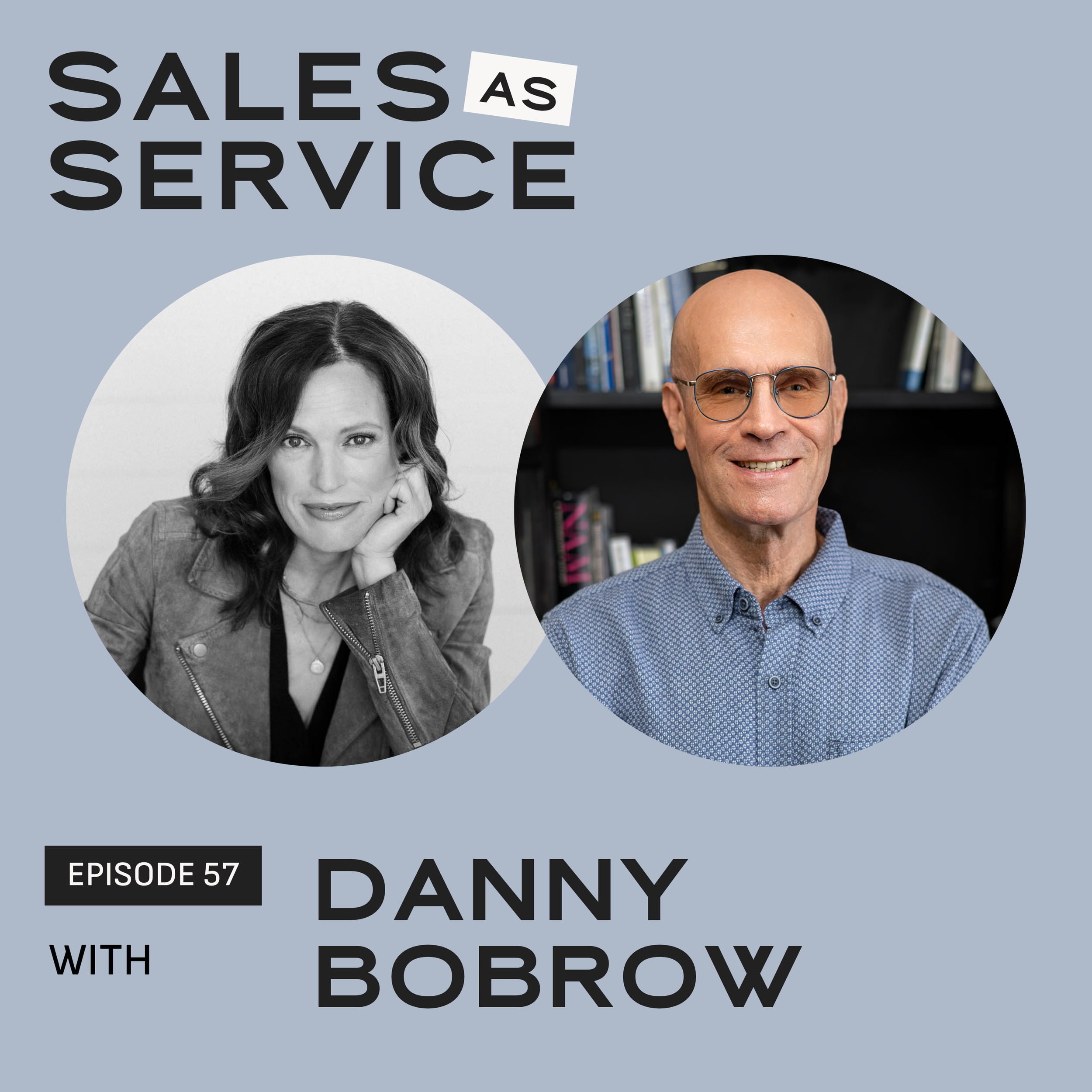
Persuasion Without Pressure: How First Impressions Shape Your Sales with Danny Bobrow
EPISODE: 57

Persuasion has a reputation problem.
For many founders and service professionals, it brings to mind pressure tactics, scripted sales pitches, and convincing someone to say yes. Danny Bobrow sees it differently.
In this episode, Danny shares the framework behind the Persuasion Blueprint, a practical approach built around three principles: signaling care, earning trust, and collaborating with the person in front of you. Rather than teaching people how to become more persuasive for their own benefit, Danny explains how better communication helps buyers feel understood, confident, and empowered to make the right decision.
Together, we explore why so many sales conversations stall after a promising start, how to avoid "expert override," and why listening may be the most overlooked sales skill of all. Whether you're having conversations in person, over Zoom, in your DMs, or through email, this episode will challenge the way you think about persuasion—and show you how to make every conversation feel more human.
In this episode, you'll learn:
Why persuasion is an act of service—not manipulation.
Danny's three pillars of persuasive communication: signaling care, earning trust, and collaboration.
The "10-second rule" for creating an immediate sense of care and connection.
How "expert override" quietly sabotages sales conversations.
Why listening is one of the greatest gifts you can give another person—and how it changes the way people experience working with you.
LISTEN TO THE EPISODE HERE 👇🏻
-
Tam: [00:00:00] Welcome to Sales as Service, the podcast designed to help you change your mind about sales, literally. I'm gonna help you change the way you think about selling. I'm Tam Smith, your host, sales bestie, and pitch partner next door. If you're tired of bros with biceps telling you how to crush a million dollars in your sleep or battling imposter syndrome on your own, you've come to the right place.
All you need to do is listen, then take action. No gym membership required. Let's get started.
Welcome back to Sales as Service. I'm your host, Tam Smith, and after a few weeks off enjoying a very short summer hiatus, we are back and kicking off season three, and I am so excited about today's guest. Danny Bobrow is the creator of the Persuasion Blueprint. And let's be honest, persuasion has a reputation problem.
For a lot of founders and service professionals, it lives in the same category as pressure tactics, pushy sales scripts, and trying to convince someone to do something they don't [00:01:00] actually wanna do. It feels like something to avoid, not something to develop. But Danny's approach, well, it just might change the way you think about that word.
He's worked with small and mid-sized businesses across industries, trained in improv at Second City, summited peaks on three continents, and spent decades studying what separates the conversations that convert from the ones that don't. The result is the Persuasion Blueprint, and it's not about convincing people of anything.
It's about communicating in a way that genuinely centers on the person in front of you, their fears, their goals, and where they are in their decision-making process. It reframes persuasion as something you do for someone, not to them, and if you're building a business rooted in relationships and service, that's a skill worth developing.
Let's get into it
Danny, thank you so much for being here. Welcome to Sales as Service
Danny: Well, thank you, Tam. It's my pleasure to be here
Tam: And I always like starting these conversations off by asking, tell us in your [00:02:00] words, who do you help and how do you serve?
Danny: Well, the Persuasion Blueprint is, is designed for largely small to medium-sized businesses who perhaps don't have the budget or the inclination to have an in-house training department or team. And, our goal is to help already competent, caring professionals, like your audience members, to be more successful by recognizing and overcoming a number of, obstacles owing to, issues with, with effective persuasive communication
Tam: And you've been at this work for a minute, since 1989, and, you know, you bring such a broad range to it: marketing, mediation, improv, mountaineering. It's, it's really a really unusual combination. When you look back at how The Persuasion Br- Blueprint came together, what was the moment you realized you were creating and building something really distinctive?
Danny: [00:03:00] For that, elusive aha moment. It's, it's, it's been, it's been a process for me. I mean, I, I initially began working in 1989 primarily with healthcare providers, and their typical story to me, which is I think probably heard by a lot of service providers regardless of the vertical, which is, you know, "Just get me the leads, just get me the leads, just get me the leads, and I'll handle it from there."
And what I learned is that in most cases, the teams w- with the best of intentions were not handling so much as mishandling the leads. That they were-- their batting average was, was in need of, uh, uh, of, of some coaching. because it's, it's expensive to, to get in front of prospective clients, patients, customers, and, and it's, and it's unfortunate when you miss the opportunity to effectively connect and convert them into a solid and kept appointment, and ultimately a happy and referring [00:04:00] customer, client, or patient.
So I, I realized fairly early on, especially once we had... were able to utilize tr- telephone tracking technology, in other words, being able to not only gauge the quantity of response, which obviously helped determine our effectiveness, through our various, lead generation tactics. But by listening in on the quality of the call, the quality of the communication or lack thereof, we became the, very painfully aware of the need for, for remedial action.
For coaching people on how to do a better job of bridging a number of gaps, as we call them, between their intention and how they're being perceived by their counterpart. So many times we're talking about not, not just, not just prospective clients, patients, and customers, but also communication with your, with your current client base, as well as your internal team.
That there are missed opportunities to show [00:05:00] caring, create a connection, and then develop a co-path in terms of collaboration so that the, the path that you're on is more likely to, to, to result in the desired outcome by, by having everybody recognize that they're in the boat together rowing in the same direction
Tam: Yeah. And you speak to your three pillars: signaling care, earning trust, and collaborating is, is the three pillars of persuasive communication. Can you walk us through each of those? And really more specifically, where do, where does it break down?
Danny: Sure It is a sequential process, which is not to say that you don't return to reestablishing caring or re-earning the connection or es- ensuring that you are on a, on the co-path through collaboration. The breakdown is often at the beginning of a relationship. it's also at various points in a relationship where we [00:06:00] forget these three essential components, that people don't care how much you know until they know how much you care, which carries through to the...
So that's, that's the care gap, the, the gap between the, the, your intention, the fact that you are a caring person, and how you're being perceived by your counterpart. And so there are a number of opportunities, and I like to talk about the, the 10-second rule, which is that w- in, on a telephone call with a prospective client, customer, or patient, you really ought to be able to signal caring within the first 10 seconds of that communication.
It can be through the tone of your voice. It can be through the choice of words that you use. It, it can be by asking them specifically if this is an urgent matter, if they're in pain, if they're a, you know, a patient, for instance. and, and, and that's critical because as I said, people don't care what you know so much as knowing that you care about them.
And then we talk about the trust [00:07:00] gap, which is a, where, where trust breaks down is often people, especially competent people who know exactly what they're doing and probably know exactly how they're able to help the person at the other end of the call or across the table from them. They tend to get into credentialing mode instead of listening, asking questions, truly understanding where that person is in terms of their challenges, their fears, their desires, and being able to articulate that perhaps even better than your counterpart can themselves, and that's the magic moment when you establish a connection.
Collaboration can likewise be derailed when we engage in what I often call expert override, where we've done this so many times. Literally some of us have done this, you know, work with the same communication I have. Over 36 years, I've probably delivered 10,000 presentations, [00:08:00] and it took me a while to recognize that, that people were more, interested in having me pause, avoid jargon, not worry so much about flattering my own ego as truly understanding what their needs are and asking questions that get them to visualize themselves participating in whatever treatment plan or p- or, or, or approach or customized approach that I, that I am proposing.
That we wanna, we want them to feel that we're in the same boat rowing together or we're on the same side of the table And that takes patience, on the part of the, the salesperson or the service, deliverer. Because as I said, we've done this a million times before, and sometimes we think that our expertise, our caring, and our knowledge are self-evident when so often they're not.
People assume that, that other people just want the facts, when in fact they really don't want the facts. [00:09:00] The-- As I've said twice already, people don't care how much you know until they know how much you care. So that's really what we work with our students on
Tam: It, you know, and I see it like whether it's face-to-face or, um, you know, over the phone, you know, where it's, you know, audio only. you know, it applies to, you know, written communication as well, you know, in a back and forth, you know, if it's a n- you know, direct message conversation or email conversation, you know, it's just as a- applicable.
Yeah. Yeah
Danny: often we project our own emotional state when we receive an email, and we can misperceive things, so we need to be extremely clear, and I think we should encourage a conversation sooner than later, even though that's getting more and more challenging, especially with the younger generation.
But not exclusively them. People are... They, they love to text, and they love, you know, uh, secondarily to... I mean, email is getting passe for a lot of people [00:10:00] now, and forget about the phone.
Tam: I-- s-
people have heard me say, like, the hill I will die on for all of our digital tools relationship, what has always been important, but will, I, I believe, has never been more important and will continue to be important. And that, like, that's the whole, whole goal, you know, that kind of initial contact, moving people through the, the stages of trust to, you know, ultimately, if you're not starting with a conversation, you know, to move that online engagement, offline to, get in a room, get on the call, get on a video call to actually have that one-to-one face-to-face connection.
Danny: That's right. and AI is a tool that I use more and more all the time, but it's also becoming more and more apparent to me that it's going to be a long time, if it's ever gonna happen, that AI can supplant empathy. It can help with efficiency, but empathy is another story. I, I don't really foresee anybody saying, "Uh, yeah, I'm, [00:11:00] um-- Thanks for agreeing to talk to me about my offering.
Now let me have you speak with my robot because they're a better communicator than I am." You know, that's, that's not gonna go well. that's not to say that AI won't have a place in coaching people. I mean, it's got very-- It's-- The technology is advancing where it can, interpret calls. It can check for the number of times you use the caller's name, for instance, and I think at some point it's gonna be able to evaluate even the tone, inflection, and resonance of your voice.
But ultimately, you're the one that's gonna have to do, do the work. And the, the happy reality is that when you communicate effectively, you eliminate friction, and you become more efficient, and it becomes more fun to talk to people. I just had a call with a, a service provider, for my CRM and, and, and frankly, I was in sort of-- I was in transactional mode.
I, I caught myself fortunately, because she actually [00:12:00] needed something from me. I was calling because I had a technical issue with my CRM, and, she had mentioned that she wasn't having a great day. And my first reaction was, "You know, that's, that's fine, but I really need this problem solved." And I caught myself, and I took a deep breath, and I said, "Well, what's going on?"
And she said, "Well, I've just been really pushed and, and ha- and been on one call after another, and I'm feeling a little bit, out of sorts." And I said, "Well, I'm sorry to hear that. Maybe w-with hope we can, we can change things, you know?" She said, "It's been a long week." I go, "Well, next week won't be a long week.
We, we have a, we have..." This is happens to be, we're recording this during M- right before Memorial weekend. And she says, "Wow, I forgot about that. Thanks for letting me know." And, and the tone of the conversation changed, and she wound up going the extra mile for me t- working to help me identify an email issue that I had, which wasn't even within her wheelhouse, but she happened to know something that I didn't.
And I even wrote a blog recently on, on how, you know, communicating when we [00:13:00] reduce tr- vendors to their function, their experience is not only less than it could be, but we never receive the level of service that we might receive if we remember that they're human beings as well.
Tam: Absolutely. Absolutely. shifting to talk a little bit about, persuasion, and I'm always hesitant when I bring up that word because I feel like it conjures up, you know, for folks that are already sales resistant, you know, it conjures up, you know, associations with, you know, the more traditional, you know, v-version of sales versus the, you know, that people associate with the, you know, kind of salesy, manipulative tactics, you know, versus the, you know, modern approach to sales and business development, which, you know, is very, values-led, you know, should be values-led, relationship-focused.
but I think of it, like, I think of so much of my work, I feel like, as helping people get out of their own way sometimes. you know, any kind of y- sales, you know, typically, you know, problem identification, it's gonna require some [00:14:00] change on the part of the person that you are speaking with, you know, the, to do something different than they were doing before.
And that is, you know, creates a lot of resistance, and that's where I feel like, you know, persuasion, when you use that force for good, you know, to help people, you know, overcome their self-imposed new limits and obstacles is really what I'm, kind of the version of it that I'm speaking of here. the difference between being likable and being able to be persuasive, a lot of, you know, service-based founders kind of lean on one.
You know, myself, you know, in kind of my early stage sales career, you know, was the, was probably more concerned, before I had a, you know, level of experience now of, you know, just, you know, re-relying on personality and being liked, you know, versus being the, the, the expert in the room that could really lead someone, you know, to a decision, uh, and to embrace, you know, that change to get the desired result.
how do you coach [00:15:00] the folks that you are working with to understand the difference and, and, and help people kind of, you know, make that transition, um, from, you know, being attached to needing to be liked versus needing to be, you know, the, the expert consultant and being able to be persuasive?
Danny: Well, that was a very content-rich, question that you shared. There's a lot to unpack, as they say. But you began by, by, by the word persuasion, and I, you know, I, I admire you by having a podcast called Sales as Service, because I think right away you're trying to impart a message that sales is not coercive nor manipulative.
Sales is empowering people to make a decision that is in their own best interest. And in that sense, if people practice that, and, and it's been said that, you know, I think, in the movie Shane, [00:16:00] and I'm very dating myself 'cause I think that came out in like 1957. But Alan Ladd said that a, a gun is just a tool.
It's just like a hammer. it's no more or less ethical than the person using it. And I define persuasion as a series of skills and mindsets intended to influence someone sort a- toward a desirable course of action, just as sales is. It's, it's, it's non-coercive. In fact, I would say that if it's used by an honest person- It's the most honest form of communication because what it does, what The Persuasion Blueprint is intended to do, is to show and empower people how to communicate their talent, their integrity, and their, their, their honesty in a, in a efficient and consistent manner.
And so, you know, s- sales training has gone through [00:17:00] quite an evolution over the past 40, or somebody-- some might wanna say 100 years, because I think Dale Carnegie's book, "How to Win Friends & Influence People," which I still draw heavily from, goes back to the early 1900s or maybe, yeah, you know, 1930s. But, you know, I learned, I cut my teeth on Robert Ringer, who wrote "Winning Through Intimidation," and Denis Waitley, who wrote "The Psychology of Winning."
Both of them had valuable information to share, but Denis Waitley focused on the internal state, which is, you know, motivating you to think positively and that just by through force of will, sheer force of will, you could determine the outcome, and I think that that was limiting, and, and not accurate.
Robert Ringer talked about basically everybody's in business, it's a zero-sum game, so really don't trust anybody. And I believe that the, The Persuasion Blueprint is a [00:18:00] synthesis and takes those to another level, which is recognizing the human element. And that, yes, people are, are self-interested individuals, but if they're communicated with in a way that demonstrates that you can be trusted and that you are there-- and they are therefore out of their limbic system, which is the emotion center of the brain, where we're-- we, we learn to respond to threats and help move them into their prefrontal cortex, where executive and cognitive function can take place, that you're in a, a much better position to-- for them to hear what you have to say.
And so that's why we go through this as a sequence. You have to signal caring, you then need to move on to c- establishing a connection, and then moving on to building the plan together by giving them agency and ownership. So, uh, I hope I've answered your question. It was a long question and perhaps an equally long [00:19:00] answer,
Tam: It's a, it's a complex topic. You know, there's, and there, it's a, it's,
Danny: We're talking about human beings
Tam: Yeah, and people have a lot of strong, strong feelings about it. Um, the Persuasion Blueprint came out of, you know, real world applicla- application across a really wide range of clients and experiences, um, and context. What has surprised you most about how people responded to it when they started using the frameworks?
Danny: Right. Well, the first surprise I got was how it affected h- how... I mean, you know, cards on the table, this is, was, was almost a form of, of, of applied self-therapy. Because just telling you a little bit of my story, I w- I was born with a, uh, a severe visual de- defect that was not correctable. And as a consequence, I, I have no depth perception.
I'm blind in my left eye, and I'm only marginally correctable in my right eye [00:20:00] So I grew up with a, with a belief that I was intelligent and athletic. Unfortunately, I had nothing to back that up. I was a terrible student and a worse athlete. And you-- we could talk for hours about the effect that had on my self-image, but, uh, I won't bore you or me with that.
Uh, but eventually I was able to address that because I, first of all, got reading glasses when I barely graduated high school. My ophthalmologist, for some reason, didn't think I needed them until I was going to college. But I, you know, better late than never. And then as a sophomore in high school, I was taught the concept of the-- by my gym teacher, taught the concept of the psychological fatigue barrier.
And I'd never heard about that before, nor have I heard about it since. And I've even done Google searches, and it's nowhere to be found, so he must have originated this. So my hat's off to Mr. Rusk. And he t- it holds [00:21:00] that our minds tell us to quit long before our bodies need to, or, or our minds for that matter.
And it, and it just turned on a light switch for me, and I became a very persistent and resilient individual. I began to excel athletically as long as it wasn't a... It was still an individual sport 'cause I couldn't play team sports which involved a projectile 'cause I couldn't see the darn thing. So I, I gravitated toward endurance sports, weightlifting, martial arts, and, uh, and I excelled.
But what happened a- as a consequence of that is that I never really developed team dynamic, effective team communication skills. As I got involved in mountaineering and adventure racing and then, you know, became a mediator and an arbitrator, I initially learned that I really didn't have the skills to work in a team setting.
Uh, being a mediator and an arbora-rator, arbitrator is not really a, a team activity 'cause you're there to hear what people have to say, and then you prescribe a [00:22:00] solution, and you try to reach a compromise. Where I really began to see where I was limited was when I got involved in the mountains with, with teams on expeditions and in adventure racing in a similar capacity.
And what I learned was that my persistence and, resilience need to be tempered with patience and respect. So I-- my watch phrases now are respectful resilience and patient, persistence and what they, what they've taught me is that you have to let the people know that you care about their vision if you expect them to care about yours.
And what I mean vision in this context is the goal that we're s- striving for. And I learned through painful experience how that works and how that doesn't work. And, you know, in these crucibles, in these challenging situations when you're actually faced with, sometimes life or death situations, attitude is everything.
And, and you only move as fast as your slowest team member. So I learned to be [00:23:00] patiently persistent and respectfully resilient, to let people know that I cared about them, that I was not concerned solely about my own welfare and development, and that it was the, it was the goal, not the role that really mattered.
So that's what sort of tempered me and taught me probably more than anything about how to be successful in, in working with individuals
Tam: a- and it's this, the mindset behind the work, I find, you know, that's like so much of it is the, you know, the mindset that you go into it and it is... For the clients that I work with and, you know, even our audience listening, you know, that, that feel that resistance around that, that shift of when it's the focus on the, you know, outward focus, you know, versus the inward focus and the outward focus on the, you know, serving and solving, kinda takes that pressure off to some degree.
I found that to be really helpful
Danny: Absolutely. [00:24:00] I do w- hasten to add that to be persuasive, you really first need to begin with yourself. You need to recognize what your emotional state is, what emotional ecosystem do you inhabit, as well as your counterpart. Because you gotta sort of understand w- you gotta attune to, to who they are and where they are.
And that's why these sales techniques that talked about, you know, ent- exuding enthusiasm and, and, and establishing needs and converting needs and converting attributes into benefits, that's all important, and we do talk about that. But that has to follow understanding where you are in terms of you and your counterpart, where you are in terms of emotion and belief, 'cause there's different types of resistance that you're going to encounter.
And if you're trying to have a political discussion with somebody whose entire identity is bound with their beliefs and attitudes or position on a particular [00:25:00] subject, bringing facts to a feelings fight is not going to, is not going to serve you. And so, you know, you have to recognize where they at as well as where you're at, at.
You know, I have certain rather deeply held political views. I think it's important that I recognize that and that I be open to possible change, and that that doesn't represent a threat to my emotional survival, as it seems to these days for so many people. That, you know, we're using brains that haven't evolved all that much since we were on the savanna or in the jungle as, as hunters and foragers.
We still respond to threat the same way, and it's, it-- And so we need to recognize that and learn certain techniques to communicate with ourselves at least as much as with our counterpart to sort of get us out of our limbic system and into our cognitive center so we can be rational instead of rationalizing beings.
Because we all [00:26:00] really make decisions based on emotion and then tend to justify them with logic. And the sooner we can recognize that and, and, and, and, and, master that process, the, the sooner we're gonna be more effective and more persuasive in our communication.
Tam: Definitely. Well, I wanna ask you about your time at Second City. I'm so envious. I'm a huge comedy, sketch comedy fan. Like, if I, you know, if someone said like, "Your, your, uh, fantasy job, you know, if you weren't doing what, what you're doing now," I would, I would, I'd wanna be a s- an SNL cast member. So, I, wanted to ask you about, uh...
It's a really, like, not an obvious credential, you know, for, kind of a sales and persuasion coach, but what ha- did improv or what has improv taught you about, you know, being present, uh, and being persuasive?
Danny: That's a great question. I don't get it asked often. What it taught me first [00:27:00] and foremost was the important of colla- importance of collaboration, because the first thing they teach you in improv is... 'Cause there's a tendency, and this goes back to listening, which I've subsequently learned, and we talk a lot about different habits that people have when they're supposed to be listening that they need to recognize and break.
But the key, they have a phrase called "yes, and" in improv, and that means whatever your counterpart serves, 'cause if you're improv- improvising, we don't know where this conversation is going to go. The, the foundation of the communication has gotta be that I agree with you, that whatever you make, whatever you s- whatever you present, whatever you suggest, I'm going to agree with it and make it bigger. And that sounds maybe obvious, but it's a lot more challenging than it may sound. Because the tendency for many people is to like, "I'm going into this i- into this improv, into this, exercise with an idea, with an agenda, with a [00:28:00] preconceived notion." And it doesn't take long for that to be completely derailed because your partner isn't a mind reader
Tam: Mm-hmm.
Danny: And sometimes if they read your mind, they might be confused anyway, 'cause you could be confused yourself as to where you wanna go.
So it really is a matter of breathing, relaxing, and looking forward to, to the future, to the exciting path, which is very much like mountaineering in attitude and adventure racing or, you know, in the military. Plans are the first thing to go out the window. You have a battle plan, but your enemy has other ideas.
And so you've gotta be very flexible and adroit at, at, at, at going with the flow and making the best of the situation. That's what it taught me. The other thing it taught me is that improv's a lot harder than it looks. I got into it because people said, "You're a really funny guy, and naturally you always have a, a, a quip."
And, and that's true. I, I do tend to be able to be very humorous and come up [00:29:00] with something original that makes people smile. And humor is a huge part of persuasive communication, by the way. But what I learned to my dismay was that I was asked to be funny or put on stage. I tended to freeze up. So what I learned is that improv, I, I, I, I never, I never thought for a moment about quitting my day job, I'll put it that way. And I have the utmost respect for people that, that are, that are successful at improvisation. But it's a-- was a good lesson for me about connecting with people, letting them be the star, putting the focus on them, and setting my ego aside. And that's where I think just-- I, I mentioned listening. That's an area where people can really improve their communication, is by recognizing that listening is not, sitting patiently waiting for the person to stop talking so you can say what's on your mind.
That's not listening. [00:30:00] And there are probably seven other habits that I've recognized, that, that derail effective listening, 'cause listening is probably the highest compliment you can, you can give somebody. You know, listen and silent are the same words. They're just anagrams. And so I like to say that silence is the ultimate compliment
you know, there's so many things that, that people do. Primarily is when we listen, often we need to ask ourselves the question of, "I-is my goal in this communication to enrich the relationship or flatter my own ego?" 'Cause when people listen, they're often thinking about what they wanna say next.
They finish people's sentences. They engage in comparative reality. They try to fix problems when people just wanted to be heard and validated.
Tam: I, I heard something. I was in a, a sales workshop earlier this week, and one of the speakers said, "Fall in love with the problem, not the product." Uh, you know, which that could go for, you [00:31:00] know, p-product or service.
And, and, and as, you know, experts and consultants, you know, we, we're very passionate about what we do and, and what we're, you know, what we wanna share, and it's really easy to fall into, you know, a product dump or feature dump. And I know I've, I'm guilty of it or have been guilty of it, and that was, has really stayed in my mind, , to fall in love with the problem.
And it's even-- I've noticed this just in the last few days, it's just h- even helped me improve my dialogue, the kind, the questions I ask.
Danny: What I love about that framing is that it, it changes the focus on, on who you are and what you offer to where they are and what they want, what they need. And that's what we talk about in collaboration and connection, that, that people get... And, and enthusiasm. I've written a recent blog on, on how enthusiasm is so often misused, 'cause you just said, "We just do a product dump."
Well, you know, and, and, and in the process we're, we're real excited about it and we believe in it. But really, [00:32:00] the, the... your counterpart could be just staring and, and, you know, v- uh, virtually or, or listening saying, "Well, you know, you're sort of on, you're on your own little journey right now. I'm not participating."
So the problem means finding out what's important to the, to your counterpart, to your prospect, and then getting enthusiastic once you've heard enthusiasm from them. What, what, what ignites their passion? And then you build it like a fire, is the way I look at it. You know, when you build a fire, you don't light a match and dump a bunch of logs on top of it, right?
You, you start with tinder and kindling, and then you amplify the fire through an organic process where you... it's, there's give and take, and you, you gauge and judge when it's appropriate to add more fuel, right? That's what the art of building a fire is, and I think it's the same thing in a building a successful sales [00:33:00] communication.
And I like, and I've written down the, uh... I can't read my own writing, but, you say, "I fall in love with the problem, not the product." I think that's excellent, and I'm gonna steal that
Tam: Oh, I'm gonna steal the fire analogy because that's so, that is a very strong visual. Uh, and I find what's, you know, so without, you know, practice and intention, so many people tend to do is we, you know, we rush to wanna like book the meeting, you know, close the deal and, you know, you've just connected with someone and started a conversation and rather than trying to tender that fire, you dump a bunch of logs on it and put it out.
and that's a really powerful visual, so
Danny: Yeah. And I don't-- can't believe it just occurred to me like yesterday. Really, I was, I don't know
what I was...
Tam: you with it when I reference it.
Danny: you. Thank you. 'Cause I don't think, I don't, never heard it from anybody else.
Tam: you've summited no less than 20 peaks on three different continents. and I know there's an obvious metaphor there for persi- [00:34:00] persistence and preparation, but what did the ac- the actual experience, what has it taught you about communication and trust, especially under pressure?
Danny: I touched on it a little bit earlier, Tam, about the team dynamic element. it did teach me that, you know, you wanna prepare for as many contingencies in, in life on the mountains, but it's a great metaphor for life, as you said. You wanna prepare as much as possible. Caring and preparation are table stakes in, you know, for, for the, for success in, in, in persuasion.
So I'm not saying ... And I'm saying that it's not the case that The Persuasion Blueprint offers any magic bullets or is a substitute for caring or preparation. But what it does is, and what it taught me in the mountains and, in adventure racing as well, is that you need to maintain a positive attitude and a belief in success, and that when [00:35:00] one door closes, another one can open. It, it won't always open, but if you think it won't open, then it certainly won't. the, a saying that I haven't thought of until right now for a long time is that, "Whether you think you can or think you can't, you're right." You may have heard it before.
Tam: very definitely.
Danny: attitude is key. It doesn't guarantee success, but a bad attitude will guarantee failure
Tam: Let's jump into our fast five. Your I can't live without it software or app
Danny: that has become Copilot for me. and I- or Grok on my phone. Something occurs to me like, you know, what's happening in, with Cuba now. So I ask, "Does Cuba pose an existential threat to America's national security?" Just try to cut to the chase, and it's very useful in that regard. It does hallucinate.
You can't rely it as- on it as gospel, [00:36:00] but it certainly helps stimulate conversation and, and further learning for me
Tam: Best advice you've ever received about sales and business development
Danny: Nobody ever, nobody ever listened themselves out of a sale
Tam: Morning routine must-have
Danny: Get out of bed early, w- b- whether I feel good or not, and get to the gym or get to my home gym and get a workout in because I know with 100% certainty that when I'm done, I'm gonna feel a lot better than I feel right now
Tam: Your walk-on song, the one song that always pumps you up
Danny: Walk of Life by Dire Straits
Tam: Hmm. Oh, that's a good one. and if you only had one hour each day for business growth, how would you spend it?
Danny: For business,
Tam: Business growth, how would you
Danny: for business growth, write a blog on a topic. I find that the best way to, for me to learn is to write on a subject, because it shows me what I don't know, and I have, [00:37:00] and it gives ... I have a, an insatiable curiosity to not wanna be stumped by anybody if they ask me a question. So that's the, perfectionist in me, which is not a virtue, but it
I guess it's more I'm, I'm trying to cr- I, I've done a pretty good job of changing that to a, a, a desire for excellence as opposed to a need for perfection,
Tam: That's an
Danny: that's
Tam: that's a good reframe. I like that. As, as a, as a per- a, a f- I'm a perfectionist as well, so I
Danny: a recovering
perfectionist? Yeah.
Tam: Yeah, that's a good reframe. Where can folks find and connect with you online?
Danny: My website is my name. It's dannybobrow.com, and if you go there, w- I will offer you a complimentary persuasion scorecard, which is just a series of easy-to-answer questions that help establish a baseline for where you are right now on the caring, connection, and collaboration, [00:38:00] spectrums. And, so we're all on the spectrum,
Tam: Yeah.
Danny: in various degrees.
And then we can also schedule a strategy call. I can offer you a primer on the Persuasion Blueprint. it's all complimentary. I'm just happy to connect with you and try to practice what I preach by getting to know you, understanding what your concerns, challenges, and opportunities are, and then see if we can't collaborate on crafting a, a path that will help you achieve even greater success
Tam: Excellent. Thank you so much for being here
Danny: Oh, it was my pleasure, Tam. Thank you for the opportunity. I enjoyed it it's Been a
Tam: a pleasure.
Thank you, Danny Bobrow, for being here this week. I love thinking about successful sales conversations like you're building a fire. You don't light a match and then go dump logs on top of it. You start with tinder. You watch it. You add more when it's ready. You pace that conversation like you're building something together, not just racing toward the close.
I also really love his perspective that silence is one of the greatest gifts you [00:39:00] can give someone. It creates space for the other person to be heard. It keeps the focus on them instead of on what you're gonna say next. So here's your sales and service challenge for this week. Do a listening audit on one of your recent sales conversations.
And side note, if you're not already recording your discovery calls yet, I highly encourage you to start. Reviewing your sales conversations intentionally is one of the fastest ways to improve your sales skills. So pull up your most recent recording or think back to one you remember clearly and ask yourself these three questions.
Did you signal care in the first 10 seconds and build rapport? Did you jump straight into your agenda? Were there moments where you slipped into credentialing or demo mode before the other person felt fully heard and you had fully diagnosed the real problem or problems? And finally, did the conversation feel co-created, a genuine collaboration, or did it feel like you were presenting while they simply watched?
[00:40:00] No judgment here. This is an exercise I do myself. You're simply looking for one thing to do differently next time. That's it. Because the goal here isn't to get better at selling everyone, it's to get better at serving the people you're best equipped to help when there's a genuine fit, and the only way to do that is through consistent, intentional practice.
You can find Danny at dannybobrow.com, where you can take his persuasion score assessment and schedule a strategy call, and I've linked both in the show notes. That's it for me this week. It's good to be back, and I'll see you right back here next week on Sales as Service.
MORE OF A READER? 👇🏻
For many founders and service professionals, persuasion immediately brings to mind pressure tactics, manipulation, and the kind of sales conversations that leave everyone feeling uncomfortable. It's no surprise so many people avoid it altogether.
But what if persuasion wasn't about convincing someone to do something?
What if it was about helping someone feel understood?
That was one of the biggest takeaways from my conversation with Danny Bobrow, creator of the Persuasion Blueprint.
Danny has spent decades studying communication across industries, coaching thousands of professionals on why conversations succeed—or fall apart. What he's discovered is surprisingly simple: most conversion problems aren't lead problems. They're communication problems. And communication is a skill we can all improve.
At the heart of Danny's framework are three ideas: signal care, earn trust, and collaborate.
Too often, especially when we're passionate about our work, we rush into explaining our expertise. We know exactly how we can help, so we start solving before we've fully understood the problem. Danny calls this "expert override." We become so eager to demonstrate our knowledge that we unintentionally skip the most important step: making the other person feel heard.
His reminder that people don't care how much you know until they know how much you care may not be a new idea, but it feels more relevant than ever.
One concept that really stuck with me was Danny's "10-second rule." Within the first few moments of any conversation, people are already deciding whether you genuinely care about them. That isn't determined by your credentials or your pitch. It's shaped by your tone, your questions, and whether you're fully present.
We also talked about listening—something we all think we're good at.
Danny shared an observation I'll never forget: listen and silent are made up of the same letters.
Real listening isn't waiting for your turn to speak. It isn't mentally preparing your next answer while someone else is talking. It's creating enough space for the other person to feel seen, understood, and safe enough to tell you what they actually need.
Toward the end of our conversation, Danny shared an analogy that's been replaying in my mind ever since.
He compared great sales conversations to building a fire.
You don't strike a match and immediately throw large logs on top of it. You begin with tinder. Then kindling. You pay attention to how the fire responds before adding more fuel.
The same is true in sales.
You don't build trust by overwhelming someone with information. You build it gradually, matching their pace, asking thoughtful questions, and allowing the conversation to develop naturally.
For me, that's what Sales as Service has always been about.
Not becoming more persuasive so you can close everyone.
Becoming a better communicator so you can better serve the people you're genuinely equipped to help.
Because when people feel understood, trust grows. And when trust grows, better decisions follow—for everyone involved.
✦ YOUR SALES AS SERVICE CHALLENGE
Do a listening audit on one recent sales conversation.
If you're already recording your discovery calls, pull up your most recent conversation. If not, think back to one you remember clearly.
Ask yourself three questions:
Did you signal care within the first 10 seconds, or did you jump straight into your agenda?
Were there moments where you slipped into explaining your solution before fully understanding the problem?
Did the conversation feel collaborative—or did it feel like you were presenting while the other person simply listened?
The goal isn't to get better at selling everyone. It's to get better at serving the people you're uniquely equipped to help when there's a genuine fit.
And the only way to do that is through consistent, intentional practice.
RESOURCES & LINKS
Your next client - Calculate what it takes.
Learn how to consistently book 3–5 sales-qualified meetings each week - Book an Alignment Call.
READY TO STOP WAITING ON REFERRALS?
If this episode sounds like where you're at right now, let's talk. Book a free Alignment Call and we'll map out what's actually stalling your pipeline. Book an Alignment Call →
And if you loved this episode, subscribe and leave a review on Apple Podcasts — it helps more service pros find the show.

TAM SMITH
I’m Tam Smith-Sales Growth Strategist and Founder of Studio Three 49. I help service-based founders find, connect with, and convert right-fit clients through predictable, sustainable outbound sales solutions.
No pushy pitches. No bro-marketing. Just simple, structured systems that turn connections into clients.