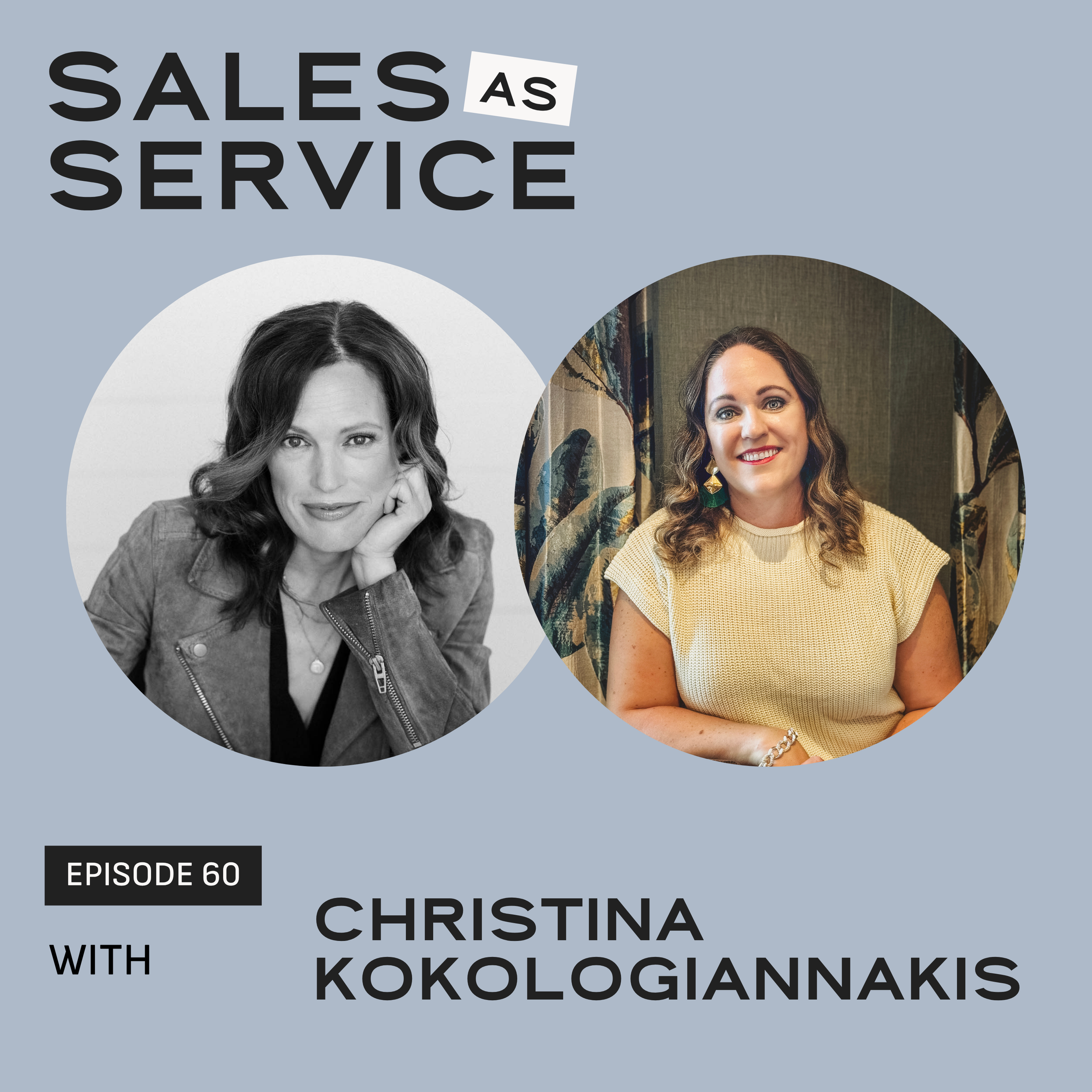
More Revenue, Fewer Clients: Rethinking the Math Behind Growth with Christina Kokologiannakis
EPISODE: 60

What if the business that got you here is also the thing keeping you stuck?
In this episode of Sales as Service, I’m talking with Income Architect and International Keynote Speaker Christina Kokologiannakis about what she calls Shadow Success: the point when a business can look successful from the outside while the model behind it requires too much time, energy, or effort to keep growing. Christina has spent years building and studying business models designed to create more revenue without requiring more hours - and helping other founders rethink what growth can look like.
We dig into her Income Jump framework and why breaking through a revenue plateau may not require finding a new audience or starting over. Instead, the opportunity may be hiding inside what you’ve already built: a bigger problem you can solve, a stronger transformation you can sell, a different pricing structure, or a more focused approach to sales. We also talk about Christina’s idea of becoming a Time Billionaire - building a business that supports the life you want instead of becoming the life you have.
In this episode, we explore:
How to recognize when you’ve fallen into Shadow Success
Why a revenue plateau doesn’t necessarily mean you need more leads
How Christina approaches an Income Jump using the audience and expertise you already have
Why undercharging can be connected to confidence and how clearly you communicate the transformation you provide
What Christina would do if she had only one hour a day to grow her business - and why her answer is sales, not more content
LISTEN TO THE EPISODE HERE 👇🏻
-
Christina: [00:00:00] When I first started really being successful, I made, like, 70K a year. So I was in corporate for a long time, but when I left permanently, like, I don't wanna go back, I don't wanna do this anymore. I had two children already. I was 30 weeks pregnant. I lost my son. And I was just like, "What is this life that I'm living?
Like, why am I doing this?" But the first two years, I made, like, 70,000 a year, right? And then I said, "I gotta do better." Like, I can't keep working so hard for 70K. To me, it just didn't make sense. And so the third year, I restructured a lot of what I was doing, and I made over half a million dollars, like, take home to my pocketbook.
Tam: Welcome to Sales as Service, the podcast designed to help you change your mind about sales, literally. I'm gonna help you change the way you think about selling. I'm Tam Smith, your host, sales bestie, and pitch partner next door. If you're tired of bros with biceps telling you how to crush a million dollars in your sleep
or battling imposter syndrome on your own, you've come to the right place.
All you need to do is listen, then take action. No [00:01:00] gym membership required. Let's get started.
I started Studio 349 in 2020, built the team, generated real revenue, and very recently I realized I'd been chasing someone else's definition of success. There's a pressure that comes with being a founder, messaging from every direction telling you more is always the goal.
Scale, scale, scale, because that's what a, quote-unquote, "successful business" is supposed to look like, and it's very convincing from the outside. The revenue, the visibility, the business everyone assumes is going well, but it can feel completely different up close. I've talked to founders, myself included at one point, who are hitting every number they set out to hit and still feel like they're barely holding it together.
And for a long time, I didn't have a name for that gap, but my guest today does. Christina Kokkinakis calls it shadow success, and she's lived it more than once, including a stretch early in her career that nearly cost her her marriage. She's spent the years since [00:02:00] figuring out what actually gets a founder out of that hole, and it's not working harder.
It's what she calls the income jump, finding a bigger problem to solve for the audience you already have instead of chasing a new one. Christina is the founder of the Time Billionaire Society and an income architect who's coached founders through pricing conversations most of them are too afraid to have with themselves.
She's also refreshingly honest about the failed businesses that got her here. Here's my conversation with Christina
Christina, thank you so much for being here. Welcome to Sales as Service.
Christina: Thank you for having me. I'm so excited to be here.
Tam: Well, I always like to start these conversations off by asking, tell us who do you help and how do you serve?
Christina: Yeah. So I help women founders who are building a business, but really want to live their life alongside of their business, and they wanna make sure that they're really building something that's gonna last, and ultimately wanna step away and enjoy it.
Tam: You use the phrase shadow success. What does [00:03:00] that mean, and how can someone recognize that they're actually living in it?
Christina: Yeah, so shadow success is very interesting, and a lot of women are actually living in it, and men, right? Where you feel like ... Okay, so, like, look at it this way. When everybody sees you, they think you're amazing. They think that you are so successful, and I have people who look at me like that, right? And they're just like, "You're so amazing.
Everything you do is great," but you're slowly dying on the inside. Nobody knows how much you're struggling. Nobody realizes that you can't breathe. You're like, "I can't get a moment." You don't spend time with your kids, and the worst one is that you're making a lot of money, but you're poor, right? You're spending more and more trying to catch up and get out of it, but at the, at the end of it, you're like, "Okay, wait.
I made, you know, a million dollars, but I only took home 200,000. Like, what am I doing?" And you're just working harder and harder, and I call it like a black hole. You just keep going deeper and deeper into it because it's consuming you. And so shadow success really is that you look amazing on the outside, but inside you're slowly [00:04:00] dying, and the women who really wanna get out of it, they wanna build that life, they wanna build that business, but they don't wanna work hours and hours for the rest of their life to do it
Tam: I can so relate to that.
I mean, that was me in 2024, where, you know, I had just- I'd said yes to everything. And, you know, from the outside in, it probably looked like, oh, she's doing really well. And I frankly had grown faster than I needed to, you know, taken on, you know, more, you know, headcount and resource than was really necessary because, you know, I was listening to kind of that voice from the outside of, you know, that's what success looks like.
You know, it's more, more, more. Scale, scale, scale. I'm learning now in this season of business, I think, to define what that means for me, you know, from the inside out versus the outside in.
Christina: And that's the hardest thing because I talk to so many women founders who are just like, "How do I do it?" Right? They're like, they're like, like, "I'm stuck."
And, and the funny thing is I pulled myse- well, I'm still kind of like pulling out, and then I fell back [00:05:00] into it. But for... So 11 years ago, I'm gonna give a little, like history of my entrepreneur journey 'cause I think people enjoy that, too. So I've been an entrepreneur for 20 years. I have only become successful in the last 11 years, okay?
So I have built multiple businesses that have failed. I've had a product, I had a tech startup, I've gone to VC for funding. I had to take all this time, basically 12 years if you wanna look at it that way, of figuring out how to be successful. And when I started finding that success, I was like, "Oh, I'm gonna work harder and faster.
Let- I could do more. Let me do more, do more." And instead of doing better, I just got into such a hole that I was so miserable, and what kinda jolted me is my husband was like, "Hey, if this is how we're living together, I want a divorce." He's like, "I don't wanna be with you." He's like, "This is absurd. We have all these children.
I don't see you. I don't talk to you. You're running crazy. Every time you do, you bark at me." He's like, "I don't want this." And I had to stop and I go, for all the money I was making, [00:06:00] for all the stuff I was doing, I was like, "What is the point of all of this?" And so I pulled myself out, but what happened is when I started my new business online and the society, the Time Billionaire Society that I'm building, I kinda got back into it because you put your head down, you're really into it, and you're just like, I- I just have to kinda grind.
And I keep telling him, I'm like, "Look, I promise it will be better next weekend and next weekend 'cause I'm kinda grinding." And he's like, "We're back at this again." 'Cause I run multiple businesses, so I'm really busy in the other two as well. And he's like, "So when's next weekend coming? Like, you kept saying we were going to, we're going to."
And I was just like, like I'm doing it again. So it's very hard even if you have experience with it To get back out, and you really need a tribe, a community, people who understand it, who are working for it, which is why I built the Time Billionaire Society in the first place, because women, even men, there'll be a men's club eventually coming.
So right now I'm just focusing on women founders. But imagine being in a community built for this by women. It [00:07:00] is not run by me as a coach. I'm not teaching you, um, certain frameworks. No. This is women shoulder to shoulder, and they wanna live an extraordinary life alongside an extraordinary business at the same time, too.
And so you're getting that proximity with these women. So if you're just like, "I fell off the track, like I, I'm really struggling. I haven't seen my family, but if I stop, I can't make the money." And then the women can gather around you and say, "Hey, I was there, too. Here's what worked for me. Maybe this will work for you."
Like, there's so much opportunity there that that really helps to pull you out
Tam: And we're talking about really, you know, it sounds like doing less to do more. You call it the income jump. Walk us through what that actually means and what's changing inside the business.
Christina: One of the biggest things with income jumping that people don't understand...
So when I first started really being successful, I made, like, 70K a year. So I was in corporate for a long time, came out of corporate. I mean, even though I had corporate, I was still doing a lot of startups trying to, like, get my [00:08:00] own thing. But when I left permanently, like, I don't wanna go back, I don't wanna do this anymore.
I had two children already. I was 30 weeks pregnant. I lost my son during pregnancy, and I was just like, "What is this life that I'm living? Like, why am I doing this?" But the first two years, I made, like, 70,000 a year, right? And then I said, "I gotta do better." Like, I can't keep working so hard for 70K. To me, it just didn't make sense.
And so the third year, I restructured a lot of what I was doing, and I made over half a million dollars, like, take home to my pocketbook, right? Not just the company made it. And what I realized is when you're income jumping, it's not just make more money, 'cause everybody says that. Make more money, work harder, grind faster.
Like, just, just put to it and you'll get there. The problem is you burn out before you make the money. Or like several of my past clients and friends, they're making a million a year, but they're stuck. They're working harder and harder and harder, and they can't get past that million that they've made it to.
It eats away at you. So what income jumping really is is finding a bigger problem to solve. [00:09:00] Then you're looking at... Really you should be looking at the same audience you really have already, so you're not rebuilding. The goal is taking a bigger problem, taking the audience you already have, solving that bigger problem at a higher price point.
So instead of looking at volume saying, "Oh, I wanna sell to a hun- 1,000 people a year or 2,000 people a year," you're like, "Can I make three times the amount of money selling to 200 people a year?" That's what it's really focused on, streamlining that because if you have more money coming in and less people you have to work with, you get more enjoyment, right?
And then it's all about building the systems. It's about not just growth and build, but, like, how can I exit? What's the exit strategy? What's the plan for me to step away? Am I gonna bring somebody in who's gonna run it? Is it built in a way that I can actually step away? Or like if I built something where I'm only the coach, and you have to come to me for everything, I have built that business before.
When you try to step away and bring [00:10:00] another coach, they're like, "Whoa, whoa, whoa, whoa. I'm paying you all this money. I don't, I don't want that person. I want you." And it's really hard. So the whole goal is to make sure that you're building something with an exit strategy built in. You are working less hours.
You're making significantly more money without rebuilding and restarting.
Tam: So talking about that bigger problem to solve How do you recommend to founders and business owners, like, how do you identify what that is and create that?
Christina: Yeah, and this is where it's like there's not really a framework in a sense because it's 100% customized.
If you're looking at the person... So when I'm coaching on this, right, I have to dig in, and I look at what they're already created, what they've done. So, like, we'll do an example. Let's say that you've already created a course and people have been coming to your course. You've been selling the course, and you sell maybe let's say 500 a year, and you're like $2,000.
And you're like, "Okay, I'm doing okay, but I'm getting a lot of questions in the course, and I'm- I'm- I'm trying to solve that, but it's not really in the course. Maybe I'll add an additional course on [00:11:00] top of that course." We'll look back and say, "Okay, but what are those questions those people are actually asking you?"
Like, what is it that they're doing? 'Cause here's what happened. If you're building a course for branding and you're helping people build their brand and their messaging and their niche and all that stuff, once they build it, then what happens? Once they perfected it, then what happens? Those people are going to somebody else so that they can actually get help to move to the next level, maybe making more money, maybe streamlining their systems.
Um, maybe it's, like, changing how they're talking, right? 'Cause maybe they don't wanna charge 2,000. They wanna charge 5,000 or 7,000. How could you do that? So the bigger problem could be, hey, my people... I've run this for a few years already. I already have a couple thousand people who've gone through my program.
Their bigger problem now is now they've got the branding, they got the sales, but they don't know what to do next. They don't know how to implement the systems with the sales. They don't know how to go back to the old school sales way, right? They're trying to get Instagram to run it or YouTube to run it, and they're exhausted.
That could be your bigger problem. And then you go back to the couple thousand you already sold to and say, "Hey, [00:12:00] I have this new program now." It could be a course. It could be one-to-one, group coaching, whatever it is you kinda wanna do, and say, "Now I'm solving for you. Now you have all this business coming in.
How do we streamline it? How do we use YouTube, Instagram, you know, LinkedIn really to help sell us and funnel in, but how do we really streamline that process?" Like, and that's where you can start charging that 5 or $7,000 for. And that's the whole point of this. It's, like, figuring out where that bigger problem lies underneath everything you've already done.
And then how can we charge more for it? Because you can't charge 5, $7,000 for the same $2,000 thing you've been charging for for years, because people are gonna be like, "Wait a minute, it's the same program that you were doing 2,000. Why is it now all of a sudden worth 5 or 7,000," right? It's like you, you're going to the store and you're buying, like, just regular, generic tennis shoes, and now all of a sudden they're like golden goose pricing and you're like, "What?
Why are they, why are these so expensive?" People won't [00:13:00] pay for it, and so that's why you have to find that bigger problem.
Tam: Can you walk us through, do you have, like, a specific case study, or even within your own business, of an example of, like, something you've taken and, and identified that, like, okay, what was the larger problem you're solving for?
Christina: Yeah, I do it... Well, I do income jumping all the time. So it doesn't matter if you're just in online services or a product. Products are a little bit harder, um, because with a product if you wanna income jump raising the price, you have to now rebrand it as a higher end luxury product. Totally doable. It just, in online services, you can do it faster, right?
It's really easy to be like, "Here, I'm switching up. Let's go," where a product it's like if it's already a product and you're not adding anything else and you're not changing it, and now you're just gonna really price it super high, you have to do rebranding, all that other stuff. So it works for everything.
It even works in real estate. So, like, if you have properties and you want an income jump, then you start saying, "How can I take one property, and can I multiply it and make it two or three properties and get [00:14:00] double or quadruple the rent," right? What's the bigger problem? Location, you want better schools, you want better tenants.
So I use it on my rental properties, I use it in my business, um, I use it in my other businesses, so I use it all the time. And here's, like, a personal, personal example. I've used it in, um, growing my own wealth. I say, when I first started in any business, I was like, "I just wanna make money. Like, I just wanna make...
Like, if I made $100,000 I would be so happy." And then I got to the 70 and 80 and I'm like, "Okay, like, I really wanna make half a million. Like, I don't wanna be stuck here." And then what you have to look at when you're, when you're doing your personal finances and your personal growth is, "What's a bigger problem I wanna solve for myself?"
And mine became not just making half a million or a million. Mine was, "Okay, I'm kinda struggling. Um, you know, I own a home, I'm trying to pay off debt, I'm trying to pay all these other things. How can I actually leave a legacy? How can I build something greater and better?" And so every move I made was applying to that problem.
Now, I [00:15:00] didn't have clients per se in the background that I had to, like, say, "What is your problem?" But I said, "I want things that are gonna grow over the next 30 years that are gonna give me 3, 4, $5 million back," right? "How can I leave something for my kids?" So I started building. Now my big question that I keep asking myself is, "What can I leave to my kids?"
That's gonna be there. And so I'm actually building, like, a 300-year trust where all the assets are gonna go inside of the trust. My kids are gonna get payouts, but they can't touch anything, and I'm gonna have a back office running it. Like, those are the way you can even apply it to your life, right? But in terms of clients, one of the biggest things is I had a client, I was helping her do all this, and she didn't realize how deeply she was undercharging for what she was already doing.
And she had this amazing course wherein it, it so happens to be branding, right? She was helping them with branding. And she was charging... For this course, it should've been $2,000. She was charging 500 bucks, and she thought that was too expensive. And she goes, "People aren't buying it. I think it's too expensive.
I [00:16:00] should go lower." And after we dug into everything, I'm like, "First of all, it should be 2,000, but right now because you've already been solving it here, let's go just..." We just went a little, a little bit deeper into the problem. We didn't even do a big one because she didn't feel comfortable, and we said, "We're gonna tweak it just a little bit.
The branding, we're not gonna just do basic branding, colors, images, logos. Let's talk about messaging. Let's talk about psychology. Let's talk about sales," right? 'Cause sales is a mind game when you write the words. You have to be very careful on the words you're writing because that's kinda doing the sales for you.
And I said, "So we have to be really careful. Let's just pick better words. Let's go a little deeper, and we're just gonna change that problem so we can get up to that $2,000 so you feel comfortable." And she started doing it, and she didn't need to have thousands of people. And she was like, "Oh my God," like, "Those little changes, people aren't hesitant to buy it, and I thought $500 was too much.
Now I'm thinking I should've gone way past 2,000." Like, it was just those little bits. Sometimes it's mindset for people. [00:17:00] Sometimes it's just tweaking what's going on there. It's hard to put a framework on the income jumping and everything because it really applies to each person so individually. But at the end of the day, if you feel like you're working really hard and you're just not making the money you want, it's time for an income jump.
And one more thing on income jumps that's important, you should not jump more than three or four times in a career. You are not jumping... It's not like I'm gonna jump tomorrow, three months later, six month, because the whole point is you should be able to get so good at what you do that you can do it in your sleep and you don't think about it.
It's so refined. Once you get there, then you can jump.
Tam: I'm curious, like, how often in your work, you know, even ahead of Uh, you know, working with your clients to explore the larger problem they're solving. Like, how many times is it just simply undercharging what they're already doing?
Christina: All the time. So people laugh at me, like, they, they're just like, "You charge so much money, like, I could never be like you."
And then I'll meet some people who are like, "Oh, you're crazy to [00:18:00] charge that." I'm like, "I get people buy it all the time." Like, all the time. Like, it's not a big deal for me. In my, one of my other businesses, I can make $100,000 or more, I'd say like almost $150,000, off of one client without hesitation, and sometimes they wanna pay me more.
They're just like, "Can I do the higher package?" And I'm like, I'm honest, I'm like, "You don't need that one. There's no point in it," right? The thing is that a lot of people who undercharge don't have the confidence. They don't see it. So what's happening, there's, there's two things in sales. When you're trying to sell, if you don't have the confidence, the people you're selling to pick up on that.
So I could be like, "Hey, I'm $30,000 for a six-month program, and here's all the things we're gonna do." Or I could be like, "Um, so I have a program. It's six months, but you're gonna get a lot of stuff, and..." Do you see the difference? Like, there's no confidence. And so people don't understand, your subconscious picks up on that.
They don't know what's wrong, but they're like, "Oh, there's something wrong there. I don't trust it." And they, they are hesitant. So it's not the price. It's usually you, [00:19:00] how you're selling it, how you're pitching it. Or are you going all on features and saying, "All these things I can do," and whatever, but instead of saying, "Here's a transformation that's so big that you should do that."
So that's really what I would say about that
Tam: How do you coach your clients to develop that confidence if they don't already have it? Raising their confidence level to match that new ask.
Christina: Do you know what the funniest thing is? All I do is I sit down and I show them the numbers. Like, I literally just show them the numbers.
I'm like, "Okay, that's fine. Like, let- let's work out the math for a $500 product, and this is how many people you're touching, and this is how much you make. And then let's do the same amount of people at a $2,000 product. This is how many people you have to touch." And most of the time it could be the first one's like three, 400 people, the second one's like 100, maybe even 50.
And they're like, "Wait, wait, wait. Wait, wait. You're telling me I just need 50 people to make that kind of money? No, no, no. That's wrong." And I'm like, "Let's go through it again." And sometimes it's just showing them the [00:20:00] math and what's realistic, and then the next question once I show them will be like, "But nobody will buy."
And then I do... I give them a little homework and I say, "Okay. Go look at these people in your industry and tell me how much they're charging and what they do, and if you think..." 'Cause, 'cause we all have that, right? We look at people in the industry and we're like, "They're not that smart. Like, how are they making that much money?"
Or, "Their sales pitch is horrible," or whatever. I'm like, "Go look at them. See if you like their pitch. Do you think they're worth the amount of money? Come back and tell me." And every time they do that, they're like, "I'm undercharging." Because they see these people who are charging 2,000, 5,000. I remember my first time I did that, there was somebody I know, she charges $100,000 a year for, um, one-to-one coaching, and you get, I think it was, like, 14 calls a year or something like that.
And I, first time I heard that, I was like, "That's bonkers." And she's like, "Yeah." She's like, "But I'm booked out all the time. I have a wait list." And I'm sitting here going, "Okay, like, I'm undercharging." So she has a really big problem that she's solving, and people are paying for it. And so I just show them that and have them come to the realization.
[00:21:00] You can tell, as a coach, you can tell your clients all day long, "You have to do this. You have to do this." We both know this, right? Like, you can't tell someone they have to do something. They have to come to that realization themselves. They have to be able to say, "Oh my gosh, I see that now." And then it just opens it and there's no more struggle.
And sometimes with some people, a big jump, let's say they're doing 2,000, I would jump to 10. I would be like, "Oh, the problem's really big." Like, I see it when we're working through it. I'm like, "It's big. I know people who pay 10." They're like, "I can't do 10. Like, I would never pay 10." So that's the first problem.
And I'm like, "Okay, then you need to go fi- buy a program for 10,000 because you need to experience it." And the second one is I say, "Okay, then let's just go to five. Let's just go to six. Let's, let's kinda cut it in half and get a little higher until you're used to it." But usually that problem is they've never done it themselves, and if you haven't gone out and paid $100,000 for something, nobody's gonna pay it to you 'cause you don't have confidence.
You don't believe in it.
Tam: Ultimately, all of this is leading to [00:22:00] what you call becoming a time billionaire. Tell us about that. What does that look like in practice? How should someone measure success differently inside that mindset?
Christina: Yeah. So a time billionaire is somebody who really says, "I want an extraordinary business, but I want an extraordinary life at the same time."
And they can be at the same time. We have so many people out there saying, "Oh, you have to build one. Build your business. Work really hard, and then later you can enjoy life." Okay, I see that later for those people, and they're usually achy body, they're unhealthy, um, they're divorced, their kids hate them, they're, everything's falling apart, and now they have time.
Like, do you wanna live that life? No, I don't want to. I don't want to be 70 or 80 going, "Oh, my body aches. Maybe I'll, maybe I'll go to the house today, nah, I'll just sit on the couch," right? Instead it is people who are like, "I want to live now." And the second part really about being a time billionaire is you want joy and fulfillment.
You want a community of people around you, and that's what the society really [00:23:00] is, is about bringing people shoulder to shoulder. I'm gonna tell you a quick story. So, like, the Navy SEALs. When you go into training to be a Navy SEAL, they actually have a, um, log PT run that they have to do, and they get, like, a telephone pole-sized log, which if you've ever seen them, they're massively huge, super heavy.
You have a team of, like, six men who have to carry this up terrain, down terrain, through... I mean, it's, like, really hard, not just straight across. And the whole goal is to get across that finish line. Well, the teams that actually have community built in belonging, feel like each other, they don't say anything.
Someone stumbles, the rest of the team adjusts, moves, lets that person get their footing to keep going, right? Somebody has, you know, they're, they're struggling a little and they're dipping, someone else carries the weight for a little bit. These are things in business we don't have anymore. They're lost.
But imagine being a woman founder who has that in a community. To be able to have someone help hold something for you for a little bit, just a thought, just some ideas. Maybe they just pick up the phone and go, "I think you need a coffee hour. [00:24:00] Let's just have coffee and chat about life." Like, it changes everything for you, and that's really what a time billionaire is.
They want to enjoy life, but they also wanna build a business in enjoyment. They don't wanna just build a business. They want it to be fun. They want friends. They wanna be able to call up someone who understands what they're doing when they're doing it, not friends that are like, "Oh, business? Like, I don't know.
Like, let's talk about laundry." And you're like, "Okay." Like, we need the other people. So that's really what the time billionaire is, and that can for... go for men as well. And then, um, the society is really built to give you that proximity to the women, and there's so many cool things inside the s- society as well
Tam: Hey, Tam here.
Most consultants and service-based founders are great at delivery. Referrals prove it, but referrals aren't predictable, and you've avoided sales because you think you have to be something you're not. Sales isn't pressure or cringey tactics. It's connection, starting conversations, recognizing when you can actually help someone.
The hard part? Doing it consistently. That's why I built the [00:25:00] VIP Lead Gen Pipeline System. It gives you a repeatable way to book three to five sales qualified meetings each week through relationship-first outreach, not cold pitching. Ready to create opportunities on purpose? Book a free alignment call using the link in the show notes.
Sales is a practice. Let's make it consistent
Well, let's jump into our fast five. What is the best advice you've ever received about sales and business development?
Christina: So this is gonna shock a lot of people, but I haven't really ever had any. I know. So I have learned a lot of it on my own, and that's something that is one of the reasons why I built Time Billionaire Society.
Could you imagine those 12 years I had to fumble and, and struggle and fail over and over again? Could you imagine if I was in a community of women who could just help me in the moment? I call them unmake days, where you can actually call an unmake day, and they come with your problem or your struggle, and it's like almost like this ping pong thing.
We're going back and forth unmaking the problem and remaking it better. I wouldn't have had to struggle 12 years. I [00:26:00] probably would've gotten the, the saying. Somebody would've said, "Do these things, do this." But I never really got that. I had to struggle through it. It, it's been a journey.
Tam: Well, what is something people are always surprised to learn about you?
Christina: Most people think that they're surprised at first because they go, "Oh, you've been an entrepreneur for 20 years?" They're like, "You look so young." And I'm like, "Okay." And then I keep telling them my story of how I actually created a product and how I was so excited about this product. I designed it, all the features.
I got it tested. I had it manufactured at China, the boxes, all this stuff. Got 3,000 shipped in through customs, all of it, and sold 100 products, and it failed, right? That was my first failure, and then I picked myself up again, and I decided I was gonna build a tech company. So we called it Auth Logic, which was actually the authentication you guys get today when you log into your email, the codes.
Back then, it was a long time ago, it was like, oh, you'll get a little fob, and it generates a code, and you'll put the code in every time you use it. And I remember being like, "This is awesome. [00:27:00] We need this. Everybody wants it." Started our patent, working through it. Went to VCs trying to sell it. VCs basically told me, "That's the stupidest idea in the world.
Nobody would ever buy this, and we're not interested." Well, I ran out of money, couldn't finish the patent, gave up on it, and I learned that it was too soon, right? It was too early, not right. Great product, too early. And when I tell those stories, people are like, "Like, I never knew you, like, knew this much stuff or, or, or what you would ca- like, all the failure had."
Because in the world today, everybody shares all their success. They're like, "Look at how good I am. Look at all this stuff." I share my failure. And, like, inside the Time Billionaire Society, there's no ego. You, you don't come in with an ego. It's not about who's sold more, who's done what. It's about learning and growth.
And so I share my failures, and people are so shocked about that. They're like, "Doesn't that make you, like... Don't people not wanna work with you because you've had so many failures?" I'm like, "If that's the case, then that's their, their issue." But most people are actually like, "Thank you for being real because I fail all the time, too, and I'm struggling, and-" I want help to get past it.
And so [00:28:00] that's one of the biggest things that I hear from people.
Tam: And I really appreciate how transparent you are about that. That is my, like, one, if I had a do-over, would have allowed myself to make more mistakes and fail more. My biggest opportunity that has been just since I've started business in 2020, and, you know, I think it's really true.
It's, like, the most su- if you look at the most, you know, successful people out there, they're the ones that have failed more. And I really appreciate you being so, like, open and transparent about that.
Christina: Yeah. Failure is just one of those things. I, I don't understand why people don't wanna fail more. I call it fail forward.
Like, just, just fail, but you, uh... Here's the big thing. Don't just fail. Like, that's, that's, like, bad. Fail and learn, right? And I'm very calculated, so, like, I'm in the process of, like I told you, income jumping some of my properties, right? And I'm being really strategic. I wanna be a little risky. I wanna get in some areas.
I wanna spend a little more money than I wanna spend, which is a little scary for me 'cause I'm like, if ev- if it doesn't make as much as I think it's [00:29:00] going to, then it kinda, that money's already baked in there, and I don't get it back. But, at the same time, I know that I'm really strategic, and I'm looking at it.
So I don't wanna fail, but I've learned a lot in the past, and I'm gonna take a little bit of a chance knowing that that's there. But if you don't take those chances, and you don't try, you don't learn, but they need to be calculated, right? And I've seen people struggle, and they are... Like, I have one client right now that I'm working with, and she's like, "I used to make $300,000 a year."
And I'm like, "You, you, you used to. Okay. Okay, like, how much are you making now?" And she's like, "I don't wanna tell you." And I'm like, "Is this confidential? Like, you don't worry." And she's like, "Nothing." I'm like, "Nothing?" And she's like, "I haven't made it for a year." I go, "Wait, you went from 3,000 to nothing. What happened?"
She's like, "I burned out." She's like, "I'm just, I'm done. Like, I don't know what to do." She's like, "I wanna do all these things, and I, I don't wanna do anything." So then that was the whole conversation. How do we get back onto track, all this stuff. But she just let... Instead of saying, "I'm failing. Let's pivot.
Let's shift," she just let it completely stop And that's the difference. We don't wanna just stop when you're struggling. It's, [00:30:00] uh, good to pivot and make sure that you're, um, really looking at how to shift if you need to shift.
Tam: AI. How are you leveraging AI in your business?
Christina: Okay, this is a fun conversation.
Everywhere. So I had a tech company, like I told you. I'm really big in seeing the vision of everything, and AI is something that you can utilize in so many different ways. You can just have it write a script. So I actually did, um, a talk at the Nashville Entrepreneur Center, and we talked about AI in sales.
And somebody asked me a question, they're like, "But can't people tell that AI wrote it? How stupid is that? I don't want people to tell AI wrote it." I go, "Well, first of all, everyone's doing it, so it all kinda looks the same now." I go, "But second of all, AI shouldn't write it. You should be writing it, and then AI should be cleaning it up and giving you some suggestions.
That's kind of the big thing. But AI can help you in many different ways." So how am I using it? I help it clean up a lot of my posts for me. I actually learn a lot from AI, but I do check sources and information, 'cause I will tell you, AI lies [00:31:00] a lot It was somebody was telling me something, and then I went and I looked it up, and I went back and I'm like, "Why did you tell me that?
That's not even right." Like, "Oh, my mistake. I just went from memory and didn't actually check it." I was like, "Thanks for being honest." I love that, and what I do right now, which is a big one, is, um, I have an AI agent running, but I was struggling with the agent because they fade, so they make... Because basically how it works is this: AI makes a ton of different decisions in a second.
As humans, we might make 10 decisions in probably, like, 20 minutes, right? We're like, "Should we do this? Should we do that?" It's a lot slower, and you can adjust. AI is making so many so fast. You give it a goal, and you give it rules. The problem is it says, "Well, this rule doesn't allow me to get to my goal, so I'm just gonna stretch the rule a little bit so I can reach the goal," but it's doing this 1,000 times a second.
So what happens is it starts going and going and shifting and shifting. Now, it's making up information. It's lying. It's doing whatever it needs to get to the goal. And so I have an AI agent, but it was doing that. It [00:32:00] was making up fake stories, fake people, fake reviews, and, like, like, talking in posts and stuff, and I was like, "Whoa, whoa, whoa.
Like, this has to stop." But I love to have Claude on my, um, browser, and what Claude does is it has eyes and hands, and it can actually go do stuff. But what I do is I keep it on the safety mode, so I want it to tell me what it's gonna do, and then I give it permission to do it. And yesterday, I just had it inside of YouTube, and it was doing an analysis through my YouTube channel about, um, what po- what videos did better.
Do I have bad videos from my old days in there that I should block? It went through, and it gave me all the videos that we should go and make private 'cause it's, it's adjusting the algorithm the wrong way, so it actually did that. Then I asked it to go write, um, and organize all my videos, so write the description, organize them, change it.
It did that. So it's literally in there clicking through, doing everything, and because it knows my business and everything I'm doing, it... I don't need to sit there and say, "Let me write a description for you." It just does it, and then I look through and I'm like, "Perfect." So it can do that, and then I [00:33:00] also have AI running through Kajabi, which is my CRM that I use.
Um, so I actually go into Claude. I don't even go into Kajabi, and I go into Claude, and I say, "Hey, Claude. We're sending out a newsletter this week. Write me up a newsletter based on this topic." Again, it knows everything, right? It writes it up. It formats it. Do you like it? I do. "Okay, can you go into Kajabi now, put that into this template, right?
Review it, make sure these people, like, my contacts are clicked by these, um, tags, and go ahead and send it out for me." Usually, I'll set everything up. It wants me to double-check it before it sends it, which I do anyways. I click send. So AI can do a lot for you. It's basically my virtual assistant now that I don't real- I've kinda trained through putting information in there, but I don't have to sit here every minute saying, "Do this.
Do that." And I can even do it on my phone. I can set it up on my phone while I'm going somewhere saying, "Oh, I just realized, hey, Claude, can you prep this for me in Kajabi?" Or, "Can you change all my dates to my next im- uh, virtual open house for Time Billionaire Society?" And it goes in and does it all, so I love AI [00:34:00]
Tam: What is your go-to way to recharge after a busy week?
Christina: It's really hard. So I'm, I, I sold one property trying to buy two more properties. I actually have my primary home that I live in that is literally, uh, basement walls. We tore it all the way down, so we're actually building a new house. So I have lumber packages coming. I have all this other stuff coming, so spending time there, right?
And I run other businesses as, as well as a time billionaire, so I'm struggling to find that. But right now the way I'm doing it, because I know a lot of people are struggling with this, if you can't just give yourself a whole day, like I try typically to have Fridays off. I've been so crazy busy that I can't.
I've been working weekends. It's been crazy. What I do now is I tell my husband I have four kids, right? So I even have the little guy always on me. I'm like, "I just need me time," but I can't disappear for hours 'cause my husband's like, like, "I need help," right? So I'm like, okay. I just go sit at a coffee shop, a really busy one, and I try to sit outside.
I'm in Nashville, so it can get really hot and [00:35:00] humid, so it depends on the weather, but I just sit outside. All I wanna do is drink my coffee and people watch. Th- this thing that kills me so much, I leave it in my purse. I don't pull it out. I leave it on do not disturb, and I just want to do nothing. And honestly, that makes my brain just calm down.
Um, normally I go on walks, but since I moved to Nashville, in the summer it gets really hot, so I try to do those in the evening if I can. But I just wanna be somewhere where nobody's calling, "Mommy," nobody needs my attention, nobody's calling or texting, right? Like, I was preparing for this, and I had someone, um, that I'm working with text me, like, 20 texts beforehand.
I'm like, "I don't have time for this. I'm not looking at it," right? So I want a moment where it's just me, nobody else. Ideally, in the summers, I would go to Europe and take the whole summer off, but with life the way it is, I can't. So I tell people, "Even if you can just get two hours... Do you like reading a book?
Go to the library. Do you like drawing? Go to a park. Get yourself out of the house and away from everything [00:36:00] so you have time to let the brain calm." I have a really hard time with cortisol. I actually take some peptides to help calm my system because my system will not shut off. And after I do just one hour or two, if I get two hours, I'm excited.
It's usually an hour, but, like, after I do that, I feel so good. And one more tip that I just did with my daughter, I took her to a cat cafe. So what it is is there's, like, 100 cats, kittens, big cats, whatever, and you just sit and play with them for an hour. It was 15 bucks a person, and my daughter has anxiety and stuff, and so, um, she was just really struggling with college applications.
And she's like, "I need something, Mom. I'm really struggling." So we went there, and the cats are jumping on you, and they're sitting on you, and they're everywhere. That actually, that one hour flew by, and it was the most relaxing time I think I ever did, 'cause I was just petting kittens, and they were on me in my lap.
I was holding-
Tam: Fantastic.
Christina: Yeah. So it's like find something little and just let it be. Otherwise, I'm gonna tell you, I burned out before, and it really [00:37:00] kills you. And I got to the point where I was so deep in shadow success that my health was horrible Right? My hair was falling out. I was losing muscle. I was gaining weight at a rapid rate.
I couldn't sleep. I was anxiety-ridden about everything. Then my digestive system went wonky and everything, and I let it get so bad that now that I'm at the point of, like, repairing it, I probably pushed myself into perimenopause with all that stress. So now I'm trying to repair it, calm down, like, get the system to work again, and it...
I'm fighting hormone changes. I'm fighting everything else, my weight, and it's not fun. So I tell people, "Don't wait till you get to the point where it's like no return." Right? It's so hard now because I'm trying so many things to get back, and my daughter's like, "You're kinda throwing everything at it, Mom.
Like, don't you wanna just do one by one?" I'm like, "No, I wanna get back to feeling good." But, like, I should have fixed myself or taken the time early on. So take the time now, and, like, just Give yourself time. Even if you're like, "I'm crazy busy," you have to do it. You just [00:38:00] have to book it, and you just have to do it.
Sometimes it's not booked and I'm cr- I'm, like, really crazy, and I'm just like, "I don't care. I just need, like, an hour," and I'll tell my husband. He knows when I'm really g- like that, 'cause I just... It's too much information, too many decisions, and I'm like, "I'll just leave." S- Most of the time I'll plan it somewhere where I have it, but if you need it, just go do it.
Tam: And if you only had one hour each day for business growth, how would you spend it?
Christina: Ooh, you're gonna like this one. It would be old school sales tactic. Reach out to somebody and talk about your product, right, or your service. Because I feel like in today's age, everybody's about, oh, Instagram selling. Let's...
Okay, y- we, we both make a lot of content, right? I am so tired of the content. Like, it is exhausting. And so people like, "Oh, just post all the time on Instagram and, and, and do all this and you'll get sales." Yes, you will. It does work. But at what price? What are you sacrificing? Remember, we're trying to live an exor- extraordinary life alongside [00:39:00] extraordinary business.
Where is your life, right? Where is that coming? And I see so many influencers that really have overdone it, and they're all f- they're all struggling and they're having issues. So it's like you could do it that way. My one hour, if you were like all you get is one hour, and some days with some of my businesses that's all I have, I wanna look at sales.
If I'm doing all this work and I'm not making money, what's the point? So that one hour can be used just an outreach. So like if y- cold outreach, introduce yourself. Talk about, like, meeting, and just I don't say, "I'm gonna sell you." It's, "Let's connect. Let's have a conversation. Let's get to kn- Build the connection of trust and belonging."
Start there. If you know somebody and you haven't talked about your product... I actually was on, um, the virtual open house for the Time Billionaire Society, and one of the questions in the mini unmake session that we did was, "I don't know how to, um, reach out to someone with a warm lead or I talk about what I do."
That was her problem. That's what she struggled with. And I said, "Oh, that's really interesting." And I was like, "Are you [00:40:00] setting up the conversation from the get-go that you wanna talk about what you do or are you just saying it's a connection call?" And she said, "It's just a connection call." I go, "Well, then a connection call is a connection call, right?
That's why you feel so sleazy trying to slide in what you do." I said, "Well, you do the connection call. You help her out with some things here and there." And that gives you the right to say, "I would love to just share a little bit more about what I do." Now, sometimes in the connection calls, I will ask people and I'll say, "What do you do?"
And they tell me, and then guess what the response back is? "What do you do?" And then I'm like, "Oh, I do this." And I leave it there. Don't sell, don't fight, just leave it there. And she was so shocked by that. No one's ever told her how to do that or anything. And I was like, "How does that change it for you?" And she's like, like, uh, just everything changes.
She's like, "I'm gonna go just start making, like, connections and reaching out and setting it up." And I go, "You can even do a little event where you're teaching something, but you're not selling anything. You're really just like, 'I wanna share with you all this stuff I have.' You start getting people on your list, people talking to you, seeing you.
You're building trust, and that changes everything." So [00:41:00] one hour a day can change a whole business if it's fo- focused on sales and not everything else.
Tam: Absolutely. Thank you so much for being here. There has been so much, like, do- appreciate you being so just generous with your expertise and the share.
Where can people find and connect with you online?
Christina: Yeah. So you can find me on, um, LinkedIn at Christina Kokkinakis. Um, and you can also, if you're interested in the Time Billionaire Society, I do a virtual open house every couple weeks. It's, we just talk about the society, what's inside, what the rooms look like, and we do a mini unmake day.
So you can bring something you're struggling with and have other women go in there and give you tips and ideas to help do that and see if this is the gr- space you've been looking for. You can find me at christinakokkinakis.com/tbs-info-session, all lowercase, and sign up to get a seat. It's free. Come check it out, and if nothing else, you walk away with [00:42:00] your biggest questions being answered and some ideas.
And that's one of the biggest thing is the community accelerates your income and your life enjoyment faster because you're not sitting there wondering how do you do something. So come check that out as well.
Tam: Thank you again so much for being here. We're gonna be sure to include all of that in the show notes.
Christina: Thank you for having me. I appreciate it.
Tam: Thank you again to my guest, Christina Kokkinakis. I hope this episode got you thinking about the kind of business you're actually running and whether it matches who you wanna be. Success doesn't have to equal suffering. Work and enjoyment can absolutely coexist.
So where in your business are you over-efforting and undercharging? For your sales as service challenge this week, I want you to take a look at how many people you need at your current price and how many you'd need at double that. And if that number feels uncomfortable, you're probably undercharging. You don't have to make a full income jump today.
Raise it just enough to get comfortable with that new number. All right. That's it for me this week. Remember, sales is an act of service. It's about what you give, not what you get. And when you serve [00:43:00] well, the ROI always follows. I'll see you right back here next week
You've just listened to the Sales as Service podcast, the podcast to help you shift your mindset around selling.
The executive producers for the show are Jess Milanes and me, Tam Smith. The show is produced by KNWN Media and Studio Three 49.
MORE OF A READER? 👇🏻
There’s a version of business success that looks great from the outside.
The revenue is growing. The client list is getting longer. The team may be expanding. People look at what you’ve built and assume everything is working.
Meanwhile, you’re working more hours, carrying more overhead, and wondering why success doesn’t feel particularly successful.
Christina Kokologiannakis calls this Shadow Success.
It’s what happens when the business is producing results, but the model behind those results is requiring more from you than you want to keep giving.
And the natural response is often to add more.
More leads. More clients. More offers. More content. More people.
But what if the answer isn’t more?
One of the simplest exercises Christina shared during our conversation was to look at the math.
If you’re selling something for $500, how many people do you need to buy it to reach your revenue goal?
Now what happens if that offer is $2,000?
Suddenly, you need to serve far fewer people to generate the same—or potentially greater—revenue.
That doesn’t mean arbitrarily increasing your prices tomorrow. A higher price needs to be supported by the value you’re creating.
Christina’s approach to an Income Jump starts by asking a different question: What is the bigger problem I can solve?
Instead of creating another offer for another audience, look at the people you already serve.
What happens after they get the result you currently provide? What do they struggle with next? What questions keep coming up? Where are they going somewhere else for help?
There may be another level of value sitting directly next to the work you’re already doing.
We also talked about something I see constantly in sales: confidence.
Christina says business owners frequently come to her convinced their offer is too expensive when the real problem is that they don’t believe strongly enough in the price themselves.
Buyers can feel that hesitation.
If you’re uncomfortable saying the number, immediately start justifying it, or overwhelm someone with features because you’re trying to prove the price is worth it, the problem may not be the price.
Sometimes you need evidence.
Look at the transformation you create. Run the numbers. Research what comparable solutions cost. Understand the value of the problem you’re solving.
Then practice saying the number without apologizing for it.
Ultimately, Christina’s Income Jump connects to a bigger idea she calls becoming a Time Billionaire.
Instead of building a business now with the assumption that you’ll eventually have time to enjoy your life, the goal is to design both at the same time.
That means revenue matters.
But so does the number of people you need to serve to create it. The hours required to deliver it. Whether the business can eventually operate without you. And whether the model you’ve created gives you room to actually live.
More revenue doesn’t automatically require more clients.
Sometimes the next stage of growth starts by asking whether you’re solving a valuable enough problem—and charging accordingly.
✦ YOUR SALES AS SERVICE CHALLENGE
Look at how many clients or customers you need at your current price to hit your revenue goal. Then do the math again at double that price.
If that new number feels uncomfortable, pay attention to that. You may be undercharging.
You don’t have to make a full Income Jump today. Choose one offer and raise the price enough to stretch your comfort zone. Then practice saying that new number out loud until it starts to feel normal.
RESOURCES & LINKS
Connect with Christina on LinkedIn.
Learn more about the Time Billionaire Society.
Your next client - Calculate what it takes.
Learn how to consistently book 3–5 sales-qualified meetings each week - Book an Alignment Call.
GET THE CLIENT PIPELINE CALCULATOR
If this episode got you thinking about your own pipeline, the Client Pipeline Calculator shows you how many conversations stand between you and your next client. Get the calculator →
And if you loved this episode, subscribe and leave a review on Apple Podcasts — it helps more service pros find the show.

TAM SMITH
I’m Tam Smith-Sales Growth Strategist and Founder of Studio Three 49. I help service-based founders find, connect with, and convert right-fit clients through predictable, sustainable outbound sales solutions.
No pushy pitches. No bro-marketing. Just simple, structured systems that turn connections into clients.