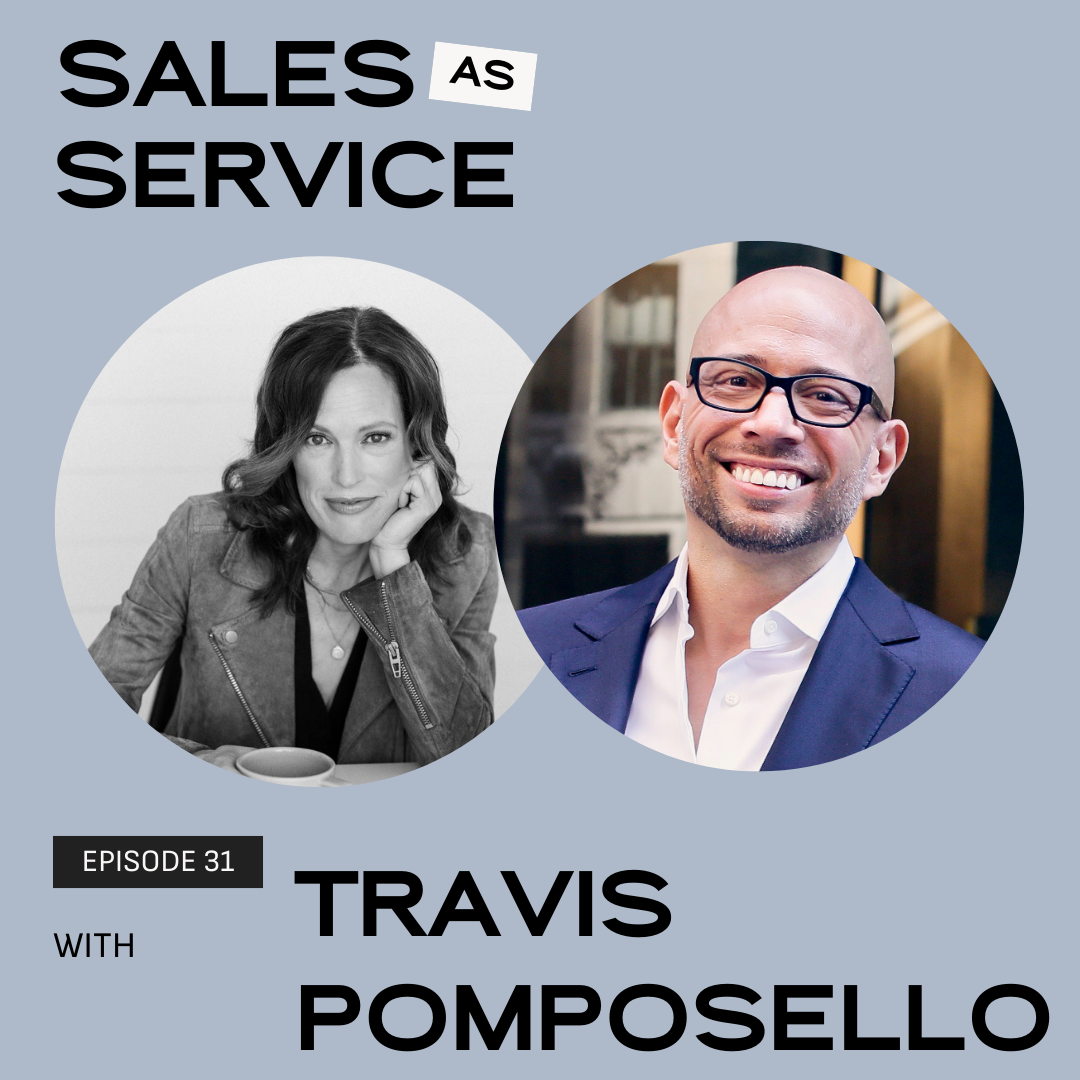
Connect, Engage, Pre-Offer, Sell: How to Turn Connections Into Clients with Hailey Rowe
EPISODE: 62

If your marketing feels like a never-ending demand to post more, follow trends, and figure out the latest algorithm, Hailey Rowe has a different approach. The marketing and sales coach teaches a four-step client attraction framework designed to move people from stranger to client without making social media the center of your business.
In this episode of Sales as Service, Hailey and I talk about why marketing and sales work better together, what it actually means to proactively meet new people each week, and why the sales conversation should feel like an invitation rather than a push. We also dig into handling objections with curiosity, turning word of mouth into a more intentional referral strategy, and knowing when to stick with a marketing strategy instead of abandoning it for the next shiny object.
In this episode, we talk about:
Hailey’s four steps of client attraction: Connect, Engage, Pre-Offer, and Sell
Why visibility doesn’t have to mean constantly posting or following social media trends
How to approach sales objections with questions and curiosity instead of canned responses
How service businesses can turn word-of-mouth referrals into a repeatable strategy
Why you should improve what’s already showing signs of working before adding another marketing tactic
LISTEN TO THE EPISODE HERE 👇🏻
-
Hailey: [00:00:00] I like to do this exercise with clients where we look at what has worked in the past or could indicate it could work, like it's gotten close, but it maybe hasn't gone all the way. Because what happens so often is we get distracted as entrepreneurs, and we spread our focus in a million different directions.
And then we're like, it's the end of the year, and we're like, "Wait, I never ended up following through on that one marketing strategy," or, "I never started my referral program," or whatever it could be. Say, what are my gaps, but also what has worked before in these areas, and how can I start doing more of those and, and amplifying it and improving it before I just go jump to another podcast to listen to or a book to read or consuming stuff, right?
Like, getting into action with that.
Tam: Welcome to Sales as Service, the podcast designed to help you change your mind about sales, literally. I'm gonna help you change the way you think about selling. I'm Tam Smith, your host, sales [00:01:00] bestie, and pitch partner next door. If you're tired of bros with biceps telling you how to crush a million dollars in your sleep or battling imposter syndrome on your own, you've come to the right place.
All you need to do is listen, then take action. No gym membership required. Let's get started. Welcome back to another episode of Sales as Service. There's a version of marketing advice out there that shows up in almost every founder's feed. Post more, chase the algorithm, learn the trend before it's already over.
And if you're exhausted just listening to that and have ever felt behind 'cause you're not doing any of that, this conversation is going to be a huge relief. My guest today is Haley Roe. She's a marketing and sales strategist who spent years helping wellness professionals and online entrepreneurs book clients without living inside social media.
She built a four-step framework, connect, engage, pre-offer, and sell, that works whether your audience is on LinkedIn, in your inbox, or standing in front of you at a networking event. We also get into why the conversation between [00:02:00] that first connection and making the offer matters so much, and how to actually handle an objection with curiosity instead of simply pushing past it.
Here's my conversation with Haley Roe. Haley, thank you so much for being here. Welcome to Sales as Service.
Hailey: Thank you. I'm excited to be here with you.
Tam: Well, tell us, who do you help and how do you serve?
Hailey: Yes, so I do marketing and sales, coaching and consulting, and my clients call me the Mary Poppins of business solutions because I got something to pull out of my hat for every business problem.
And most of my clients are coaches and online entrepreneurs who do some kind of service, and I help them with how do you book clients, how do you market yourself locally and online. And I got into all this, originally I sold fitness DVDs in high school. I was an old soul. That was my first stab at sales.
And I ended up getting my bachelor's degree in entrepreneurship, still kind of having an interest in wellness and personal growth, and wasn't really sure how I wanted to tie [00:03:00] all my interests together. And so after school, I worked in business development and marketing for startups, and one was a coaching certification company, one was a wellness company, things like that.
And did that till about 2017, and then one of the companies I worked for was taking forever to get approved to open, 'cause it had a health side to it and it, it wasn't getting approved. And the entire team was let go in a day, and that is when I decided to go into my own business and help entrepreneurs who are online do the part that they don't usually love, which I do love, um, the marketing and the sales side of things.
Tam: You and I share that. It's like I feel like we're, we're, have made a business out of the things no one else really en- wants to do.
Hailey: Yeah. Exactly.
Tam: And, and we were talking earlier before we hit recording, I really appreciate, uh, your work in that you teach both the marketing and the sales side together. Why do you think so many people [00:04:00] treat them as separate functions?
Hailey: Well, marketing is everything that happens up until the point of the sale, and sale is what happens when you actually close the deal and get paid. And both are very important, right? Yeah. Because most of your time is actually gonna be spent getting people ready to buy, getting people interested in buying, and then that kinda like last 10% is the sales part, and you have to be able to be confident and be able to, you know, have a business model that makes sense for you and is charging the right amount.
And so I saw a lot of the clients who I worked with, either they're missing pieces, honestly, in both. You can't just have one without the other, as you know. So that is kind of why I do both.
Tam: I wanna get right to the good stuff. Your four steps to client attraction without social media overwhelm. What inspired you to create this?
Hailey: What inspired me was the fact that I was coming across a lot of coaches and entrepreneurs who kept saying, you know, "I need to be on [00:05:00] social media. I need to be following the latest trends. I need to be working with the algorithm." And none of that is true. There's really four steps that you move through with somebody to take a stranger to a client.
And why I created this method was to show that you could apply these four steps to any platform or locally in your community, and you don't have to just dance in TikToks and do the latest trends- ... with social media, because I'm definitely not somebody ... If you see my reels on Instagram, they're not trendy.
It's literally me talking to the camera. It's not perfect. And so I wanted to show people that you c- can do this and, and use ... kind of show them also the big picture of what we're trying to do with marketing. Mm-hmm. 'Cause if you don't really know, you're probably gonna feel a little bit lost and overwhelmed.
So that's why I created the four steps.
Tam: And when you say client attraction, at high level, walk us through the four steps.
Hailey: So the four steps are connect, engage, pre-offer, and [00:06:00] sell. And what I mean by that with connect is we're gonna first decide what is gonna be your visibility strategy? How are you gonna be meeting new people every single week?
So for a lot of my clients, it's partnerships, so they'll be on podcasts, or they'll give a guest talk to a community, or they'll go out in their community and meet people at a networking event and collaborate with them to get in front of each other's audiences. Or for other clients, they like LinkedIn.
I'm a big fan of LinkedIn, been using it since 2018, like favorite platform of all time. And so they'll connect with their potential clients or speaking opportunities or collab partners through that. So we need to just figure out, like, what is gonna be your way you're meeting people, because if you have nobody to make offers to and nobody who indicates they're ever interested in your stuff, it's gonna be really hard to make sales.
And then the engage phase is where you ask an intentional question to see who among your audience has the pain point or has [00:07:00] a pain point that you can help solve or has a goal or dream outcome that you can help with. So this is where we start to actually s- have the conversation. "Hey, you know, what kind of content do y- uh, thanks for being a part of my Instagram community.
What kind of content would be the most helpful for you?" Or having that call to action in your posts for people to actually engage with you about what they're struggling with or what they wanna see more of or whatever it may be, or doing market research interviews with people and asking them questions about what they would pay to solve.
Or going, if you know you're gonna do collaborations, making that ask, "Hey, would you be open to collaborating together? What if we tried XYZ?" And then the pre-offer part is where you give value upfront to build a quick win and to build trust. So this is usually a free offer. I like to do it in the form of an email lead magnet, where people have to give you their email in exchange for the free thing, the f- free class, the free checklist, whatever it may be.[00:08:00]
And the reason I like that is because email marketing is a great way to go through the four steps of client attraction. You can deeper connect with your people. You can make offers to help them throughout the years on your email list, 'cause not everybody's gonna be ready right away to take action, and so you need a way to continue to nurture them.
And what some people do is they think, "Well, social media, they'll, they'll just follow me, and they'll see my posts." But the truth is Maybe 2 to 6% of your people on social media see your posts and remember you, versus on your email list it's like 18% or more. 18% of people opening your emails is like kind of on the low end.
We want you to be able to build those touch points, build that trust, give a quick win upfront, and then naturally you can transition and invite to your sales phase because you've already heard your audience express a need or a challenge or a goal or whatever. You've built some trust. You've given a quick win upfront, and now you can naturally say, you [00:09:00] know, "If you do want more help with this, would it make sense for you to come to my free webinar or have a discovery call with me?"
Or whatever it could be. And not, like I said, it is kind of like a funnel where not everybody's gonna make it all the way through to a sale, but you move through those four phases and you continue to nurture them until whoever's ready is gonna be ready and s- and sign up for your service
Tam: I so love what you're putting out there, and it just, it, we're so aligned.
And I, uh, so appreciate that you are speaking to proactively getting in front of new people every week and taking a, like, an active part in your... You know, it's not just a post and wait, you know- Mm-hmm ... a post and hope. It's a great, you know, while that content is compounding, you know, you're out there pro-actively putting yourself in front of new people every week in a way that fits your business and what you can sustain.
But then you are also, [00:10:00] like, actively engaging to start conversation, to identify, "Hey, who can I help? How can I serve?" Sharing value, and then great, you have kinda earned permission to make the ask. And it's really not even a- It's like an invitation at that point.
Hailey: I like to call it an invitation, 'cause when you see sales as, like, pushing or forcing or convincing, it doesn't feel good.
And I do like it to be a question, like permission based. Mm-hmm. Rather than, "Hey," we've all gotten those messages where it's, like, straight to the sale. Yeah. Here's a long message. You didn't even know if they had that problem or not. Right. You're just assuming, right?
Tam: Right. Right.
Hailey: So yeah, big, big fan. And I like what you said too about, yes, we're doing the active with the four steps, but I always say there's, like, long-term marketing activities, and there are short-term, right?
Mm-hmm. So, like, the short-term is kind of what we've been talking about.
Tam: Mm-hmm.
Hailey: The long-term could be building SEO, search engine optimization, on your website, right? By doing blogs or whatever, where you are kind of passively putting the blogs up [00:11:00] and hoping people see them. But over time, that builds, you know, credibility on Google, and then you get more leads through that.
Tam: Let's talk about leaning into the objections a little bit. 'Cause I think, you know, what I experience on my end is there's a lot of, you know, I think hesitation or fear around, you know, putting ourselves out there because, you know, you, you put yourself out there, you get that vi- visibility, and, you know, part of it is you're gonna be told no or you're gonna, you know, receive some criticism or, you know, feedback that ne- necessarily doesn't, you know, feel great.
But, you know, and when it comes to being told, you know, no or not now, I appreciate you saying leaning into objections with ques- questions and curiosity. Mm-hmm. Can you share a few examples of how to work through that?
Hailey: Usually what we like to do is we wanna ask because we wanna find out more about what's really going on for them and acknowledge they're not wrong.
Like, so if people have objections, it's not that they're wrong, it's not that they're using excuses, it's that there's [00:12:00] something, there's a limiting thought maybe, there's a circumstance in their life, there's other examples of past experiences that are causing them to feel like they can't get the most out of your service.
So we just wanna find out what that is, and we kinda wanna coach through it. So for example, if somebody says it's the finances, a lot of times they're using that ... I mean, sometimes it's truly about the money and their bank account, truly. But other times it's, "I'm gonna use that as a scapegoat 'cause what's really going on is I don't see the value in this service, and I don't see it as worth the money.
I could pull the money together if I wanted to, but I don't really want to because this isn't super useful to me." So what we wanna do is we wanna ask questions like, "Okay, aside from the finances, if you did have them handy, would this still be something you're interested in or wanna do? Would it be a no-brainer?
Or if not, what's coming up for you? What's kind of, you know, what's the concerns? It's totally okay for this [00:13:00] to be a no." And that's the other thing, you wanna give them permission to be a no. It's okay. "But what is coming up for you?" Or if they s- you know, say it's the finances, that's a workable thing. "Okay, we could explore a payment plan.
We could explore a deposit option." Like, whatever. But that's very solvable. So you wanna be like their teammate and say, you know, "Is this something you kinda wanna solve for? 'Cause I do have starting options, or we could work out a payment plan or whatever." And then if they're like, "Oh, you know, it's timing or some other circumstance..."
So it's either gonna be, just a side note, they're either gonna say it's some kind of circumstance in their life. Mm-hmm. It could also be a limiting belief though about them. Like, "Oh, I'm not gonna use this," or, "Every time I bought something, I never ... It just sits in my, you know, house, and I never end up using it," or, "I, I just i- I don't believe in myself to follow through on your program or whatever."
Mm-hmm. Or it's gonna be a objection to your method. They [00:14:00] don't like the way you do it. Mm-hmm. They don't trust you as their service provider.
Tam: Mm-hmm.
Hailey: So make sure you're trying to figure out which category this falls under 'cause you don't wanna solve for the wrong thing, right? Like, so if they're saying it's time, okay, well then we don't n- they already trust us.
It sounds like they already trust ... We don't need to prove ourselves and our credibility. We need to figure out, okay, what does your week actually look like? What would be different if you could make room for this? What kind of things are you worried about that are gonna take up so much time 'cause maybe we can solve for that, right?
So just a lot of questions and making sure you're not just sa- Saying a canned, like, "Oh, I read this objection handling statement in a book." Right. "So I'm going to say this." Because nobody... It, it needs to be their idea. Nobody wants to buy when it's your idea being imposed on them. Right. Now, I will say the book by Grant Cardone, Closer Survival Guide.
Mm-hmm. He's very [00:15:00] extreme. I do not agree with everything he says, but it is a great book if you're just brand new to sales and you wanna, like, test your mind a little bit on, like, how might you ask questions about this? Mm-hmm. Or what kind of things might you say in objection busting posts or emails or some- You know, like, there's stuff you can learn from that.
But I definitely wouldn't just repeat what he says as, like, a response to an objection because it's, like, very much a canned, like, I'm just gonna tell you what to do type of thing. But yeah, I would just say those are the things to keep in mind with the objections.
Tam: And we're talking here, really when it's someone you, you've identified fit and there's genuine opportunity for you to serve and solve.
You know, the goal here- Right ... is not to sell everyone. But legitimately, it's like I've... I feel like so much of My work, your work, it's really helping people get over their own... I mean, there's, there's some mindset limiting belief around, you know, and it's when... [00:16:00] Inevitably, I feel like we're, in any kind of sales decision, you're asking someone to make a change, and that's scary.
And it's using the, you know, curiosity and questions to really help people overcome their own discomfort with change.
Hailey: Yeah. Yeah. Definitely.
Tam: Hey, Tam here. Most consultants and service-based founders are great at delivery. Referrals prove it, but referrals aren't predictable. And you've avoided sales because you think you have to be something you're not.
Sales isn't pressure or cringey tactics. It's connection, starting conversations, recognizing when you can actually help someone. The hard part? Doing it consistently. That's why I built the VIP Legion pipeline system. It gives you a repeatable way to book three to five sales qualified meetings each week through relationship first outreach, not cold pitching.
Ready to create opportunities on purpose? Book a free alignment call using the link in the show notes. Sales is a practice. Let's make it consistent. You often recommend building a [00:17:00] referral program. What does that actually look like for- Yeah ... a service-based business?
Hailey: Right. So if you are... Uh, 'cause this is, this stemmed out of a lot of my clients come to me, and they're not getting clients at the level that they want.
Mm-hmm. And they think they need to always just start adding a ton of new strategies. But when I ask them- Mm ... "Where have all your past clients come from?" A lot of times they'll say referrals and word of mouth. Mm. And they think they can't scale that. They think they can't control that. They think that that's something outside of their control, and it actually can be more in your control than you think by starting a referral program.
So what I mean by that is basically either having something where if somebody who has loved your service Or likes your work or loves what you do, wants to share it with somebody else, and that person they refer enrolls, the person who referred you gets either a commission or a credit towards your [00:18:00] service or a free service or something, right?
Something that they would actually want and find beneficial. And this is something where you could announce it seasonally or monthly to your email list, or you could, you know, if you have past clients who you've loved working with and who've referred you before, you can thank them and let them know now you have a referral program, 'cause maybe that will chime up some new referrals.
And the other cool thing that you can do is have, like, monthly or seasonal cool different perks of being a referral partner. Like maybe this month when you refer someone who enrolls in the service, you get extra commission, or maybe this month you get a bonus and a commission or, uh, you know, some kind of resource and a commission, right?
And you can even have, if you have a lot of free resources, like for me, throughout the years I've created a lot of support resources. And one thing that you could do is if somebody refers you, even if the person doesn't sign [00:19:00] up Have some kind of free resource anyways as a thank you, right? So there's just a lot you can do with that, and I think some people are missing what we call, like, the low-hanging fruit.
Mm-hmm. And so that can be a great thing to install in your business if you get word of mouth often and you wanna amplify it.
Tam: So let's talk about expectations when someone implements, you know, a new, a new strategy or tactic. What expectations, uh, do you set with clients on, you know, how long they should stick with something before they decide, okay, you know, this was a, a wise investment of, you know, time, money, or both, or- Mm-hmm
okay, great, we tried it, didn't work, need to move on to the next thing?
Hailey: Well, I think it's important to determine your decision criteria. So in other words, like, what are you willing to give this time, energy, money wise, right? Because if you're like, "Oh, I'm not willing to give it the time," maybe we do need a virtual assistant to help you, or maybe we do need to delegate, or maybe it's not even a strategy [00:20:00] we're gonna implement.
So I think first, before you do any marketing strategy, determine, like, how... At the end of... Let's say I'm gonna try this for three to six months. At the end, h- what's my criteria for me deciding fairly if I wanna keep doing this? And make sure you're not being unrealistic, meaning look at the averages.
That's a big thing. A lot of people don't know. Like, for example, with a webinar, a 30% show up rate live is great. Anything above that is amazing. But if you think 100% of people should show up or it wasn't worth it, well, then you're gonna let... You're gonna just be defeated from the start, right?
Tam: Right.
Hailey: So I think, number one, look at the realistic criteria and averages to know kind of what to expect, or ask someone like us who knows what the numbers are.
Tam: Right.
Hailey: Number two, determine your own questions or criteria f- you'll use to evaluate and keep getting better and improving it so that by the end you really know you gave it your fair shot. And then I think number three, make sure you're picking [00:21:00] something that long term you could sustain and that could be scalable, meaning you could either have a virtual assistant helping you with it at some point, or you could outsource it at some point.
But don't do that until you know it works and has gotten you proof of concept.
Tam: I think, too, you know, when it comes to paid media, you know, I immediately think that people, like, wanna jump to paid media. I'm like, whoa, whoa, there's, like, so much that you could be doing before that, um, because that, that could be a very expensive test.
Mm-hmm, mm-hmm. But y- you're pouring gas on something that, that, uh, you have, don't really have, like, proof of concept to know it works. So, you know- Right ... like, starting, starting small, you know, getting some data, then you can scale, you know, once you know what works.
Hailey: Totally.
Tam: Yeah. If listeners could implement one thing today from everything we've talked about, what would you encourage them to do first?
Hailey: I like to do this exercise with clients where we look at what has worked in the past or could indicate it could [00:22:00] work, like it's gotten close, but it maybe hasn't gone all the way, and how can we do more of that and do it better before adding a brand-new shiny object? Because what happens so often is we get distracted as entrepreneurs, and we spread our focus in a million different directions.
And then we're like, it's the end of the year, and we're like, "Wait, I never ended up following through on that one marketing strategy," or, "I never started my referral program," or whatever it could be. I think the one thing I would take away or do is when it comes to the four steps of client attraction we talked about, look at each one, say what are my gaps, but also what has worked before in these areas, and how can I start doing more of those and, and amplifying it and improving it before I just go jump to another podcast to listen to or a book to read or consuming stuff, right?
Like getting into action with that.
Tam: Let's jump into our fast five What is the best advice you've ever received about [00:23:00] sales or business development?
Hailey: One thing that has helped me, and, uh, this is just the first thing that comes to mind, I don't know if this is the best, but I do know a lot of us are really fearful of rejection.
Tam: Mm.
Hailey: And one thing that really helped me is growing up I did auditions, and I used to sing and act and do s- theater when I was a kid. You would go to these auditions, and you may or may not hear back. Sometimes you just, you don't make it. You don't even hear a no. You just are wondering forever, right? And so one thing that helped me not feel as nervous for that is knowing that the casting director, they, they wanna fill the role.
They want to get the job done. They wanna be done casting. And I think it's the same in business. People want you to do, do well. Nobody is out to get you inherently. Sure, there are internet haters and stuff, but if you really believe, like, you have a problem you wanna solve for people, [00:24:00] and people wanna hear what you have to offer, and you are in demand, I think it's a way better energy to come to your business with compared to thinking, "Everybody's out to get me.
I'm gonna get rejected," you know, "This is so hard," that kinda thing. Because it, it can be very easy to tell ourselves that when we're not seeing instant gratification.
Tam: What's something people are always surprised to learn about you?
Hailey: Well, I do sing. I do sing in two wedding bands as a sub, and I used to sing fully in one wedding band pretty much every weekend, and then I got a little tired.
Um, but-
Tam: That's a full-time job on top of a full-time job.
Hailey: Yeah. So I've done a lot of fun singing projects and stuff throughout the years, and I even at one point had auditioned to be on this, I don't know why I did this, but my agent got it for me, um, this show that was to, like, find the next K-pop group.
That's neat. And you were gonna go to Korea and, like, stay in a house with people and try [00:25:00] to become this international group. And thankfully I didn't make it, but I made it pretty far in the, in the audition process. So that's always a fun fact I like to share. That's
Tam: awesome Uh, what's one task that you have happily handed over to AI?
Hailey: So this is a good one. I have handed over evaluating certain big data. Like, so I'll s- I'll give it my call forms, and I'll say, "Please rank where are most of these people finding me, and tell me where I should focus more of my energy." Or another thing I love using AI for is making graphics. I hate being in Canva and making things look pretty.
Mm-hmm. That's not my strong suit, so I love using Claude to help me, like, improve my slides or improve my images that I'm using for certain things.
Tam: I've recently discovered that myself, and it's been really helpful. 'Cause I, I know enough, like I know what I like and I don't like, but I would never call myself a designer.
But, you know, in a pinch when I need to turn something around, it's been, um, really helpful, uh- Yeah ... to [00:26:00] improve upon, uh, my own work. Your go-to way to recharge after a busy week?
Hailey: I love walks, I love podcast listening, I love the sauna, I love working out. I'm a big health nut. Mm-hmm. So usually to restore myself, I'm doing one of those things.
And it's summer right now, so summertime I like to go to the pool. But that's just a summer thing.
Tam: And if you only had one hour each day for business growth, how would you spend it?
Hailey: I would spend it on one of those four steps of client attraction. So either connecting with new people, answering my messages, having conversations with people, delivering my freebie or free workshop, having sales calls.
Any one of those things counts.
Tam: Thank you so much for being here, and where can people find and connect with you online?
Hailey: Yeah. Well, thank you for having me. And if you do wanna get my free gift, I have a free action plan and class, and it's sharing five types of posts you can use on social media to drive more discovery calls.[00:27:00]
So instead of posting all the time or needing to be trendy, you're posting intentionally and strategically about the value of what you do. And so if you wanna see what those posts are and use them, you can go to haleyroe.com/discoverycalls and you can get the freebie. I'm also on Instagram @haley_roe. My name has a I in it for Haley.
Uh, sometimes Haley's don't have an I. And then my website's haleyroe.com, and I'm so excited as well to have you on the Health Coach Nation podcast, and that's the other place you can find me. We put out two episodes a week on Wednesdays and Fridays.
Tam: Thanks so much to my guest, Haley Roe, for this conversation.
And one thing I want you to sit with from this conversation is Haley's four steps, connect, engage, pre-offer, sell, because it's so easy to stop at the first one. You can have a growing list of connections, followers, and likes, and still have no real pipeline because none of that is the same as engaging.
Engaging means [00:28:00] reaching out to ask a real question, finding out what someone's actually working through, and giving something of value before you ever bring up your offer. The ask only works when you've earned it. So here's your sales as service challenge this week. Look at the people you've connected with recently on LinkedIn, in your inbox, wherever, and pick one.
Don't pitch them. Simply reach out and ask a genuine question about what they're working on or struggling with, and actually listen to the answer. And then consider where you can add value. Maybe that's a resource or an introduction, a testimonial or review, or an invitation to something you're attending or hosting that might help them take the next right step.
That kind of action compounds over time, and it pays you back with interest. And if you want a head start on the rest of the framework, Haley put together a free class and cheat sheet, Four Steps to Client Attraction Without Social Media Overwhelm. You'll find the link in the show notes. All right. That's it for me this week.
Remember, sales is an act of service. It's about what you give, not what you get. And when you serve well, the ROI always follows. I'll see you next week [00:29:00]
Hailey: You've just listened to the Sales as Service podcast, the podcast to help you shift your mindset around selling. The executive producers for this show are Jess Milanes and me, Tam Smith.
The show is produced by KNWN
Tam: Media and Studio 349
MORE OF A READER? 👇🏻
One of the easiest traps to fall into as a business owner is assuming the answer to slow sales is another marketing strategy.
Maybe you need to post more. Start a podcast. Try a new platform. Run ads. Build a funnel. Finally figure out whatever the algorithm wants this week.
But before you add something else, there’s a better question to ask:
What’s already working—and are you actually doing enough of it?
That was one of my biggest takeaways from my conversation with marketing and sales coach Hailey Rowe.
Hailey teaches four steps of client attraction: Connect, Engage, Pre-Offer, and Sell.
The first is Connect. How are you consistently meeting new people? That might happen through LinkedIn, networking, podcast appearances, speaking, partnerships, or collaborations. The platform matters less than having a sustainable way to expand the number of people who know you exist.
Then comes Engage.
This is where visibility turns into conversation. Instead of simply publishing content and hoping someone eventually raises their hand, you ask questions. You learn what people are trying to solve. You pay attention to what they need.
That gives you the information you need for the third step: Pre-Offer.
Give people an opportunity to experience your thinking and get a quick win before asking them to buy. That could be a workshop, checklist, lead magnet, resource, or another useful way to help them move forward.
Then—and only then—comes Sell.
By this point, selling doesn't need to feel like convincing someone to do something they don't want to do. You know there's a need. You've established trust. You've demonstrated value.
The offer becomes an invitation.
That same curiosity matters when someone has an objection.
If a prospect tells you money, timing, or another concern is holding them back, you don't need to immediately reach for a canned objection-handling script.
Ask another question.
If money weren't the issue, would they want to move forward? If timing is the concern, what specifically feels difficult about the timing? Is the real hesitation about the circumstances—or are they unsure the solution is right for them?
The point isn't to overcome every objection and close every prospect.
It's to understand what's actually getting in the way so you can determine together whether there's a problem worth solving.
And before you go looking for more people to put through this process, don't overlook the people who already know you.
Hailey points out that many service providers say most of their business comes through referrals while simultaneously believing referrals are something they can't control.
You can't control whether someone refers you. But you can make referring you easier and more intentional. You can create a referral program, remind past clients how they can introduce you, and give people a reason to keep you top of mind.
There's a larger lesson underneath all of this.
We don't always need more.
More platforms. More content. More tactics. More information.
Sometimes growth comes from looking at what's already producing conversations, opportunities, and clients—and doing it more consistently.
Before you add the next strategy, give the current one a fair shot. Decide what success should realistically look like, measure what's happening, refine the process, and give it enough time to learn something.
You may already have more of the answer than you think.
✦ YOUR SALES AS SERVICE CHALLENGE
Look at the people you’ve connected with recently—on LinkedIn, in your inbox, at a networking event, wherever—and pick one.
Don’t pitch them. Don’t tell them what you do.
Ask a genuine question about what they’re working on, what they’re trying to solve, or where they’re getting stuck.
Then actually listen to the answer.
Because connecting with someone is only the first step. Engaging them in a real conversation is step two—and it’s the one most of us skip.
Your job this week isn’t to make the sale. It’s simply to start the conversation.
RESOURCES & LINKS
Connect with Hailey on LinkedIn.
Get the 4 Steps to Client Attraction without Social Media Overwhelm.
Your next client - Calculate what it takes.
Learn how to consistently book 3–5 sales-qualified meetings each week - Book an Alignment Call.
GET THE CLIENT PIPELINE CALCULATOR
If this episode got you thinking about your own pipeline, the Client Pipeline Calculator shows you how many conversations stand between you and your next client. Get the calculator →
And if you loved this episode, subscribe and leave a review on Apple Podcasts — it helps more service pros find the show.

TAM SMITH
I’m Tam Smith-Sales Growth Strategist and Founder of Studio Three 49. I help service-based founders find, connect with, and convert right-fit clients through predictable, sustainable outbound sales solutions.
No pushy pitches. No bro-marketing. Just simple, structured systems that turn connections into clients.