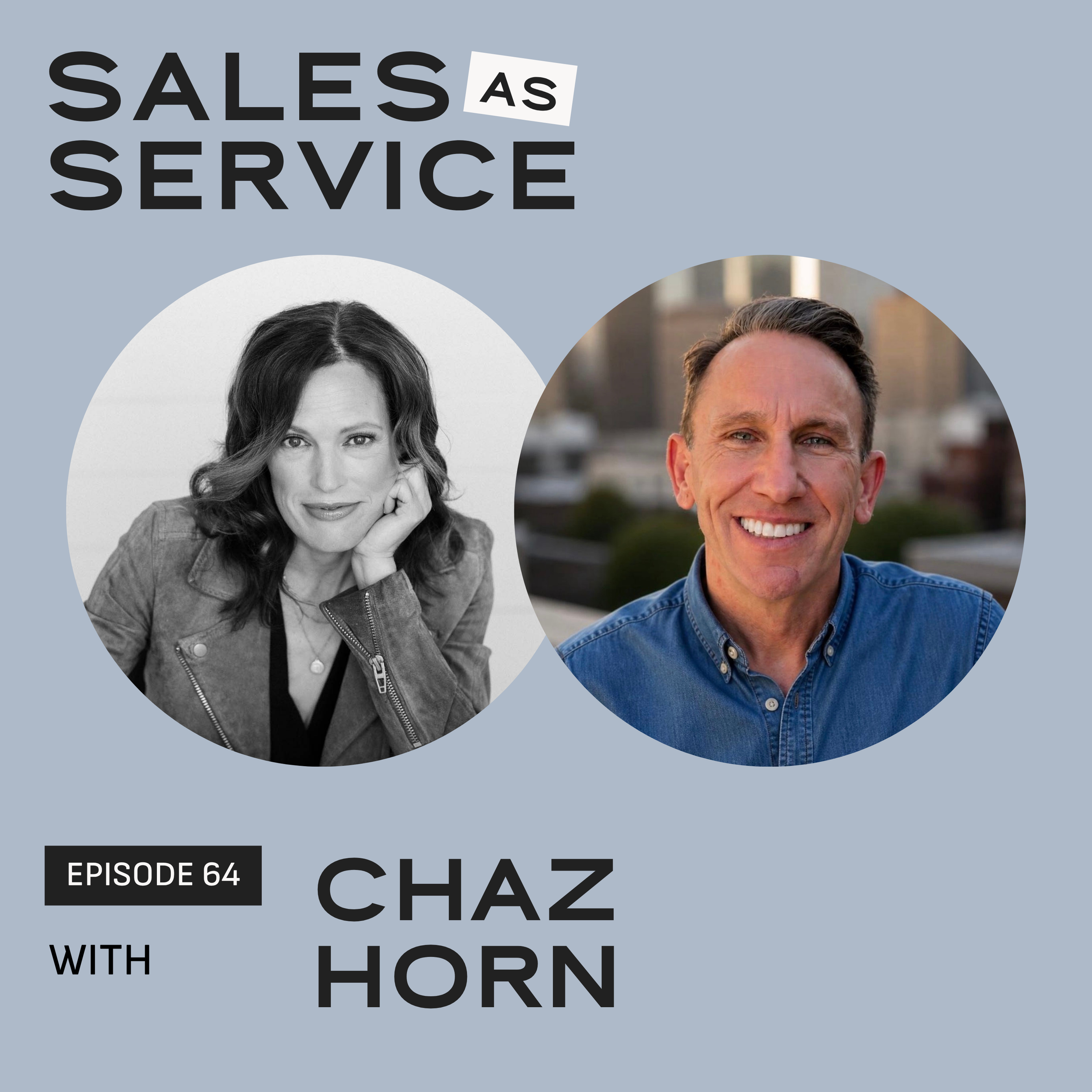
Progress Over Perfection: Building the Skills to Sell with Chaz Horn
EPISODE: 64
What if being good at sales has less to do with personality and more to do with practice?
Chaz Horn didn’t start his career as a natural salesperson. In his first commission-only sales job, he went months without making a sale. Then a mentor helped him change what he believed was possible, gave him a process to follow, and challenged him to practice it. Within 45 days, Chaz had become the number-three salesperson out of a team of 119. That experience eventually shaped the way he now teaches sales to B2B founders and teams.
In this episode, Chaz and I talk about what actually makes someone better at sales. We get into his TTABS framework—tactic, technique, attitude, behavior, and strategy—but we also spend a lot of time on something even more fundamental: taking action before you feel completely ready, learning from what happens, and treating sales as a way to help someone move toward a goal rather than convincing them to buy something.
In this episode, we talk about:
Why salespeople are developed, not born
How belief in yourself and what you sell affects the entire sales conversation
Chaz’s TTABS framework for diagnosing where a sales process is breaking down
Why execution—not access to more information—is often the real challenge
How to use LinkedIn conversations, content, and your existing network without jumping straight into a pitch
Why rejected prospects can become one of your best sources of sales feedback
How founders can turn what works for them into a repeatable process a sales team can actually follow
LISTEN TO THE EPISODE HERE 👇🏻
-
Chaz: [00:00:00] Like a 30,000 foot level, the most important thing to sales is belief in the product, service, or solution, whatever it is you're selling. You can have a newbie salesperson and a sales professional. The newbie believes in the product, service, solution, and the professional doesn't, and the newbie can outsell them every time.
So belief in what you're selling is essential. Belief in yourself is essential.
Tam: Welcome to Sales as Service, the podcast designed to help you change your mind about sales, literally. I'm gonna help you change the way you think about selling. I'm Tam Smith, your host, sales bestie, and pitch partner next door.
If you're tired of bros with biceps telling you how to crush a million dollars in your sleep or battling imposter syndrome on your own, you've come to the right place. All you need to do is listen, then take action. No gym membership required. Let's get started
Welcome back to another episode of Sales as Service. I'm just not good at sales. I hear some version of that [00:01:00] all the time, and usually it's not really about sales. It's about what we believe about ourselves when we're selling. Because what you think affects how you feel, and how you feel affects how you show up, and how you show up ultimately affects the results that you generate.
And today's guest has learned that firsthand. Chaz Horn started his sales career in a 100% commission role and went months without closing a single deal. And at some point, it would've been pretty easy to decide he just wasn't cut out for sales. Instead, one conversation with a mentor challenged what he believed was possible.
His mentor told him, "You can be," and then gave him a process to practice. Within 45 days, Chaz went from making no sales to becoming the number three salesperson on a team of 119. He spent the 30-plus years since studying what happened in that shift and helping other people build the same skills. Chaz is the founder of Mastery of B2B Sales, where he works with solopreneurs and [00:02:00] small B2B businesses to build more intentional, repeatable sales processes.
And in this conversation, we get into the connection between belief and behavior, why the best tactic in the world won't help if you don't trust yourself or what you're selling, and how taking action, even when you don't get it exactly right, is what gives you the feedback you need to keep getting better.
Here's my conversation with Chaz Horn. Chaz, thank you so much for being here. Welcome to Sales as Service.
Chaz: Awesome to be here. Thank you, Tam.
Tam: Tell us, who do you help and how do you serve?
Chaz: Yeah, so let me, let me back up a couple steps because I think it's really important for your audience how I got there.
To who I serve, because it was a journey. You don't just stumble out of bed one day and bam. Salespeople are not born. They're made. They're developed. And I remember my first sales job, it was 100% commission. Day after day, week after week, and sadly, month after month, I was getting zip, [00:03:00] zero, nada sales. And I remember one day I'm thinking...
I stopped my car. It was raining. It was, the sun had just set in Northern California, and there was this orange glow from my dashboard, the empty gas light. And I'm like, "Great, that's exactly how I feel, empty. How am I gonna provide for a family if I ever have one?" And so I was sitting there having a pity party.
And by the way, a pity party is no one comes and everyone has a miserable time. And so that's where I was. My boss had me over for dinner, uh, the next day, and afterward he sat me down in the den. I can remember it like it was yesterday. Ken Upton. And he sat me down with the fire in the fireplace, and he said, "Chaz, you can be."
Those three words changed my life. Why? Because I had a boss who became a mentor who was speaking life into me. Now, he followed those words with, "The top salesperson in the company, but you gotta follow the [00:04:00] system, you gotta follow the process because it's proven. We've spent hundreds and hundreds of hours of developing this.
But if you do this, I believe you could be the top salesperson." So long story short, I followed the system, I followed the process. I'll never forget walking out of this place with a check for which, adjusted for inflation, would probably be, like, $12,000 today. And I'm like, "Wow, it actually works." And 45 days later, I became, not number one, but the number three salesperson, and that was out of 119 salespeople And from that opportunity of growth and having someone speak life into me and really mentor me and give me guidance and direction and me being coachable, I developed a framework, which is TTABS, which we can talk about, tactic, technique, attitude, behavior, strategy.
And over the last 30 years, plus years, I've worked with small B2B businesses, solopreneurs, to help them identify, attract, [00:05:00] and onboard clients, not by selling, but serving. And I look at sales like this. It's not about getting people to buy the thing you're trying to sell them. It's about helping them overcome those obstacles that are stopping them and helping them reach their goals.
It's about transformation. And when you look at it like that, it takes all the pressure off you, and you start to develop deep, meaningful relationships, which builds trust, which leads to a longer lifetime value w- with your clients. But that's who I serve, and that's the backstory on how I got here.
Tam: That resonates so deeply, I know with me and everyone listening, because there is, there's this perception that salespeople are just born, and you come out of the gate just knowing how to do this.
And I can't say enough that it's a skill and a practice that, you know- Yes ... we're constantly developing. You had wonderful mentorship in that experience. What else, like, kind of w- what was the process that you were, I guess, [00:06:00] following or the big change in those 45 days that, you know, really, um Was it one thing or was it like a stack of small things?
Chaz: There's that one thing, him speaking life- Yeah ... into me is belief. Yeah. So i- if, if you look at it from like a 30,000-foot level, the most important thing to sales is belief in the product, service, or solution, whatever it is you're selling. You can have a newbie salesperson and a sales professional. The newbie believes in the product, service, solution, and the professional doesn't, and the newbie can outsell them every time.
So belief in what you're selling is essential. Belief in yourself is essential. Now, those are foundational, and when I look, when you look at TABS, T-T-A-B-S, tactic, that's what you do, technique, that's how you execute on the tactic, your tone, your delivery, your pauses, depending upon how you're communicating in a, what platform, whether it's alive, whether it's through content or whatnot.
Then A is attitude. That's the centerpiece, and it's not just [00:07:00] positive mindset, but it's about your perspective about yourself and your prospects. I come across, going through some sales training, it's, there's this one sales training that's like, "Yeah, buyers are liars." I'm like, and it was just the way that it was said, the tactic and technique and the way it was said.
I'm just like, it sounds like you're engaging with an enemy, not someone that you wanna help. So your perspective is so important, and when you go with the intention to serve and not sell, you will attract and not repel. So that is essential. B is the activity, the KPI. When you have the right tactic, the technique, attitude, then you'll know how many tactics with the right technique and attitude, and then strategy, which I haven't talked about yet.
You'll do a certain number, and that will lead to a certain amount of conversations. It will lead to a certain amount of onboarding clients. In strategy, this is what most salespeople miss. This is where you get to the identify and attract, is you have [00:08:00] to speak to that main need, that main want, and do it in such a way so they realize you get them.
They see you as an authority. You know, Dale Carnegie said in How to Win Friends and Influence People, I've read that over 100 times. But- They have to see you as an authority. Dale said how, they have to know you, like you, trust you, but now in 2026, see you as an authority. So if he wrote that book today, I'm sure he would add authority, and it's so true.
If they don't see you in authority in the marketplace at where it is, they'll just move on down the line. So those are what um- encompasses big picture, and then when you're reaching out, there's the, you know, the business development, there's the marketing to identify and attract, and then there's the sales, which is about onboarding, moving them through the process seamlessly.
But there's a lot of little things that you could do with the right tactic, with the right technique. And the thing that you have to be really careful of, and I tell people, [00:09:00] you can use some of these things to manipulate people, but at the end of the day, it's not what you are building and the goals you're meeting, but who you become in the process.
So that's important.
Tam: It's almost like for everything you think you bring to the process, it gives you so much back just in your own, you know, personal and professional development.
Chaz: If, if you have the right perspective, yes.
Tam: Yeah. In the system that you developed, are there parts of it that you see people struggle with more than others?
Chaz: Always the same thing. We don't have an information problem, we have an execution or implementation problem It's taking action. This is why I give people the Mel Robbins five-second rule. Are you familiar with that?
Tam: Yes.
Chaz: Yeah, and if you haven't bought the book out there, I'll, I'll give it to you in five seconds.
Basically, you're gonna do something, you need to take an action, you need to make a call, you need to reach out to someone, you have a fear, you have angst, you're procrastinating. You're like, "Oh, what [00:10:00] am I gonna..." Then you pick up your phone. You look for dopamine hits. Just go five, four, three, two, one, act. And so one of my clients who struggled in this, and she wanted to develop a sales team, but she was still the salesperson, she goes, "Chaz, I did it.
I had to do it five, six, seven times sometimes, but I did it." And Julie just went to the next level, and her business is in a place that, uh, she never thought or imagined today. So taking action, but when you take action, it's gonna be flawed, and we get so caught up on perfection that it's like, "Oh, my goodness," and you feel embarrassed.
You just, "Oh, man, how could I do that?" And then you beat yourself up, beat yourself up, beat yourself up, and then you are afraid 'cause now your amygdala puts you in fight or flight. Your hippocampus, which feeds, which is like a filing cabinet, feeding your amygdala and your brain, saying, "Don't do this. This is pain."
So when it gets uncomfortable, I tell my clients three things. If... Here's the... I tell them, "Here's the catch." [00:11:00] They go, "I knew it. There's a catch." Yes. You have to be coachable, you have to be committed, you have to be decisive. And I ask them on a scale of one to five to score themself on each one of those areas, those attributes.
I said, "Otherwise, if you're not, it's gonna be a waste of your time, my time, and your money, your investment. And when you fail, which you will, because that's not a... It doesn't define you. It's not a, a destination. It's a step in the process. You have to come back to me and ask me questions, and that's part of being coachable."
That's the most important thing. I love, uh, Atomic Habits with James Clear. He talks about the 1% rule. If you make those 1% changes every day, the 1% rule says that you'll lead to 37 times growth in 12 months. The British Cycling team did this. They hadn't won the Tour de France in 100 years, and after implementing this, they won Tour de France four out of the next six years.
So it's those little improvements over and over and over. And this transitions not only into sales, to every area: lead [00:12:00] management, operation. Everything is the small little improvements, but you have to have data so you can understand what you've done, what's not working, and then it all falls into these five areas: tactic, technique, attitude, behavior, strategy.
And they have to be in alignment with one another. And I guarantee you, if you're not identifying, attracting, and onboarding clients, it falls into one or more of these fi- It's usually it's more than one of those. So-
Tam: For a, you know, founder or listener who has not to this point had, you know, any kind of a consistent business development practice, what do those tiny...
You know, 'cause what I'm hearing and what I know, it's, it's not the big shift, the big swing, it's those tiny, daily, consistent actions. Like, just baseline, what is, what does that look like for someone? Or what should that look like for someone?
Chaz: When I onboard a client, first thing I look at is where can we get some quick wins?
So I'm like, "What are your resources?" Who do you know? What's your list? Who have you talked to? [00:13:00] So I'll go through, so okay, who are you connected with on, on Facebook? Who are you connected with on LinkedIn? Do you have s- do you have a, a podcast? Do you have... So we go through a list, and, you know, they have people that have rejected them.
That's many times where I'll go first, and I'll give you an example. I had a lady who became my client, and she had just gotten rejected by a guy who wanted to move forward, and she had gotten four of his credit card numbers during, on a Zoom like this, and he's just like, "Ring." And he's like, "Hold on a second.
I need to take this. Uh-huh. Oh man, seriously? Holly, I gotta take this. Please follow up with me." Boom, he was gone. And she followed up and followed up and followed up and followed up, and she, he was getting, she was getting ghosted. I said, "Throw yourself under the bus." She's like, "What?" Throw yourself under the bus.
This is the best way for us to learn. Who has the best information? Our clients and people that we've talked to. [00:14:00] And I gave her a way to sh- she can get him in a conversation, which worked, and it was a Chris Voss, "Hey, have you given up on the idea of developing leadership, leaders in your business?" She helped develop leaders.
He responded. She got him in a conversation, and she said, "I realize you probably don't want to... I, I didn't do a very good job in sales." He goes, "Yeah, I felt kind of pressured." "Would you be okay," she said to him after I coached her, "to give me some honest feedback on good, bad, and the ugly?" And so 15 minutes later, guess what?
She onboarded him at, for $5,000. When you go with sincerity and hum- humility and actually want to get feedback, it doesn't mean they're gonna automatically turn into a client, but they'll give you the best information, and it takes you from a place of self-protection and self-promotion. And when you're in self-protection, self-promotion, you're operating from a false identity.
That's a, that's a, a video and a, a podcast for another day, which there's a lot of information there. But if you [00:15:00] break that self-protection and self-promotion to really go to the source and really learn, then you're not gonna have this wall of fear keeping you from improving, because you're dealing with it head-on.
But many of my clients that do do, do this, I don't have a percentage, but I'd say maybe it's, like, one out of five. They actually are... They get them into a conversation, and they become their client. And the other four, they have a lot of respect, and years down the road they refer business and whatnot their way.
So that's what I find is, is really most effective when I have a, a client, is what are your resources? Who has rejected you? And then with your clients, because most businesses, Tam, they're missing out- On 30% increasing their lifetime value with their clients.
Tam: Mm-hmm.
Chaz: So I have a process to go through with a scorecard where they get honest feedback and whatnot, and all of my clients that, that do this, the [00:16:00] minimum, the...
It's conservative as they increase sales 30% through upsales, cross-sales, and, um, referrals. With the other people that maybe they haven't worked with or, or whatnot, the best thing to do is, like, one client, he didn't really have any lists and whatnot, and I said, "Well, if you're on LinkedIn, right?" He didn't... I mean, he had, like, 200 people on LinkedIn he was connected with.
I go, "You know the best way to get people? There's a process. It's, I call the trifecta. It's your content, your profile, and your DMs, or outreach calls. You can do that."
Tam: Mm-hmm.
Chaz: So your content, speaking to that member strategy, speaking to that main need and want, so they see you as an authority. They realize you, you get them.
So when you have content that goes out there, it's like, wow. So where do people go? They go to your profile because you're speaking to them. When your profile complements your content, it grabs their attention. You can set it up like a landing page, so it's a lead magnet. My LinkedIn profile generates anywhere from one to five [00:17:00] new leads every day.
Tam: Mm-hmm.
Chaz: So people go to my content, and then it, it confirms that, and they can get my book, uh, and now they're being marketed to. And then the business development is, on LinkedIn, when you're putting out content and you're sending out messages, they're more likely to see your content. That's how the algorithm, fancy word for they're gonna see your content more.
So with him, he wanted to... He was struggling with a lot of different things. I go, "Send out 50 messages a day." Not co- not messages like DMs, but comments on people's posts in your... We, we went through this, his ICP, his ideal customer profile, and it's like, put a comment that, that, not like, "Hey, great post," but you speak to the post, and you add some value.
You don't try to sell yourself or put links or anything to that, but when you do that, it's like, wow. And this guy owned a, owned a business, a manufacturing business for 33 years. He'd been doing this for five months. He had scheduled zero meetings on LinkedIn, [00:18:00] which is a story for another day. Anyway, that's why, that's why he hired me.
So he did that And he had four meetings within seven days just by people seeing his comment, going to his profile, and they're like, "Hey, someone viewed my profile." And he sent a connection request, "Hey, thanks for viewing my profile. Many people view my profile after seeing some of my content. What brought you my way?"
"Oh, yeah, I saw your comment." Boom, and then he got them into a conversation. So those are some different levels with resources, people you know, people that you're connected with on social media, and there's a whole business development way with people that are first degree connections or friends, whatever social media platform, they call them something different, that you go through to grab people's attention and get them into conversation without being salesy or
Tam: spammy.
Absolutely. There's just, there's so much opportunity when you, once you identify who you want to talk to, regardless of the platform, whether it's LinkedIn, Facebook, Instagram, whatever it may be, you know, rather than just [00:19:00] collecting followers, connections, actually engaging and leaning in to just ask with curiosity, you know, to be interested in getting to know if...
You know, you and I were having some conversation ahead of recording. It's not about trying to sell everyone or anyone. It's just being curious enough to know, hey, how can I add value to your, your world, help you?
Chaz: Can I give you something real practical for your guests? Absolutely. That's gonna speak.
Please. So there's demographics and there's psychographic. 80% of all people are using demographics, and that's, okay, here's someone, here's a, here's a CEO in this industry and this geographic area and this size company. Only three, this is the 3% rule. Only 3% of those people are ready to make buying decisions, and when they're made, ready to make buying decisions, they've already done research before they got to that place.
So if you're reaching out to people on DMs cold or whatnot, and you're trying to sell them, irritant to the 3% and you're a pest to the 97%, well, eventually that will move into the 3%. So you [00:20:00] want to think psychographics, not psycho. Obviously, we don't want any psycho clients. But psychographics. Mm-hmm. And so I'll give you an example.
There is an organization on LinkedIn, and they have content that goes out that gets a lot of engagement, and it's a faith-based organization. I reach out to them, and it's like, "Hey, I see you're connected with," ba, ba, ba, ba, "and, um, would you like to connect?" I'm like, "Yeah, okay." So now we have this common connection.
Robert Cialdini called it the unity principle. You guys can look it up. It's very, very powerful. He wrote the book Six Ways to Influence: The Unity Principle. So you now have this unity in background, so it, it will increase your likelihood of connecting with them, like 50%... by 50%. And then I g- get them into a conversation.
I know they're faith-based, and so I wrote a book called... Well, there's several books I've written, but one e-book is How to Co-Create with God. And so as I'm asking them about [00:21:00] this, I'm... 'Cause I was looking into this organization. "I'm looking to join the speakers bureau and whatnot. Any feedback?" So we're having a conversation back and forth.
I didn't sell them or anything. And they said, "Oh, well, I haven't joined yet, but it seems intriguing." And then I say, "Okay. I appreciate the feedback. I wrote this book on this. Would you be interested in getting a copy? And, uh, it's just complimentary." And so a good number of those are like, "Sure." "And I provide your best email, and I'll send it to you," and I'll say, "I'll, I'm gonna add you to my, my list."
So, um, I get a very good percentage of those people that want my book. I've had a conversation, and then I will reach out afterwards and say, uh, uh, feedback. "I haven't read it yet," which is common. So I have a, um... Now, these are people that are in my ICP. It's just we have this common background with faith. I- I'm offering a sales and marketing assessment.
It's complimentary. It's 30 minutes. It will give you clarity on what to do, what not to do, what's keeping [00:22:00] you from reaching your goals, and the cost of inaction if you don't take action, the ROI if you do. Would you be opposed to scheduling that? And you'll get a, a full report after we meet. We have the common background, and so I'm taking them through the process.
That's a gem that people can use 'cause most people use DMs incorrectly. That's the correct way to use it.
Tam: Mm-hmm. You are speaking my language because most folks come out of the gate with what I call the pitch slap, and it's all about them and their offer- Exactly ... and their service. Yeah. Mm-hmm. And that's the fastest way to burn trust and lose it.
Like-
Chaz: Yeah, you're like everybody else.
Tam: Yeah.
Chaz: If you have a founder, CEO, president in your title, I mean, just know, 'cause I get... It just... I mean, just from yesterday I had, like 41 people trying to connect with me. Mm-hmm. I mean, it's, it's crazy.
Tam: Mm-hmm.
Chaz: I go through the mess- If there's, like a really good message or something, even if they're not In my ICP, I'll connect.
I'm like, "Oh, I like what, I like what they're, uh, what they're saying here. This is different and unique."
Tam: Mm-hmm.
Chaz: But all the [00:23:00] message is like, "Hey, we're connected to the same people. Hey, you're in Lee Summit, Missouri. Hey, you're like..." It, it's like everyone does that. You gotta differentiate yourself and be unique.
And when you go with the intention to serve, not sell, it will change not only what you say, but how you say it, most importantly, and that's the key differentiator.
Tam: Hey, Tam here. Most consultants and service-based founders are great at delivery. Referrals prove it, but referrals aren't predictable, and you've avoided sales because you think you have to be something you're not.
Sales isn't pressure or cringey tactics. It's connection, starting conversations, recognizing when you can actually help someone. The hard part? Doing it consistently. That's why I built the VIP Legion Pipeline System. It gives you a repeatable way to book three to five sales qualified meetings each week through relationship first outreach, not cold pitching.
Ready to create opportunities on purpose? Book a free alignment call using the link in the show notes. Sales is a practice. Let's make it consistent When, you know, you've built the [00:24:00] system for yourself, you know, as an, as an individual, how do you translate that to leading a team?
Chaz: Yeah, I love that question.
I wrote a whole book about this. It's called The B2B Blueprint to Pred- Predictable Sales, and Tam, I ga- I gave you the link when I filled out the information, so.
Tam: We'll be sure to include that in the show notes.
Chaz: So the most important person that you lead is yourself, and if you can't lead yourself, you can't lead a team.
For yourself, what are your expectations and standards? Many businesses, they have expectations or weak expectations, but no standards. Expectations are, "Oh, I gotta do 30 cold calls." You know? Standards are how you perform on those. And so I was working with a company and this guy, "30 in-person cold calls.
This is one of the 10 commandments in here." And I'm like, "How many appointments are getting scheduled with these?" These were in-person cold calls. And he said, "Uh, none. We gather information, then we call them up." I go, "Wow, why don't you do less cold calls and focus on scheduling meetings?" [00:25:00] So that was the standard, is to have a conversation, improve the tactic, the technique, and strategy in how you approach people.
And so they did one-third, one-third of the cold calls, and they tripled the meetings that they were scheduling. So that was expectation and that's standard, two different things. So you need to have the value that people step into, hire them to the value, to the expectation, and to the standards, and then so many people do not have a proven system and process.
This has happened so many times, Tam. Oh my goodness. I've talked to so many founders. They're like, "Well, I'm gonna hire a salesperson. I already did," and they've spent $100,000 and it, on all these salespeople. It's like, "I don't know. There's no good people out there." I go, "If I can ask the person that you hired, 'What's the sales process?'
would they be able to tell me without thinking twice?" "No." "Why not?" "Well..." There's selling system, there's sales process. [00:26:00] There's some nuances between what they are. But you have to have a, a process they go through, just like Ken Upton to me, on what to do, what not to do. Here's step one, two, three, four. Oh, and then selling system, this is what you do in step one.
This is what you do in step two. That's why What I focus on and why I wrote The B2B Blueprint to Predictable Sales is to help founders have a selling system with standards and expectations with an overall vision for the company that people step into and they're excited because they believe in what you're doing.
And Gen Z, they wanna be a part of something they believe in. They wanna be a part of something that makes, that transforms other people's lives. Back to my comment, you know, several minutes ago. Those are all important, and then it's like, do you know the right type of person? Do you do assessments? I can't tell you how many people don't do assessments.
[00:27:00] I'm working with a guy right now, he's like, "I don't know why they're not getting it, why we're not scheduling meetings." And I s- I did a, a friction audit for him. I go, "You're hiring the wrong people. You're hiring people that are managers to be business development people." Go figure. So, and I was, we were doing the DISC assessment.
And we need someone that has like a D, which is more dominant personality, or an I, influencer, which I have a, a combination of, of those. And he was hiring people that are more like accountant types who the opportunity sounded good because they could r- develop their own business, but they needed someone to, to back to taking im- implementation and execution.
So you gotta have a proven system and process, and then you, there's so many different things with the meetings, how you have the meetings, how you have accountability, how you speak to their mindset. Do you know how to shift their mindset if they're having a bad day? Do you have a culture of fear where they're not aff- where they're afraid to talk to you?
Or are they open? It's [00:28:00] like, I'll give you an example 'cause this is so important. I was talking with a sales team. There are three people. There's a founder there. We're on Zoom, and the guy's not performing, and I develop trust in a culture where it's safe to talk. And I asked him, I said, "Aria, w- what's your greatest fear?"
You could hear a pin drop. The founder's in there, he goes, "I'm afraid I'm gonna lose my job." "Why?" Because I'm not performing. This was the last quarter or going into the third quarter going into the fourth quarter in 2025. So I, I took him through an exercise to shift his mindset so he can go from imposter, that's the story he was telling himself, to step into who he was created to be into his future self.
In the end of the fourth quarter, uh, his boss, Syed, said, "Arya just broke all the sales records in the company," and it all started up here. So if you don't have a safe culture so that people can talk, if they're not telling you [00:29:00] problems, then it's probably not safe for them to do so. And, you know, 10 years ago, I was not creating self-- safe environments and whatnot because I just d- I, I just didn't have the emotional intelligence to do so, but I learned through it.
So all these things are, are very important, and m- that's why I wrote my book to help people with that because it's a major transition from 'Cause salespeople cannot sell like a founder. A founder can go through something 'cause they have the belief, they created the solution, the service, the product, or whatever, and a salesperson cannot sell like a founder because they're approaching it from a different way.
Tam: Mm-hmm.
Chaz: Employees don't think of things as business owners, and so that's why you need the selling system and sales process. What worked for you will generally not work for them unless it was a proven system and process you went through.
Tam: If someone listening to this right now feels like they're just not a sa- like, kind of overwhelmed, you know, by this conversation, I, I [00:30:00] think we've proven that sales is not, don't come out of the gate knowing how to do this.
There's a lot of components that are developed over time. So someone listening to this, you know, that says, "I'm just not a good salesperson. I'm just not a salesperson," what's the first thing that you would want them to kinda unlearn and start practicing?
Chaz: It's not about perfection, it's about progress.
That's it. The... It's, it's not about perfection, it's about progress. But get with someone who can help you bec- like for me, I've made more mistakes than anyone probably in the history of the world, but I learned from it. Behind that is when you take an action and it's flawed, which it will be, we have a habit of beating ourselves up, and we ask our questions like, "Why does this always happen to me?"
The victim type questions. And that will put you in a frame of reference of your brain answering you, 'cause your brain will answer you based on the questions you [00:31:00] ask. The questions you ask will determine the direction of your life. So your brain will say, "You're an idiot," if you're asking why me, why does this always happen to me, oh my gosh, here we go, it's snowballing.
When you go, uh, you own it, and ask questions like, "What can I learn from this? How can I get better? Who can help me?" Your subconscious will go to work and start answering those questions. So get someone to help you. Show up committed, coachable, and decisively act on what you learn, and just give yourself some mercy and give yourself a break.
Don't beat yourself up, 'cause I make mistakes each and every day. As I was telling you, I locked myself out of my house. I'm like, and luckily I have my phone, I'm like, "Tam, I'm gonna be late today." And it was like, "Oh my goodness, how could I do that?" But it's the same with sales. I still make mistakes in sales conversations, but I always, I go, I'll go back...
I say always. 90% of the time now, I'll, if I made a mistake, I'll reach out to someone and say, "You know what? That was, I teach this stuff, and I [00:32:00] just messed up. I just want, I, I'll, I'll, it sounds like you're not gonna work, and it sounds like we're not a good fit, but I just wanted to reach out to you and just give me some feedback on this.
Would you be willing to do that?" And so the best, when you make mistakes, going back to throwing yourself under the bus, the people that you talk to can tell you, and that helps you face your fear, get out of your comfort zone, and face the really glaring fear that you just got rejected. And when you go to that fear, 'cause most people are like, "Ah, just forget that person.
They don't know what they're talking about." When you get into your fear and ask other people to speak into your life from a place of humility, that will take your confidence level up here. And if your confidence isn't up here, you're not gonna be good at sales.
Tam: I wanna talk about that mindset piece and the exercise that you took, uh, that business development representative through, 'cause I think, like, that ahead of anything [00:33:00] else, you know, getting your mind right and the, that, like you said, that confidence piece.
Chaz: Mm-hmm.
Tam: What is the exercise, or you have an exercise that you can, for listeners can practice to help overcome that resistance and fear?
Chaz: I have two. I have a faith-based, and I have a one I just deal with my, my secular clients. And so I'll give you the secular one 'cause it's a little bit shorter. So the, it's, it's, it's a 3D process.
It's three-dimensional process to look at your thoughts and beliefs from 360 degrees. And so as I was taking him through, Aria, through the exercise, I was asking, "Okay, what's your greatest fear?" Okay. And I said, "W- what's the story you're telling yourself?" So you have to identify the story you're telling yourself.
That's the first step. That's the first D out of the 3D. We went back and forth, back and forth, and he goes, "I'm an imposter. I'm no good. I'm worthless." If we're not aware of the story we're telling ourself, it will control our lives [00:34:00] and take us to places we never intended to go. I've been there, done that, and got to a very dark place back in 2004, a story for another day.
So he said, "I'm an imposter," basically. Okay, so you say you're an imposter. Now we're going to obliterate that lie. He, "What do you mean?" We're gonna show you that that is a lie that you're telling yourself, and you're allowing that lie to keep you from stepping into your God-given potential. He's like, "Okay, how do you do that?"
I said, "How long have you been in sales?" "12 years." "Okay. How many clients have you served?" And he went, uh, I can't remember, hundreds and hundreds. "Did you serve them well?" "Yes." "Did you have good sales years?" "Yes." "Aria, I know you sold your business, and in your business before you sold it, you got your business to a certain level.
How did you bring the sales in?" "Uh, me? I sold." "Okay. So you did a good job in selling so that you could sell your business, correct?" "Yes." I said ... And we [00:35:00] went on and on. I said, "Okay. Do you see, when you d- when you go to step two, the third, uh, the second D, it's you remove the emotion." That's 90% of the battle right there
Like, when I'm, when I'm locked out of the house, I'm like, "Ah!" I'm like, "Okay, I need to, I need to calm down because if I don't calm down, I'm gonna show up at this podcast and like, ah." So I just did some, uh, breathing exercises. I'm like, "I can only do what I can do, so I'm just gonna chill and wait till I, someone opens the door for me."
So you remove the emotion, and you deal with the facts. I said, "Aria, the facts, do you see what the facts are saying? And they're contrary, they're the antithesis of you being an imposter." He's like, "Yeah, I do." And I could have a, kind of like a sense of hope, and his kind of shoulders are back and sitting up a little bit straighter.
I'm like, "Okay, now let's go to the third D. 10 years from now, you are in the [00:36:00] place. Think of yourself 10 years from now. You are in the place that you wanna be. You have the relationships, the business, or whatever it is you wanna be." And I, I was taking him through all this. "So I want you to get a really clear picture and spend some time," and I took like a 60-second pause so he could think through this.
"Tell me when you have that clear picture in his mind, in your mind." He said, "Got it." "Okay. Now, your future self comes back to your imposter self right now, and what is... We already s- we already determined that you're lying to yourself, okay? Your brain is lying to yourself. Now your future self- tells your self right present day, what does he say to you in this situation?
He's like, "Well, get my butt in gear." He s- he said something a little bit more colorful than that. I said, "Okay, but what else?" He said, "Aria," this, this is h- his future self talking to him. He said, "Aria, this challenge you have right now is where you [00:37:00] grow. You need to step into it because if you don't, we're not gonna be where we are 10 years from now.
But if you do, this is where we will be," his future self with his present self, "and so take action, learn from it. You've got this." Boom. That was the exercise, and he went through it multiple times every, every day 'cause when we do something with our mindset, it's not like bam, and we are fixed for life. When we deal with our emotions, and, you know, people say, depending upon what study, 20 to 80,000 thoughts a day, and most of those negative, so we need a process to be able to process our emotions so they don't process us, regulate our emotions so they don't regulate us, and that's been a very effective tool, a process to take people through to help them reframe how they see things.
Tam: I love that Let's jump into our fast five
Chaz: Bam. Let's go
Tam: Best advice you've ever received about sales and business development [00:38:00]
Chaz: Okay. The best advice, uh, it's, it's progress over perfection
Tam: What's one task you've handed over to AI?
Chaz: Um, searching for my leads. I use Cowork with Claude, and so I have it set up.
It's actually, I'm not sure if it's running. It could be done now. So that's what it does. It, it, it does the searches for my leads with people who are in a place they actually wanna buy. So that's one of the things. Content. Uh, content in my voice. Now, that's a, that's a more complicated process, but those are a couple.
There's more, but those are a couple that I'm doing
Tam: Best purchase you've made for your business under $100
Chaz: Oh, AI, definitely. It's gonna be much more than $100 though, when I, you know, I... Over the years, 'cause it's that $20 fee I, right, I pay every month
Tam: What's your go-to way to recharge after a busy week?
Chaz: I'm a big biohacker Mm-hmm And so I do biohacking, so it's not just, hey, I'm gonna take a day of rest, which I do.
I take a Sabbath on [00:39:00] Saturday. Um, but I'm, I'm, I'm taking days and breathing exercises and meditation, spending time with God and getting into His Word. On Saturdays, I take a Sabbath, and sometimes I fast. Um, I go deep into God's Word, and I just rest. I, I have the, the Oura here- Mm-hmm ... which tracks my stress levels and whatnot, and if I would take the, uh, like, from last Saturday, it's usually, it's like the orange is the stress level, and then the blue is the restoration.
And so on Saturdays, like last Saturday, usually they're like, yeah, here's a little bit of restoration, here's stress, or if it's a day like this. It was just all blue. And so because I was, I was being restored. I figure if it works for God to, to rest on the one day a week, then it can work for me, too.
Tam: Intentional rest. Yep And if you only had one hour each day for business growth, how would you spend it?
Chaz: Content Live content because it's one-to-many, and it [00:40:00] could be a live event, one-to-many, which is content. Any time I do a live, it's, it's one-to-many content. You know, if we think content, oh, it's a LinkedIn post.
Yeah, but that's one-to-many, too. So any form of content where I'm speaking in front of people, but it would be live events, but content in general and live events, and I do videos, live videos on LinkedIn, uh, three times a week, and then I edit. I have someone take care of those videos and edit them and repurpose them on YouTube, and so YouTube really usually drives people to LinkedIn, and so it's, yeah, content most definitely.
That's where people get to know you, like you, trust you, and see you as an authority, those four things.
Tam: This has been such a valuable conversation. Thank you so much for being here.
Chaz: Been an honor.
Tam: Well, thank you so much, and I know people are gonna wanna find and connect with you online. Where can they find you?
I know YouTube, LinkedIn. Tell us all the things. [00:41:00]
Chaz: Yeah. So yeah, if, uh, Chaz Horn on LinkedIn, uh, Chaz Horn on YouTube, and I have a book, um, that I gave you, Tam, if you want to share that with them, the link. Yeah. It's complimentary, The B2B Blueprint to Predictable Sales. If you reach out to me On LinkedIn, as I mentioned, and I told Tam just a few minutes ago, let me know.
It's, put Tam in the, in the connection message, then I'll know. 'Cause many times I'm just like, "No, no, no, no, no, no, no, no, no." Because every day it's like a new list of people trying to connect to me. But if you put Tam, I'd be happy to connect with you and chat and have a conversation with you if you want me to see what's going.
And I, every, all of your guests, I'll, three of them, I'll offer a complimentary sales and marketing assessment, and you'll actually get a report. It takes a half an hour for me to interview you, and if it makes sense, then we have a next conversation. But that will give you clarity on where you are, where you need to go, [00:42:00] and with that clarity, you'll have confidence on what to do and what not to do.
Tam: Oh, that's fantas- thank you so much, and thank you again so much for being here. Thanks again to my guest, Chaz Horn, for being here. I absolutely know the impact of mindset and just how much what we believe about sales, the product or service we're selling, and ourselves shapes what happens next. But it still blows me away when I hear stories of that kind of transformation.
And this is something I have to remind myself of, too. Before almost every sales conversation, I take myself through some version of this exercise because in my effort to serve and solve and not come across as, quote-unquote, "salesy," I can actually become the very thing I'm trying to avoid. I talk too much, I overshare, I start trying to prove how much I can help, when really my only responsibility is so much simpler.
It's just to show up, ask good questions, listen, and help the person in front of me make the very best decision for themselves and for their business, whether that decision is me, someone [00:43:00] else, or something else entirely. Because if you go into a conversation thinking, "I'm bothering them," or, "I'm not good at this," or, "I need to convince them, I really need this sale," those thoughts are going to show up somewhere in the questions you ask, how much you talk, whether you follow up, or whether you even ask for the business at all.
So here's your sales as service challenge this week. Before your next sales or prospecting conversation, write down the thought you're bringing into it. Just one sentence, and be honest about what's actually running through your head. And then ask yourself, "If I believe this, how am I likely to show up?"
And now replace it with something that puts the focus back on the person you're there to serve. Maybe it's the reminder I use for myself. My job isn't to convince anyone. My only job is to understand what this person needs and help them make the very best decision. Take that thought into the conversation and pay attention to what changes, what you ask, how you listen, how you respond, and ultimately, what happens next.
You don't [00:44:00] have to become a different person to get better at sales. But you may need to change the story you're telling yourself about what it means to sell. All right. That's it for me this week, and everyone listening, thank you so much for being here, and I'll see you right back here next week on Sales as Service.
You've just listened to the Sales as Service podcast, the podcast to help you shift your mindset around selling. The executive producers for this show are Jess Milanes and me, Tam Smith. The show is produced by KNWN Media and Studio 349.
MORE OF A READER? 👇🏻
One of the most persistent ideas about sales is that some people are simply born good at it.
They’re outgoing. Confident. Quick on their feet. They know what to say, when to say it, and somehow asking for the business comes naturally.
Everyone else? We decide we’re “not a salesperson.”
My conversation with sales coach Chaz Horn was a good reminder of how misleading that assumption can be.
Chaz has spent more than 30 years in sales, but his career didn’t exactly begin with evidence that he was a natural.
His first sales job was 100% commission. And for months, he made no sales.
Then a mentor told him something simple: You can be.
More importantly, he gave Chaz a proven process to follow. Chaz practiced it, adjusted, and kept going. Within 45 days, he became the number-three salesperson out of 119 people.
That story gets at something I talk about often on Sales as Service: sales is a skill.
And skills can be developed.
Chaz breaks sales down through a framework he calls TTABS: tactic, technique, attitude, behavior, and strategy.
A tactic is what you're doing. Technique is how you're doing it. Behavior is whether you're consistently doing enough of it. Strategy makes sure you're doing it with the right people and toward the right objective.
But sitting in the middle is attitude—what you believe about yourself, your prospect, and the conversation you're having.
You can use the right script and still make someone feel like a target.
Or you can enter the same conversation genuinely curious about what that person needs, whether you can help, and what the right next step might be.
As Chaz put it during our conversation, when your intention is to serve instead of sell, it changes not only what you say but how you say it.
That's the difference between following a sales tactic and developing an actual sales practice.
One of my favorite parts of our conversation was Chaz's advice for what to do when a sale doesn't work out.
Go back and ask.
Instead of immediately deciding the prospect wasn't serious, didn't have the budget, or wasn't a good fit, ask what influenced the decision.
Maybe you moved too quickly. Maybe your offer wasn't clear. Maybe the prospect felt pressure you didn't realize you were creating.
You can't improve what you refuse to examine.
And yes, asking can feel uncomfortable.
That's exactly why it's useful.
The goal isn't to turn every no into a yes. It's to understand your own process well enough to make the next conversation better.
Chaz summed up his best sales advice during our Fast Five in four words: progress over perfection.
I think that's especially useful for founders who have spent years telling themselves they're not good at sales.
You don't need to become someone else.
You need a process you can practice, enough repetition to understand what works, and the willingness to look at what doesn't without turning every imperfect conversation into evidence that you shouldn't be doing this.
Make the call. Send the message. Ask the question. Get the feedback.
Then make the next one a little better.
That's how sales confidence gets built.
✦ YOUR SALES AS SERVICE CHALLENGE
Before your next sales or prospecting conversation, take a minute to notice the thought you’re bringing into it. Are you worried about sounding salesy? Feeling like you need to prove your value? Already thinking about whether they’ll say yes?
I do this exercise myself because when I get too focused on serving, solving, or proving I can help, I can end up talking too much and oversharing—the exact behavior I’m trying to avoid.
Write down that thought, then ask yourself: If I believe this, how am I likely to show up?
Replace it with a simpler reminder: My job is to show up, ask good questions, listen, and help this person make the best decision for themselves and their business—whether that’s me, someone else, or something else entirely.
Take that mindset into the conversation and notice what changes.
RESOURCES & LINKS
Your next client - Calculate what it takes.
Learn how to consistently book 3–5 sales-qualified meetings each week - Book an Alignment Call.
GET THE CLIENT PIPELINE CALCULATOR
If this episode got you thinking about your own pipeline, the Client Pipeline Calculator shows you how many conversations stand between you and your next client. Get the calculator →
And if you loved this episode, subscribe and leave a review on Apple Podcasts — it helps more service pros find the show.

TAM SMITH
I’m Tam Smith-Sales Growth Strategist and Founder of Studio Three 49. I help service-based founders find, connect with, and convert right-fit clients through predictable, sustainable outbound sales solutions.
No pushy pitches. No bro-marketing. Just simple, structured systems that turn connections into clients.