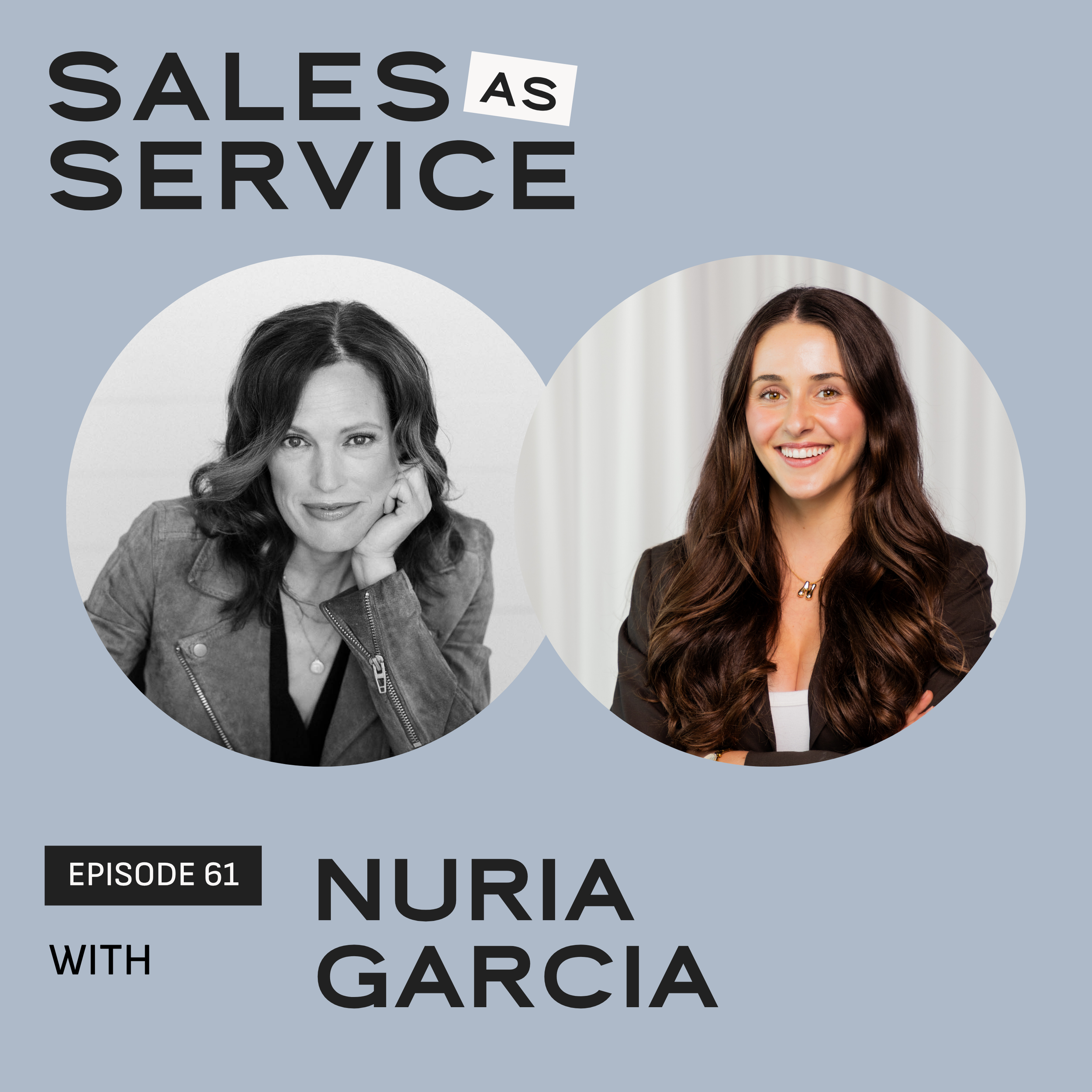
Be Known for More Than What You Sell: How Personal Stories Build Trust with Nuria Garcia
EPISODE: 61

You can have years of experience, deliver great work, and still be one of the best-kept secrets in your industry. Because expertise alone doesn't make you visible - and it doesn't automatically give people a reason to remember you.
In this episode of Sales as Service, I'm talking with personal branding strategist Nuria Garcia about how service-based founders can use their own experiences and stories to stand out in a crowded market. We talk about why we tend to overlook the most interesting parts of our own stories, how to connect personal experiences back to your expertise, and why that becomes even more important as AI makes information easier for anyone to generate. We also get into the piece that often gets missed: visibility isn't business development until you use it to start conversations.
In this episode, we talk about:
Why doing great work isn't enough if people don't know what makes you different
How to uncover stories and experiences you've probably been taking for granted
Why your story becomes more valuable as AI-generated content becomes more common
The difference between being visible and actually building trust
How to turn engagement into business development by being the first person to say hello
LISTEN TO THE EPISODE HERE 👇🏻
-
Nuria: [00:00:00] A lot of people think that to have those meaningful conversations after they have the followers, they have to always say like, "Oh, I helped my client make a million dollars." Or like those crazy stats that we see on LinkedIn, right? Like,
Tam: yeah.
Nuria: But that's not true, because what people want is that the person that you're gonna hire is gonna stick to their word, is gonna do their job, they're gonna be very pleasant to work with, and of course, that they are experts on what they are talking about.
Tam: Welcome to Sales as Service, the podcast designed to help you change your mind about sales, literally. I'm gonna help you change the way you think about selling. I'm Tam Smith, your host, sales bestie, and pitch partner next door. If you're tired of bros with biceps telling you how to crush a million dollars in your sleep or battling imposter syndrome on your own, you've come to the right place.
All you need to do is listen, then take action. No gym membership required.
Nuria: Let's get started.[00:01:00]
Tam: Modern sales training teaches you to cut two words from your vocabulary: I and me. Make it about the client, their problem, their goals, their outcome. And for the actual sales conversation, that's still right. But here's the thing about the sales conversation now. Most of it has already happened by the time you're in it.
60 to 70% of a buyer's decision is now made before they ever talk to a person. So the question becomes: what fills that gap? What are they actually forming their opinion of you from? And more and more, it's the parts we were trained to leave out. I, me, your story, not your service, the highs and the lows, the thing that didn't work, and the lessons that came out of it anyway.
That's the gap my guest today spends her time helping people close. Nuria Garcia is the founder of Networking by Nuria and Meet More Doers. She works with service providers, coaches, consultants, and founders who have businesses that work, but a presence that doesn't reflect any of it. Her whole approach is built around finding the stories people have written off [00:02:00] as unremarkable and showing them why those are exactly what makes someone trust you before you've said a word to them.
We get into why she thinks AI has shifted the value from the knowledge itself to the person delivering it, and why so many people confuse getting seen with actually building a pipeline. Here's my conversation with Nuria
Nuria: Nuria, thank you so much for being here. Welcome to Sales as
Tam: Service.
Nuria: Thank you for having me.
I'm excited about this.
Tam: I always like to start these conversations by asking, tell us who do you help and how do you serve?
Nuria: I help service providers or anybody who does services themselves, think of coaches, even accountants, lawyers, define their story and be able to share it on social media. A lot of people just rely on their services, rely on their expertise, but there's a lot of people that offer the same things.
So we get into more the personal part.
Tam: What are your clients typically struggling with when they come to you?
Nuria: Honestly, that's a great question because I think we have a lot of variety. [00:03:00] A lot of people struggle with just putting themselves out there, right? Of like, how do I even write something that sounds like me?
And mind you, the content is, like, the end goal, but before, there's all the work that all these people actually come to me for because they don't know, like, what their hobbies truly are or that they can share on social media to define themselves and sell their services. Or even they take for granted everything that they have done in life, and they're like, "Oh, no, I just started a business a year ago."
I'm like, "Well, you worked in the industry for 20 years. You have no stories that you can explain?" So we do all this work depending on, like, what stage are people in. And some others are just like, "Okay, it's time to do something with my life. I, like, invest in my business. Let's do this." Like, "Okay, let's go."
Tam: So you talk about experienced founders becoming, you know, the best-kept secret in their industry.
What do you mean by that? How does that happen?
Nuria: Yes. I [00:04:00] mean, somebody like you, right? You're fantastic at what you do, but if you don't put yourself out there and you don't really explain what makes you personally unique- You're just gonna be one more person offering the same services.
Tam: Mm-hmm.
Nuria: So it's about using that, the power of the people.
Like for example, you and I, the first time we spoke, we both have an accent, right? And I'm sure a lot of people recognizes us for that. Mm. So I'm like, okay, somebody that has an accent, and beautiful accent like ours, should get on video, should get on podcast, should put themselves out there to be differentiated by others by the things that make them unique, not just how many millions they help their clients make.
Tam: And I think a lot of founders still believe, you know, "If I do great work, people will just, you know, notice." But, you know, at what point does letting the work speak for itself stop being enough?
Nuria: I think right at the beginning. Unless you have referrals coming into you because of all the amazing like clients you've had and like [00:05:00] all the many years that you've been do- been in business, we take it for granted.
Again, like if we don't sell ourselves, who's gonna sell us? And the best way to sell us is, again, not focusing too much on the services, because nowadays so many people offer the same things, but on areas that makes us unique particularly. So I think that people are too nice or too naive, hoping like, "Oh, no, I'm just a good person and things will come."
Yeah, like come on. Uh, sometimes you need to do something for yourself, right?
Tam: Roughly.
Nuria: Yeah.
Tam: How do you help people mine their stories, like find the stories that resonate on social media, and like how to tie that to the work that they do?
Nuria: I love this question because it's my favorite part about working, working with clients.
To be honest, everybody, even myself, we take our story for granted.
Tam: Mm-hmm.
Nuria: So as soon as you have somebody in front of you asking the right curious questions, and we make a list of [00:06:00] all of those things that came up, is when you start realizing like, "Oh, wait, what about this? And what about that?" Or, "I can't believe I did this."
Or like, "I started a business when I was 16, and I'm 50 now, and I don't care about that anymore." Or even, "One time I moved abroad, and I knew nobody or nothing, and I still made it happen." Like it's just part of our life so much- Mm-hmm ... that we just don't care.
Tam: Mm-hmm.
Nuria: So when I ask questions and I read it back to them like, "Hey, you've done X, Y, Z," and all this long list, right, they are like, "Oh, wait, I did."
Like yes, now that you're aware, sometimes they also become more confident about themselves because sometimes we don't value the things that we've done. We only value the things that others have done. Then like the work is way easier.
Tam: How do you help them like take those stories and actually tie it to the, the business and their expertise?
Nuria: This is definitely the most difficult part. [00:07:00] Not for me, but for them to understand because the example I always use is, like, imagine that you're a runner. Your running hobby and your business might have nothing to do, but when you use your running after work to go, like, release stress and, like, calm your, your mind and everything, and while you're showering after the run you come up with a solution to a client problem-
Tam: Mm
Nuria: they belong together. And here's where storytelling comes in because you cannot just tell me, like, "Oh yeah, I was taking a shower and I found a solution for something my client told me like six hours before." Like, come on, nobody wants this movie , you know? You wanna actually put into, like, after 15 minutes of running and sweating everything off after a difficult day of work, I had an aha moment in the shower when I least expect it.
Running for me is a way to X, Y, and Z. And then you just don't only show that you care about your clients enough that you think about them [00:08:00] after hours- Mm-hmm ... or things like this, but somebody that's a runner might be like, "Oh, I love that. I also run." And then connection comes in.
Tam: It actually puts the, the reader, like, in the experience.
You know, giving the, the detail of the story that it actually puts the reader in the experience, that they can connect, you know, and see themselves inside of it.
Nuria: Exactly, like they are in your life. That they are there with you.
Tam: Mm-hmm. I love your own LinkedIn positioning says that your story is the only thing AI can't generate.
Uh, you know, with, with so much AI generated content out there now, what do you think, you know, becomes more valuable now? I mean, like, a story is even more valuable now as a result of that.
Nuria: I mean, I would love to hear also what do you think- Yeah ... because I'm obviously too much into the industry, I guess.
Yeah. But we all can read right away AI generated content because they've, we've all used it for anything or even to give us an answer. It sounds exactly like what some other people post. And [00:09:00] don't take me wrong, it's good if it has the good bones, but it's not, like, pleasant to read. I sometimes feel like I'm being lied to or like somebody's cheating, right?
Because I'm like, "Dude, you could have write this yourself." Even if it has grammar or spelling errors, you know? Like, just do it. But also, like, I think- It's also an opportunity for the people who are aware that the value is not in the knowledge, but it's in the messenger. Mm-hmm. Mm-hmm. Because we can go onto ChatGPT, Claude, whatever you use, and you can ask for the knowledge.
Tam: Yeah.
Nuria: But everybody has the knowledge now, so the way you share it is the most important part. So, like, we should put more attention to the messenger.
Tam: Absolutely. Is that... To kinda to your point, you know, you've talked about that sometimes your expertise can, like, work against you, you know, being that, that...
Is that kinda what you're getting at there?
Nuria: I think, like, they are two different things because sometimes your expertise is, like, something you rely on [00:10:00] too much. Of like, no, you write a post, I'm like, "Because of my 20 years of experience," yeah, but so many things have changed in the last three. How are we gonna count 20 years ago?
So some people that are still, like, too focused on the older things versus, like, not adapting to the new things. Mm-hmm. And that experience can make them, like, not be willing to learn the new things. Or focusing so much on, like, the previous marketing that used to work of like, "No, no, I help my clients do X, Y, and Z, period."
"Okay, cool. Nobody else can help me do that. I'll go with you."
Tam: You know, and I think to the point that things are changing so quickly that your personal stories are the w- you know, the one things regardless of, you know, what platform or channel or, you know, what you're using, you know, the, s- your personal story is always gonna be relevant.
I think it's always gonna be relevant, always gonna be usable. Uh, and the thing that, you know, no... It, it's unique to you that, you know, no one else can copy
Nuria: [00:11:00] 100%. And that's the, that's the point of using it and having it, being aware of it, valuing it yourself
Tam: Hey, Tam here. Most consultants and service-based founders are great at delivery.
Referrals prove it, but referrals aren't predictable, and you've avoided sales because you think you have to be something you're not. Sales isn't pressure or cringey tactics. It's connection, starting conversations, recognizing when you can actually help someone. The hard part? Doing it consistently. That's why I built the VIP Legion Pipeline System.
It gives you a repeatable way to book three to five sales qualified meetings each week through relationship first outreach, not cold pitching. Ready to create opportunities on purpose? Book
Nuria: a free alignment call using the link in the show notes. Sales is a practice. Let's make it consistent.
Tam: I'd love to hear just like a, a client success story of someone you worked with that you know that came in that it's hard to see those stories.
You're bright. They're stories for yourself because they're so familiar to you, and it's easy to just look over or dismiss. So I [00:12:00] think it's so valuable having someone like you that can help people, you know, identify the stories that other people can connect with and relate to that are, um, shareable. But I'd love to hear just an experience of someone that came in, you know, working with you, how you identified those and, you know, the impact that it made on the business.
Nuria: I have one of, like, my favorite examples is because she came to me Like, "Hey, I just wanna invest on myself, and I think this is the way to do it." I'm like, "Okay. So anything could have worked for you, but you chose this. I'll take it." Starting from there. Uh, but as I- as we started working together and asking questions, I realized how even though she was one of the first employees at very big...
I don't wanna drop too much information just in case, but very big company right now, which was a startup at the moment, like employee number seven or something like this. And by being employee number seven, they already asked her to do some development and some training for all [00:13:00] the employees, and, like, she realized that that would lead her into, like, leadership coaching.
It was, like, mind-blowing to me to see her at the beginning. She was like, "Oh, no, I just started a business, and I wanna just talk about myself, you know, to, to promote the business." And then the, the biggest transition was, or transformation, was when I saw her be like, "No, no, I did this. I did this. I was an early employee.
I helped this many companies do X, Y, and Z." I'm like, "These are all the things that you can actually use," right? So going to, to see her from, like, having nothing, like, not knowing how to explain anything, to be able to start sharing post, putting herself out there. Embrace the things that she was kind of, like, ashamed of or afraid of or like, you know.
You've done it. Go get it. Go explain it to the world. Otherwise, how are others gonna know that you can help them do the exact same thing? And of course, once I've st- she started posting, which she did with video, and it was very nice because [00:14:00] she has a great presence. She started getting so many engagements, speaking engagements where they flew her out to the other side of the country, like two or three different clients in the first week that she was posting.
I was like, "Exactly. People were looking for you. They just couldn't find you because you were not out there as yourself."
Tam: Where do you see people confusing visibility with business development? Because, you know, you can have, you know, followers, impressions, engagement, and still not be having, like, meaningful conversations or clients.
What should or has to happen after someone sees you?
Nuria: Someone needs to trust you because we can see everybody. Some people might see yourself right now and be like, "Oh, we don't trust them," and some other people like, "Oh yeah, I completely understand what they mean," right? Somebody needs to trust you. But for that, I don't think you need to change who you are.
A lot of people think that to have those meaningful conversations after they have the followers, they have to always say [00:15:00] like, "Oh, I helped my client make a million dollars," or like those crazy stats that we see on LinkedIn, right? Like, yeah. But that's not true because what people want is know that the person that you're gonna hire is gonna stick to their word, is gonna do their job, they're gonna be very pleasant to work with, and of course, that they are experts on what they are talking about, using those stories, using like everything.
You wanna get in their brain. You wanna hear how they think, and this way is how you understand like or you trust them when you see the content. Then we get into other type of strategies of, okay, you cannot wait for everybody to knock on your door and send you a DM. Maybe you can start sending DMs to people that, that like your posts.
Tam: Mm-hmm.
Nuria: Right? So many people don't even like your post and they send you a DM. Right. But the ones that liked it, go say something. Somebody else would even say if they come on LinkedIn, because you can see that, come see your profile, go say something as well. Because if you were in a physical [00:16:00] store and somebody would come through the door, you would actually say hi.
Tam: I've heard it said that, uh, you know, half the world is waiting for the other half of the world to say hi. And I really just, you know, encourage folks, be the first to say hello, and it's amazing like how many doors that will open for you if you're just, again, you, you make the connection and start a conversation.
Nuria: Exactly. Put yourself out there somehow. Make sure that you're not a fake profile, that you don't look like a scam, and then go say hi.
Tam: Do you struggle? Like, you know, now I think the most recent statistic I've heard recently is, you know, 60 to 70% of the, you know, buying process is happening before someone ever engages with, you know, someone representing the company, which I've known how important, you know, a consistent digital presence is.
But, you know, when you consider how much of the, the buying process is happening before someone ever engages with you, how do you encourage your clients who may be a little bit resistant in putting themselves out there [00:17:00] to get comfortable with it? Well, A, you know, understand the value and get over their, you know, resistance to putting themselves out there.
Nuria: I don't wanna say I have to, like, convince anybody because a lot of people struggle with self-confidence. Not in, like, their work or anything, just in putting themselves out there. Everybody had somebody from college, high school, anything that they have on it in their Facebook, their LinkedIn, somebody from an, a previous work that you don't wanna post for them to see about you.
Because you're just like, "Oh, what are they gonna think?" And that happens to all of us. Whoever says no, they either practice a lot or they're lying, right? But, like, we all have that. The thing is when you realize that paying the cost of putting yourself out there, getting uncomfortable, trying for the first time, getting in front of the camera, saying something that you would have not said before, pays way more than the cost of getting...
Staying quiet.
Tam: Yes, I would agree. I... Now, you know, it was a... [00:18:00] For myself personally, you know, it was that fear of you're gonna hear no. You know, everyone's not going to agree, and it's not a sign you're doing something wrong or the system's broken or you need to completely rethink your whole business or, you know, offer.
It's just a part of playing on a larger stage. And I've had to, you know, re- retrain myself to think if I'm not hearing, you know, no or, or getting some res- I'm not putting myself out there enough. So I've really had to try to retrain my brain to think, you know, differently because, uh, you know, I think a lot of the, you know, resistance for most, it's just, it's the, it's the fear of rejection and the fear of no.
Yes. And, um, you know, just knowing that's part of the process. Uh, it, I can't... It never feels good. Mm-hmm. But just know that it's part of the process.
Nuria: Exactly. Like dating. At the beginning, nothing feels good until you find your ideal one, if ever. But What is, what is one way you put yourself out there, either sending messages, like you tell me, to get those nos?
Tam: [00:19:00] Direct messaging. LinkedIn offers you the ability, you know, to put yourself... essentially put yourself in front of, you know, up to 200, you know, new connections a week, where you can find and, uh, connect with your ideal clients, referral partners, collaborators. So why, you know, wouldn't you wanna do that? It's an opportunity just to, again, organically build your own visibility, but at the same time, you know, not just collect connections, but actually engage with people who would ultimately become your, if there's a problem you can solve, a, you know, potential client or, you know, potential referral partner, collaborator.
And everyone's not gonna be your client, and that's okay. So yeah, that's where consistently putting myself out there, that, to be the first one to say hi. So yeah, that's... What about you?
Nuria: I, I like that too, and I've been using the message of like, "I'm just trying to be the first one of saying hi," because sending the first message is very awkward.
And I'm like you, then I'm like, "You know what? I'm just gonna break the ice, call out the elephant in the [00:20:00] room. 'Hi, we don't know each other, but I think your profile is so cute,' then your, your picture, or like something, uh, stand out, very interesting. Or like, or I'm actually just saying hi- Mm-hmm ... so somebody starts the conversation.
Tam: Mm-hmm.
Nuria: Just like if you already start with something, "Hey, how's it going? I saw that you've been in this company for six years. How do you like it?" I'm like, "You could have also seen that I'm the founder of the company. What about that?"
Tam: Yeah, it's just gen- genuine curiosity-
Nuria: Mm-hmm ...
Tam: and compliment, you know, a genuine compliment.
The genuine just curiosity of just like you would, you know, meet anyone new in real life. You know, to actually just, to start a genuine conversation and, you know, it's not to come out of the gate trying to sell someone. It's a genuine interest in getting to know, like, hey, is there... Great, ultimately, maybe you do end up working together, but it could be a, you know, you end up introducing them to someone.
There's a great resource you can share or, you know, there's any... It's just how do you have an opportunity to start a conversation and build a relationship.
Nuria: 100%. [00:21:00] And we're only talking about LinkedIn, but on Instagram, obviously it's completely different because you can follow somebody without them following you, and you can still message them.
And I realize that just by, like randomly scrolling, I find people that I really like what they talk about, and when they post a story, I'm like, "Oh, this is so cool," whatever. And this builds something right away that I'm going to New York the next month and I'm gonna meet with somebody that I randomly DM'd on Instagram.
They followed me back, and then like, oh, perfect. You know, like now we, we can hang or anything like this. I'm like, you never know what can come from you just saying hi or giving a compliment. Being genuine.
Tam: Yes. Yes. I absolutely, I think that that, that's like the biggest takeaway from this conversation.
Nuria: Literally. Yeah.
Tam: Let's jump into our fast five. What is the best advice you've ever received about sales and business development?
Nuria: I'm gonna stick with sales-
Tam: Mm-hmm ...
Nuria: mostly, is that because somebody [00:22:00] said no today doesn't mean that they would say no tomorrow.
Tam: Mm, that's a good one.
Nuria: That blew my mind because I'm like the type of person that's like, "No, thank you.
Not today, not tomorrow."
Tam: Well, what's something people are always surprised to learn about you?
Nuria: I like adrenaline sports. Anything skydiving, I, I guess skiing a little bit. Mm-hmm. Bungee jumping. That's
Tam: why I liked you. One of the reasons why I liked you.
Nuria: We have more things in common than we thought. Yeah.
Tam: What is one task that you have handed over to AI? How are you using AI in your business?
Nuria: To do research.
Tam: Hmm.
Nuria: Like, sometimes if I wanna, I dunno, find a sponsor for my community or anything like this, I use AI to do the research, find the messages, i- the, the emails and things like this. And, like, all the, like, boring stuff that I hate doing, I, like, create skills and automate it for it to do it for me.
Tam: What's your go-to way to recharge after a busy week?
Nuria: Oh, man, I would've said after a [00:23:00] busy day. Uh, I'm like, "I, I cannot wait until the end of the week." Uh, for me, it would be, like, walking outside, seeing nature, swimming in the ocean, depending on, like, the g- the place where I, I'm at at the moment. But going playing sports, for a run, anything that engages my body instead of my brain so much.
Tam: And if you only had one hour each day for business growth, how would you spend it?
Nuria: I would definitely put content out there maybe for 20 minutes so my videos wouldn't be not so prepared. But, like, I would put something out there, and then the other 40, like, would be starting new conversations all the time.
Tam: Thank you so much for being here. Where can folks find and connect with you online?
Nuria: Uh, you can find me on both Instagram and LinkedIn, Nuria Garcia, N-N. Actually, on LinkedIn you're gonna see MBA, and I think there's the same profile picture on both.
Tam: We'll link that in the show notes. Again, thanks so much for being here.
Such a great conversation.
Nuria: Thank you for having me. This was a pleasure.
Tam: It's interesting how long it took Nuria's client to [00:24:00] see her own background as material. She'd been doing leadership development since her first startup and didn't think it counted for anything until someone asked the right question.
I think a lot of us are probably sitting on some version of that. So here's this week's sales to service challenge. Set a timer for 15 to 20 minutes and just write everything that comes to mind about your experience. No editing, no filtering, no deciding yet whether it's good or not. And then go back through it and find one moment you can tie directly to a business lesson or an outcome.
Doesn't have to be dramatic, just something true. And then share it this week however that feels right. Could be a post, message to a client, conversation with someone in your network. And thank you again to Nuria Garcia for being here. You can find her on LinkedIn and Instagram. All the links are in the show notes, along with everything else we talked about today.
That's it for me this week. Remember, sales is an act of service. It's about what you give, not what you get. And when you serve well, the ROI always follows. See you next week.
Nuria: You've just listened to the Sales as Service podcast, the podcast to help you
Tam: shift your mindset around [00:25:00] selling. The executive producers for this show are Jess Milanes and me, Tam Smith.
This show is produced by KNWN Media and Studio 349.
MORE OF A READER? 👇🏻
For a long time, expertise was the thing that set service providers apart. If you'd been doing the work longer, or better, or for bigger clients, that was the pitch. Say what you do, back it up with results, let the credentials carry the rest.
That math doesn't hold the way it used to. Nuria Garcia, founder of Networking by Nuria and Meet More Doers, put it plainly in a recent conversation: anyone can ask ChatGPT or Claude for the knowledge now.
The information isn't scarce anymore. What's scarce is a specific person's way of explaining it — the story behind how they came to know it, and the voice that makes their version worth reading over the twelve other posts saying roughly the same thing.
This is a harder shift than it sounds like on the surface, because most experienced founders don't think of their own history as material.
Nuria described a client who'd been an early employee at a company that's now a recognizable name — employee number seven, doing informal leadership development before the term existed — and who, when she first sat down to talk about her business, wanted to talk only about the business.
Not herself. Not the path that got her there.
It took a round of direct questions before she connected the dots: the thing she'd been asked to do accidentally, years before she called herself a coach, was the actual proof of what she now charged people to teach.
That's a common pattern. People discount the parts of their history that felt ordinary to them at the time. A career built slowly rarely feels like a story while you're living it. It just feels like work. The value only becomes visible when someone else asks the right question and you hear yourself answer it out loud.
The other thread worth sitting with is the gap between being seen and being trusted. It's possible to post consistently, get real engagement, and still not generate a single meaningful conversation from it.
Nuria's point here isn't that visibility doesn't matter — it's that visibility is not the same job as business development, and treating them as interchangeable is where a lot of founders get stuck. Someone can watch your content for months and still need a reason to reach out. Often, that reason is you reaching out first.
Which is where the conversation landed on something almost embarrassingly simple: send the first message. Not a templated pitch, not a funnel — just a specific, genuine note to someone who liked a post, viewed a profile, or showed up in a shared community.
Nuria's version of this is direct: acknowledge that reaching out first feels awkward, say so, and start talking anyway. It works because it's honest about the moment instead of pretending the moment isn't a little uncomfortable.
None of this requires reinventing a personal brand or manufacturing a dramatic origin story. It requires noticing what's already there — the plain, unremarkable-feeling parts of a career that actually explain why someone should trust the person behind the work — and then being willing to be the one who says something first.
✦ YOUR SALES AS SERVICE CHALLENGE
Pick one piece of content you’re working on—a proposal, pitch, lead magnet, or presentation—and run it through Ally’s process.
Define the business goal and get specific about who it’s meant to serve. Then ask: Does what I’ve created actually deliver what that person needs, or is it simply what I wanted to say?
If there’s a gap, close it before you invest more time.
RESOURCES & LINKS
Find Nuria on Instagram.
Your next client - Calculate what it takes.
Learn how to consistently book 3–5 sales-qualified meetings each week - Book an Alignment Call.
GET THE CLIENT PIPELINE CALCULATOR
If this episode got you thinking about your own pipeline, the Client Pipeline Calculator shows you how many conversations stand between you and your next client. Get the calculator →
And if you loved this episode, subscribe and leave a review on Apple Podcasts — it helps more service pros find the show.

TAM SMITH
I’m Tam Smith-Sales Growth Strategist and Founder of Studio Three 49. I help service-based founders find, connect with, and convert right-fit clients through predictable, sustainable outbound sales solutions.
No pushy pitches. No bro-marketing. Just simple, structured systems that turn connections into clients.