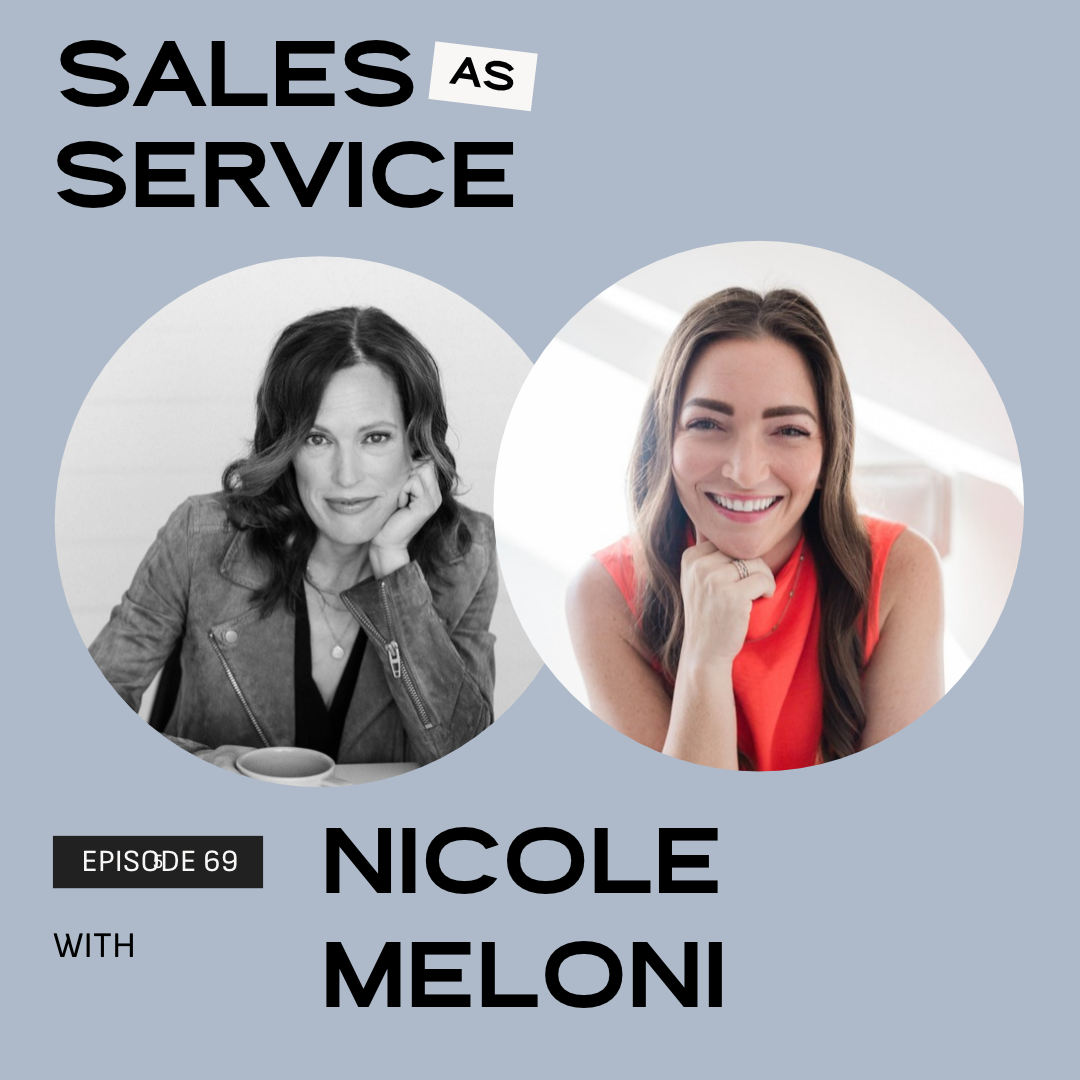
The Cost of Being Busy: What Founders Get Wrong About Business Growth with Nicole Meloni
EPISODE: 69

You can spend an entire day working on your business and still avoid the activities that actually help it grow. Updating systems, revising your website, managing clients, and putting out fires can all feel productive. But are they moving your business forward?
In this episode of Sales as Service, I sit down with Nicole Meloni, a fractional COO who helps service-based founders move beyond the operational challenges that come with growth. We talk about what happens when business owners become the bottleneck in their own companies, why delegating can be so difficult, and how the gap between what founders think is happening and what's actually happening can create confusion for their teams.
We also get into the relationship between being busy and generating revenue, including the uncomfortable sales activities we sometimes avoid. And Nicole shares an unexpected turning point in her career: training lions on a wildlife reserve. That experience changed how she thought about hustle culture, leadership, and building a business that supports her life instead of consuming it.
In this episode, we explore:
Why founder overwhelm is often a natural growing pain, not a sign that something is wrong with your business.
How unclear expectations, inconsistent leadership, and disconnected systems create unnecessary work.
Why delegation requires trust, clear expectations, and a willingness to let people make mistakes.
How busywork can become a way to avoid revenue-generating conversations and the discomfort that comes with selling.
What training lions taught Nicole about trust, boundaries, leadership, and finding fulfillment outside work.
LISTEN TO THE EPISODE HERE 👇🏻
-
Nicole: [00:00:00] You have to be okay with people making mistakes or you will never be able to let things go. So it is your baby, I understand, but you can serve and help your baby grow much better in different ways and better ways than you are now and, and how it's, it's handling. And it, it's eating you alive, truly, is, is kind of what's happening.
And so it's okay to have structures in place that can allow people to take on work well, you feel comfortable in knowing it is getting done, and you're not getting micromanagey.
Tam: Welcome to Sales as Service, the podcast designed to help you change your mind about sales, literally. I'm gonna help you change the way you think about selling.
I'm Tam Smith, your host, sales bestie, and pitch partner next door. If you're tired of bros with biceps telling you how to crush a million dollars in your sleep or battling imposter syndrome on your own, you've come to the right place. All you need to do is listen, then take action. No gym membership required.
Let's get [00:01:00] started.
Welcome back to another episode of Sales as Service. I wanna start with a question. How much of what you're doing every day is actually moving your business forward? Because I think a lot of us, myself included, have gotten really good at being busy. We're answering emails, managing clients, solving problems, trying new tools, and putting out fires. We get to the end of the day feeling like we've accomplished a lot, but when we look back at what we've actually done to generate revenue, develop our team, or build a business that doesn't depend on us for everything, sometimes the answer is not much.
And here's where I think it gets really interesting. We talk a lot about growing our businesses, but are we building the systems, processes, and teams that can actually support that growth, or are we just creating more work for ourselves? My guest today is Nicole Meloni. She's a fractional COO who helps founders address those very challenges.
Nicole has a particular way of looking at the relationship between leadership, operational [00:02:00] efficiency, and business growth, and she's not afraid to challenge some of the habits that keep business owners stuck. We're gonna talk about why being busy isn't the same as being productive, how the disconnect between what we say and what we do affects our teams, and what it takes to create a business that can grow without consuming every part of our lives.
And we're also gonna talk about lions. Yes, actual lions, because Nicole has a pretty remarkable story about an experience that completely changed the way she thinks about work and success. Here's my conversation with Nicole Meloni. Nicole, thank you so much for being here. Welcome to Sales as Service.
Nicole: Thank you so much for having me. I'm excited to be here.
Tam: Me too. I'm excited for this conversation. Let's get started. Tell us, who do you help, and how do you serve?
Nicole: Absolutely. So I love working with service-based founders who have built something amazing. They've got the clients, they have the team, they have the revenue, but they are so overwhelmed and don't know how to fix it.
They're starting to lose the [00:03:00] passion in their business. They may even start to feel a little resentful for their team. They'll say they don't feel like they're being proactive or taking accountability. And the reality is this is a normal growing pain. You have built a business around what you know how to do best, and that is you touching everything.
You, you, you touch every part of every escalation, every client. You just can't do that at a certain point when you would like the, you know, business to kinda work for you instead of you working for it. And that freedom looks different for people, whether it's putting time back into the growth of the business or attending a kid's soccer game every week that you've been missing, but it's really about giving founders their life back when they have been so sucked into the weeds of their business that they, they don't know what to do.
And so operationally, I take a look at what's actually happening, because it's very interesting what people think is happening versus [00:04:00] what's actually going on, and creating those systems, a structure, streamlining what we can so that, you know, the founder can have the freedom to do what they would like to do.
Tam: And I so appreciate that you're normalizing that it's a natural part- It is ... of the business growth process. 'Cause I think a lot of, if not everyone listening, you know, that's in business is either on their way to that point or has already hit that point. I mean, I know I can i- very clearly identify that moment.
And you do, you think there's something... I'm doing something wrong or it's broken, you know, versus realizing that it's just part of the process.
Nicole: It's 100% part of the process, and it's really funny 'cause I had a conversation recently with someone. She's starting a business, and she said, "I'm so scared because I don't know how to run a business."
And I said, "The reality is most people don't." They start something because they're passionate about what they're doing, and they figure it out along the way, and that is touching everything. And, and it becomes your baby, and it becomes, you know, [00:05:00] you're wrapped up in it so much, but it does get to a point where you have to decide, do you wanna stay like this, or, you know, do you kind of want to shift into something else?
Tam: I wanna touch on what you said about, like, when you get in to actually kind of look under the hood of these businesses, like, what's actually going on under- underneath is not- Yes ... what the founder thinks. 100%. Uh, talk a little bit about that.
Nicole: Yeah. I think there's a really big disconnect about what founders say and how it's received, and it can kind of be brought down...
'Cause you see the patterns across everybody, where, "Well, we've done this and this," and they've made improvements, but they'll always say, "Well, they know that. I told them." And it's like, okay, you told them something. You do something else half the time. What do you expect? There are, there are times, and they are trying to make those things work, but they're doing something else.
And so, you know, yeah, your team can't be proactive and take accountability if you have an exception for every client that you're [00:06:00] taking on, but you're doing something with. How? How do you expect them to know what you're expecting out of this? How do they know what success looks like? You know, something that falls apart that I find so interesting is a lot of the times people don't know what they're actually working for.
It's like, "Okay, yeah, we're growing." What does that mean? What i- what- what is that? Mm-hmm. You know, how do you take that? Especially in a smaller business, if you had everyone working towards a common goal, you can get there a lot faster. But if you're kind of like, "Oh, it's this," and, "Oh, they know," they don't know.
That's I think that's the biggest thing that I could say to every founder. They don't know. Don't expect people to know what you've told them because you're showing them something different.
Tam: When you f- first start working with a client- Mm-hmm ... kind of what is your approach? You know, how do you get started, actually diagnose or, you know-
Nicole: Yeah.
Tam: kind of what the roadmap to improvement is gonna be?
Nicole: Yeah, absolutely. I do a lot of listening, and that can be hard for me in that stage because my gears... Mm-hmm. I'm listening, I'm like, "Oh, [00:07:00] oh, oh," like, all these... Again, it, it... No matter what industry or what type of business or how it runs, there's these patterns that come alive, especially at this stage.
And so the first part for me is truly listening to whoever I can get to talk to me, whoever I can get. You know, the founder's okay, let me talk to everybody. Let me try to do an intake survey if I can, if I can't, you know, get in front of everybody, and have very candid conversations about- If there was a magic wand and you could just go poof and fix this right now, what would that be?
What would that look like for you? You know, ask some of those questions where maybe they haven't been asked before, or they don't feel like they've had the opportunity to kind of respond to it candidly. And so, um, a big part of the start is listening and then kind of taking a look at the, the tech stack and the tools being used.
Again, very natural for throwing apps and Band-Aids at problems. Mm-hmm. And then next thing [00:08:00] you know, you have 10 apps that are working in their own silo. You are touching each one of them manually, and it's just like, maybe there's... Let's figure out what we actually need to be doing here so that we can either get rid of some, maximize, automate.
You know, what, what does that kinda look like on the tech side to support maybe the changes that are kinda happening on the other piece? But first part is really listening so that I can, um, actually get the information of, of what's really happening versus what the founder says is happening.
Tam: And knowing this is kind of a natural part of growth- Mm-hmm ... do you see this hap- Is it kind of a consistently, like, X number of years in, you know, where, you know, founders and business owners listening can start... 'Cause I think about the time you realize you need to pull in someone like you for help- Mm-hmm ... you're already so in the way. Like, how can we be proactive to be, you know, kind of looking for the signs in our own business that, that we can get ahead of it becoming a crisis?
Nicole: Yeah. Absolutely. I wish I could give a magic answer to that, because the reality is, as you're going [00:09:00] through it, you lose sight of it really fast. There are certain markers. You're in it. You're in it, and no matter how you say, "I'm going to watch for this or look for this," you are in it, and if you haven't done it before, it- it's not always identifiable.
And so usually when you start to get close to the million mark is where I start to see this a little more, because you typically have a few members on your team. You may have some in leadership, actually, at this point, and there's just not a, a fluid working of, of really anybody. And so it's interesting because depending on the stage that a business is in, I've worked with founders that don't have a leadership team but do have, you know, a team, and then I've actually worked with founders that have, already have a COO or, or a director of operations.
So it could kind of be you've gone through these growing pains and it's like, hold on a minute, how, how can we fix what's happening here, and having to take a step back and look at the foundation.
Tam: And, you know, it's [00:10:00] like you've been running so long, like you said, putting Band-Aids on things. You know, apart from just the, the time suck and the frustration- Yes ... for the founder and the team, it also gets expensive really quick when you- It does ... especially when you talk about the tech and tools that are doing... You know, you're paying twice for, you know, two different apps that are doing the same, or two different software platforms that are doing the same thing- Yeah ... 'cause you've just been kind of like just throwing cash at something to, you know, stop the bleeding versus- Mm-hmm ... diagnosing what's really happening underneath.
Nicole: It is, and, you know, even for one client, I found 50,000 in the year that was cut out that really didn't impact anything. And I was like, "Oh, okay."
Like, we need to look at these things. But it's more than just the financial. It's, it's the time wealth that comes with it, too, and the time of feeling, "I can't fix this. I don't have time to train. I don't have time to hire." And look, I get it. You don't have time, so we have to figure out how to build that time in.
Tam: How do you work with founders? I mean, I'm thinking of myself specifically. Delegation has been the hardest skill. Mm-hmm. Again, not for [00:11:00] lack of not wanting the help and wanting to delegate, but, you know, I've, I'm definitely guilty of being that it's just faster for me to do it. How do you work with founders to kinda get over that resistance of delegating?
'Cause, you know, and, and some of it even I don't, I don't really wanna admit, but you know, a little bit of control freak. It's your baby.
Nicole: Yep.
Tam: So how do you work with them to, you know, release the grip?
Nicole: Yes. There is a time part that comes to this. So I do wanna recognize that people are busy. There is a time constraint, but it is a fear-based issue.
You're, you're afraid of losing control. You're afraid of them making mistakes. You're afraid of them not doing it. For me, it's not about just saying, "Bueno bye, this task is done." It's about setting up, you know, how do you feel comfortable in letting it go? What are the things they have to know about this?
What are the hard deadlines? How do you make sure they're meeting those deadlines? You know, I think there's a, a little bit of a misconception when you're [00:12:00] talking about structure and streamline and things like that, where people are afraid it feels corporate, when really it's about giving people the guardrails to do their best job.
And I will always, always say when we're talking about delegation and kind of upskilling your team, people will make mistakes. You have to be okay with people making mistakes, or you will never be able to let things go. So that is the first thing. It is, it is your baby, I understand, but you can serve and help your baby grow much better in different ways and better ways than you are now in, in how it's, it's handling.
And it, it's eating you alive, truly is, is kind of what's happening. And so it's okay to have structures in place that can allow people to take on work well, you feel comfortable in knowing it is getting done, and you're not getting micromanage-y, 'cause that's kind of the other side of it where you let it go, you don't wanna lose control, and then you're like, "Why did you pass this off anyways?"
Because [00:13:00] you're not letting them do it.
Tam: Yeah. I, I'm thinking specifically of a, of a boss I had early in my career that it, it became... it felt like my whole job was really just to try to decipher what was in his head.
Nicole: Mm-hmm.
Tam: You know, to the point of-
Nicole: Yeah ...
Tam: "Why don't you just do it? Why are you, why are you delegating this to me?"
Nicole: It's crazy. And I think, too, it's the recognition no one is ever gonna do it the same way that you do it. Mm-hmm. And that's also really hard, but it can be a good thing. They can find, you know, other pieces of this puzzle that you didn't even realize were there. And so- It is a multifold. It's very scary, I recognize that, but you have to do scary things.
Mm-hmm. And you have to do scary things to grow, and that's just part of it.
Tam: And I know, you know, this is the Sales as Service podcast, and we spend a lot of time though talking about operations, systems- Mm-hmm ... process, because I think it really is the foundation to be able to-
Nicole: Yep ...
Tam: s- grow the business.
Specifically, you know, the revenue-generating tasks that get-
Nicole: Yep ...
Tam: you know, sidelined, uh, [00:14:00] for, you know, just operational inefficiency. Yes. How do you help founders figure out, like the same two, or, you know, is it really kind of specific to the business, and how do you help them identify what those are?
Nicole: Yeah, it kind of depends.
Um, what we have to look at is what is the main priority for the business? And I will say 100% of the time, especially for businesses in that stage, it's revenue and growth. Sometimes it's not necessarily that. It can be a little bit of a longer term strategy. So it really depends on what is the highest priority, what is the goal here?
Like, what do we want for a year down the road this business to look like so we can break it down and make it digestible? I will say I am also guilty of this. Like, there are times I have to step back and I'm like, "What am I spending my time on? Am I actually doing things I think the same to move the needle, but truly to move the needle of what I actually want from my business, or am I just trying to make myself feel [00:15:00] busy and important?"
And I go through that of, "Oh, let me, um, let me update my internal frameworks. Let me do a few revisions on my website." Why? Yes, those could impact, you know, my long-term goals and visibility, things like that, but ultimately, what do I want from my business? If it is revenue and clients, then I need to be doing revenue impacting conversations.
I need to be... So kind of going back, it depends on what the goal is. Most of the time it is revenue now, so it needs to be revenue gener- it needs to be conversations with collaborators, referral partners, potential clients. And for me, I am not a very, um, I'm not a very... I should just say I'm not a cold salesperson.
Like, I, I want things to be warm, I want it to be- Mm-hmm ... just 'cause that's how I work. And so how do you warm your network? How do you do things that every day gets you closer to those people that do wanna be your [00:16:00] clients, that will refer clients to you? Those are the things you have to be prioritizing.
Tam: Absolutely. And it kind of... It's so true that saying, you know, being busy isn't being productive. But that, you know, I think even related to myself, like there's this distrust I ha- still have a little bit of ease and flow because I guess the devil I know is- Mm-hmm ... that, you know, treading water, you know, dog- Yes ... paddling a little bit. Yeah. And so that's familiar.
Nicole: Yes.
Tam: And, you know, when you move into, you know, a level where you're, you know, you're again putting operational efficiency and good systems- Yeah ... and process in place and there is more of a... You know, I feel like I've hit that more recently in my business where there's a little bit of ease and flow.
I find myself, it's unfamiliar and I think, "Ooh," I'm like, "What? Som- what's wrong?" You know, so, so it's I'm having to get comfortable with that, you know, things not feeling, you know, constantly like I'm treading water.
Nicole: Yeah. [00:17:00] Absolutely. And, you know, I think it comes down to what are you actually doing? Yeah. And sometimes, again, I'm calling myself out here.
Mm-hmm. Well, I will spend a day and I'm like, "Oh my gosh, I did so much. What actually is coming from this?" Like, yes, I did so much. I feel so- Right ... accomplished, but what will actually come for my business from this today?
Tam: Mm-hmm.
Nicole: And half the time it's nothing because it was stuff where it was, like, busy work when really- It's about me getting out of my comfort zone and doing those things that make me a little more vulnerable.
Mm-hmm. Touch on my fears of failure, and that is all coming down to revenue generating pieces. Mm-hmm.
Tam: Okay, you know we gotta talk about the lions.
Hey, Tam here. Most consultants and service-based founders are great at delivery. Referrals prove it, but referrals aren't predictable, and you've avoided sales because you think you have to be something you're not. Sales isn't pressure or cringey tactics. It's connection, starting conversations, recognizing [00:18:00] when you can actually help someone.
The hard part? Doing it consistently. That's why I built the VIP LeadGen Pipeline System. It gives you a repeatable way to book three to five sales qualified meetings each week through relationship first outreach, not cold pitching. Ready to create opportunities on purpose? Book a free alignment call using the link in the show notes.
Sales is a practice. Let's make it consistent.
So you spent some time training lions. Yes. I wanna hear about that, and I almost wanna hear about how it has translated, you know, those- Mm-hmm ... you can't walk away from an experience like that- Yeah ... without, you know, lessons.
Nicole: Yep,
Tam: yeah. So how has that translated to the work you're doing now?
Nicole: Absolutely. So this was a life-changing moment for me. I was one that was all, a, I was advocate, I mean, like poster child of hustle culture, spewing all the things where now I would beat my head against a wall, like, "What was I thinking?" But then I took a trip, and that's what I was doing. I was on a wildlife reserve, and part of that was training lions, and it was the first time I can remember [00:19:00] being happy in my life- Mm ... and I was like, "Oh, my gosh, this, you can have something outside of work." 'Cause up until that time, everything about me was tied to my title, to my promotions, to my raises. And literally, that moment changed how I think about business now, where it should be something that supports your life instead of consumes it.
You should have value in what you're doing outside of work. So, like, for me to move away from that hustle culture, especially after, you know, running emergency rooms, which was a 24/7, 365 gig, was a huge mindset shift about how I thought about business and what I wanted for myself in business. But also, you know, lions are funny, funny creatures.
I think there's certain perceptions about them. They are so lazy. Like, they- Yeah,
Tam: fu- funny is not the first word I would have thought you would have said.
Nicole: They, you know, they, they're lazy. You have to get up, and you have to make it work, and so you've [00:20:00] got to be as productive in that short amount of time that you're, you've got them awake as, um, as you can, and you can't force them to do anything.
And I think part of that is in order to work with them, you have to build a trust with them. They treat you as one of their pack, so they recognize your smell. They will kind of take, "Okay, yeah, like I know who this is, part of the pack." They'll rub on you, but you're not gonna force them to do anything. And one of the funny things is when they were being a little ornery, literally all you have is a stick, just to be clear.
Like, a stick versus a lion, but, like, the, the stick was there if they need a little redirection. I never used the stick, but you would say, "Change your mind. Change your mind." Like, they're doing something, maybe they're coming up behind you and they're doing a stalking behavior, which can be dangerous if they continue that.
"Change your mind," and then you redirect them to do something else. And so I think it's about kind of getting, spiraling into these habits that maybe aren't healthy or beneficial [00:21:00] to your business, figuring out how to redirect some of that energy. But also, when you're talking about working with a founder or a founder working with a team, you can't force people.
Like, people, they're adults. They want value in their life and, and what they're doing, and if you're just forcing people to do things without any type of buy-in or- any type of true accountability or value or impact, they're not gonna do it. And so I think there's a lot of little, little kinda lessons I learned, but it really shaped how I thought about, how I think about business now.
Tam: Yeah, I was gonna say, hearing you describe that experience, it's really not unlike working with people.
Nicole: No, it's not. And it's funny 'cause you have a perception of w- what they are, and truly, there was only two times that I kind of worried about my life, and that was, um, when I was stampeded by elephants and then a pack of zebras.
So there was only two moments, and it did not involve the [00:22:00] lions, which is pretty funny, so.
Tam: But that's s- what a fantastic experience, though. I mean, not necess- this, not necessarily the, the life-threatening ones, but still, you lived to tell about it, so that's the important thing.
Nicole: Yes. Yes, absolutely. Yeah, I would, I would, um, reco- I'm a huge, huge animal person.
It's a big passion for me. I actually made my first official business sponsorship, and it was with a animal rescue, so for me, it's just something I wanna keep giving back to and, and go back and, and see the lions 'cause they're... You know, they'll remember.
Tam: I wanna talk about just the mindset shift, you know, you had around business and what it can be-
Nicole: Yeah ...
Tam: coming out of hustle culture. I just suspect it's not like a one and done, you know- Right ... that you just decided to be able to- Yeah ... to not be that person. How have you sustained that, or how do you sustain that?
Nicole: Yeah. If you don't put boundaries in place, you're never gonna get there. Sometimes the boundaries are like why, or it's a learned where in the past you're like, "Oh, I should have [00:23:00] maybe set that boundary."
If I did not have boundaries in what I wanted my work to look like, who I want to work with, and what that actually looks like, I think I could easily fall back into really kind of the, the cadence I was in in the hustle culture because I love working. I love it. I do find, you know, my, my cup is filled by filling the cup of others, and I do have so much joy and love for what I'm doing, but I also recognize, you know, that I can find that in things outside of work as well, and I need to find that in, in things outside of work.
And so boundaries and, you know, how I onboard and when, and the cadence of onboarding clients, and who I decide to take on. Like, it's, it's really important, and I think that unfortunately is another thing that takes a little bit of experience and time to recognize, but then you go back and you're like, "Oh, I maybe shouldn't have done that," or, "I should have listened to that red flag."
So sometimes it is a learning experience, but it's [00:24:00] important to have those boundaries, or else you're just gonna fall, fall right back into it.
Tam: I so appreciate you talking about learned experience. I, I, I feel like as women especially, we put so much pressure on ourselves that again, we're supposed to know this and not allowing ourselves, you know, r- room to mess up and for things- Yeah ... to be a little imperfect. Yeah. And so I appreciate you calling out that it is, it's practice and a learned experience.
Nicole: It is, and it's unlearning a lot. As you said, it... I mean, there, there's so many things where- Even when you're talking about your personal branding and how you represent your business, you should be very professional.
Only put what you would want on the front page of the paper, like I grew up hearing that about everything. Mm-hmm. Um, and no. Throw it out the win- Like, talk about what you wanna talk about. Talk about it how you wanna talk about it. Your business is you. You get to shape that, and it is hard to unlearn these things that we have been taught our entire [00:25:00] lives on how to act, how to talk, how to be.
And I think kind of with that, it is just, it's learning, it's unlearning, and if you have a value in self-awareness and kind of looking at how you want things to be, how you act, how you put things out into the world, I think it makes a big difference.
Tam: For a founder listening right now who is, you know, in that spot of either approaching overwhelm or just overwhelmed- What can you share with them, like if they, i- you wanna...
What's on the horizon if they can pause, like-
Nicole: Mm-hmm ...
Tam: long enough, you know, to invite in support- Yes ... to get through it? What, help them see what's on the other side.
Nicole: Yeah. The, the best way that I can represent that is your shoulders drop. Like, you get to actually breathe out for the first time in a long time.
Your shoulders drop. You feel that weight release. It is something that I hope every person can feel because there, there's no, uh, e- [00:26:00] especially when I'm talking about operations, you can look at all these metrics of things, but for me, the most important thing with someone I'm working with is seeing that, where it's like, "Oh my gosh, I feel so much better."
And that for me, it's like I know I'm doing a good job.
Tam: And I think, you know, even in my own, the sales and lead generation work that I do, you know, it's the mindset and the, you know, the energy that you're bringing into the situation, it- it's that intangible, but directly impacts your short-term and long-term success.
Nicole: Absolutely. It's not just your business either, it's your personal life. Mm-hmm. Mm-hmm. You start building... I mean, I would love to say as, you know, I think it was the old corporate saying, you know, 9:00 to 5:00, shut the door, leave it there, and then go home. Mm-hmm. And that's not the reality, and we know it's not the reality.
And so once it starts kind of negatively impacting your home and personal life, like that's when it start, because then you start losing the passion in the [00:27:00] business. I mean, there's so much about it where, where then you're losing that hope, and truly you need hope when you're, when you're running a business or else, or, or else it's gonna stink really bad.
Tam: Let's jump into our fast five.
Nicole: Yeah.
Tam: What, uh, is the best piece of advice you've ever received about sales and business development?
Nicole: That it's not sales.
Tam: Hmm.
Nicole: I think when I think about sales, it makes me feel like I don't wanna be a car salesman. I don't wanna feel like cringey. I don't wanna feel salesy.
It's not sales. You are helping people solve their problem. If you can help people solve their problem, that is why you're here. So I, I think for me, that was the biggest shift. It's not sales, it is helping people who need it to solve the problem that I know I can solve.
Tam: One task you've handed over to AI?
Nicole: I have all the things. I, I'm still... Even though I'm operations, I still have the visionary part of me where I have all the ideas, and, um, I kind of use it to filter through my brain dump to kind [00:28:00] of re-categorize what's happening. I have tested a lot of things. I've built dashboards, like, lots of things to make sure I'm staying up to date.
But, um, I always say anything AI has to have a person, has to have a review. So for me, it's I test, I, I try different things. I, I know what's happening with it, but really for, personally for my business, it's kind of that brainstorm dumping, uh, cycle that I use it for.
Tam: Best purchase you've made for your business under $100.
Nicole: I don't know why this is a hard question, but I really had to think about it. And, um, it's so silly, but a really nice laptop bag because I am kind of semi-nomadic. Uh, there will be times where I might do a client workshop, and, you know, my laptop is my life. Mm-hmm. And so, um, just a nice professional looking but still cute laptop bag- Mm-hmm ... is, is, is what I- Mm-hmm ... was thinking about.
Tam: And to that point, kind of semi-nomadic life, what's always in [00:29:00] your bag?
Nicole: Pens. I al- And, you know, it's so funny because I am all laptop- Mm-hmm ... cloud-based, but I think I'm forever going to have 500 pens in my bag. And over 10 years ago, someone told me that I was a Virgo rising, and apparently they're extremely prepared and have all the things.
So that's just one of the many overprepared items I have in my bag.
Tam: I know who to go to if I'm ever, uh, short, uh, for a pen. And if you only had one hour each day for business growth, how would you spend it?
Nicole: Yeah. I... It would be targeted messaging, and what I mean by that is, um, kind of what I touched on on, on warming your network, but it would be talking with potential collaborations.
Like, I'm... You know, I'm operations. I know my lane, but I have good collaborators, you know, accounting teams, things like that, where we work really well together. I make their life easier, vice versa. So thinking about who is a good collaborator for your business, who could be a referral partner for your [00:30:00] business, and then, um, on the side of, you know, maybe a potential client.
But for me, it's, it's about thoughtful, personalized, targeted messaging is, is really the biggest, biggest piece of that, and I've gotten clients from that. So that's, that's my recommendation.
Tam: Um, and thank you so much for being here. I know folks are gonna want to find and connect with you online. Where can they do that?
Nicole: Yeah. So the best bet is through my LinkedIn. I am unfortunately a LinkedIn nerd. That's what I use for everything. I do have a business website, but I am more active and, uh, loyal to LinkedIn, I would say.
Tam: Awesome. Well, we'll definitely include that in the show notes, and thank you again, Nicole, so much for being here.
Nicole: Thank you so much. I really appreciate it. It was great to come on today.
Tam: Thanks again, Nicole, for being here. The difference between being busy and actually making progress. This is especially relevant when it comes to sales and business development. It's so easy to fill our days with things that feel productive, updating our CRM, tweaking our messaging, researching prospects, creating [00:31:00] content, or trying another tool that's supposed to make everything easier.
And don't get me wrong, some of those are absolutely very important. But as Nicole pointed out, sometimes we're doing those things because they're comfortable. They're a lot easier than putting ourselves out there, starting a conversation, following up, or asking someone to make a decision. And I really appreciated Nicole's willingness to acknowledge that she catches herself doing the same thing, because I certainly do.
And that brings me to this week's Sales as Service challenge. I want you to do a quick audit this week of how you're spending your business development time. Start by looking back at the last five working days. Write down the activities you spent time on that were related to sales and business development, and then ask yourself one question.
Which of these activities actually moved a relationship or sales opportunity forward? Not which ones kept you busy, which ones created a conversation, helped a prospect make a decision, or brought you closer to generating revenue. Now, identify one activity that's taking up time without [00:32:00] producing much movement, and this week, replace just thirty minutes of that activity with something that directly supports your pipeline.
Reach out to a prospective client. Follow up on a conversation that's gone quiet. Ask a current client for an intro or reconnect with someone in your network you've been meaning to contact. Whatever you choose, make it something that involves another person, not just another task on your to-do list.
Because as Nicole reminded us, building a successful business isn't about how much we can fit into our day. It's about being intentional with the work that matters and creating a business that supports the life we want to live. And that leads perfectly into next week's conversation with Sophia Nikoloudis, founder of Gearing Together.
Because while Nicole helped us look at how we're spending our time and running our businesses, Sophia takes that conversation a step further and asks why we feel the need to keep doing so much in the first place. We'll talk about burnout, self-trust, and how our need to prove ourselves, say yes to [00:33:00] everything, and constantly do more can undermine our confidence, our leadership, and even our ability to sell.
It's a conversation that builds on so much of what Nicole and I talked about today, and one I think a lot of us, myself included, can relate to. So be sure to join me for that one. And if you found today's conversation helpful, share it with another business owner who might need to hear it. All right, that's it for me this week, and I'll see you right back here next week for another episode of Sales as Service.
You've just listened to the Sales as Service podcast, the podcast to help you shift your mindset around selling. The executive producers for the show are Jess Milanes and me, Tam Smith. The show is produced by KNWN Media and Studio Three 49.
MORE OF A READER? 👇🏻
You can spend eight hours working on your business and still accomplish very little that moves it forward.
You answer emails. Update your CRM. Research potential clients. Tweak your website. Try another software tool that's supposed to make everything easier.
By the end of the day, you're exhausted.
But how much of that work actually created a new opportunity, strengthened a relationship, or generated revenue?
It's a question I've had to ask myself, and one that came up during my conversation with Nicole Meloni, a fractional COO who works with service-based business owners.
Nicole helps founders who have built successful businesses but find themselves overwhelmed by the very companies they created.
They have clients, teams, and revenue. What they don't have is enough time, structure, or freedom to enjoy what they've built.
And often, the problem isn't a lack of effort.
Most founders start businesses because they're good at something.
They develop a service, find clients, and build relationships. As the business grows, they hire people and add systems to manage the work.
But there's a point when the approach that helped build the business starts working against it.
The founder is still involved in every decision, client issue, and operational problem.
Nicole describes this as a natural growing pain. The business has reached a stage where the founder can't continue operating the same way.
One of the first things she does when working with a client is listen.
Not just to the founder, but to the team.
Because what the founder believes is happening and what's actually happening can be two very different things.
A business owner might believe expectations are clear because they've explained them. But if their actions contradict those expectations, employees are left guessing.
Or the company might have ten different software tools, each added to solve a specific problem, with someone manually moving information between them.
More tools don't necessarily mean better systems.
Sometimes they just create more work.
I admitted to Nicole that delegation has been one of the hardest skills for me to develop.
Not because I don't want help.
But because sometimes it feels faster to do something myself.
Nicole pointed out that while time constraints are real, resistance to delegation often comes from fear.
Fear of losing control. Fear that someone will make a mistake. Fear that the work won't be done the way we'd do it.
But delegating effectively doesn't mean handing someone a task and hoping for the best.
It means providing clear expectations, deadlines, and enough structure for someone to take ownership.
And it means accepting that people will make mistakes.
The goal isn't to get someone to do everything exactly as you would.
It's to build a business where other people can contribute their skills, judgment, and ideas.
Here's where this conversation becomes especially relevant to sales.
Nicole acknowledged something I think many business owners can relate to.
She can spend an entire day working, feel accomplished, and then realize that very little of what she did contributed to her business goals.
Maybe she updated an internal framework or revised her website.
Those activities can have value.
But if her immediate goal is generating revenue, she needs to prioritize conversations with potential clients, collaborators, and referral partners.
And sometimes those conversations are the very activities we avoid.
Because they involve uncertainty.
We might hear no. We might have to follow up again. We might have to ask someone to make a decision.
Updating a spreadsheet feels much safer.
I've caught myself doing the same thing.
And it's an important reminder that sales and business development require more than good systems.
They require us to engage with people.
One of the most unexpected parts of our conversation was Nicole's experience training lions on a wildlife reserve.
At the time, she was deeply invested in hustle culture. Her identity was tied to her work, promotions, and professional accomplishments.
That experience helped her recognize something she hadn't fully appreciated before.
There could be a fulfilling life outside work.
She also learned some practical lessons about leadership.
You can't force a lion to cooperate. You have to establish trust, work within its behavior, and recognize when redirection is needed.
Nicole sees parallels in how we lead teams.
People need clarity, trust, and a reason to care about what they're doing.
Simply telling them what to do isn't enough.
And the same principle applies to how we lead ourselves.
Sometimes we need to recognize when our habits aren't serving us and redirect our attention.
Nicole's philosophy is that a business should support your life, not consume it.
Getting there requires boundaries, systems, and a willingness to reconsider habits that may have helped you reach one stage of growth but won't support the next.
It also requires being honest about how you're spending your time.
So here's something to try this week.
Look back at your last five working days.
Which activities actually created opportunities for your business?
Which ones simply kept you occupied?
Choose one activity that isn't producing meaningful progress and replace 30 minutes of it with a revenue-generating conversation.
Reach out to a prospect. Follow up with someone. Reconnect with a referral partner.
You don't necessarily need to work harder.
You may need to spend more of your time on the work that matters.
✦ YOUR SALES AS SERVICE CHALLENGE
This week, take a look at how you're spending your business development time.
Review your last five working days and ask yourself: Which activities actually moved a relationship or sales opportunity forward, and which ones just kept me busy?
Now pick one activity that's taking up time without producing much progress.
Replace 30 minutes of it this week with something that directly supports your pipeline.
Reach out to a prospective client, follow up on a conversation that's gone quiet, or ask someone in your network for an introduction.
The goal isn't to do more. It's to spend more time on the activities that actually create opportunities for your business.
RESOURCES & LINKS
Learn more about Azzuro Advisory.
Find Nicole on Instagram.
Connect with Nicole on LinkedIn.
Your next client - Calculate what it takes.
Learn how to consistently book 3–5 sales-qualified meetings each week - Book an Alignment Call.
READY TO STOP WAITING ON REFERRALS?
If this episode sounds like where you're at right now, let's talk. Book a free Alignment Call and we'll map out what's actually stalling your pipeline. Book an Alignment Call →
And if you loved this episode, subscribe and leave a review on Apple Podcasts — it helps more service pros find the show.

TAM SMITH
I’m Tam Smith-Sales Growth Strategist and Founder of Studio Three 49. I help service-based founders find, connect with, and convert right-fit clients through predictable, sustainable outbound sales solutions.
No pushy pitches. No bro-marketing. Just simple, structured systems that turn connections into clients.